Thank you for visiting SNEWPapers!
Sign up free
Editorial
July 17, 1793
Gazette Of The United States
New York, New York County, New York
What is this article about?
An editorial proposes integrating Native American warriors into the US military with American officers to instill discipline, prevent hostilities, secure treaties, and advance civilization, industry, and self-governance among tribes.
Clipping
OCR Quality
95%
Excellent
Full Text
Hints respecting a project for establishing universal peace with the Indians.
Echuacoodsail.
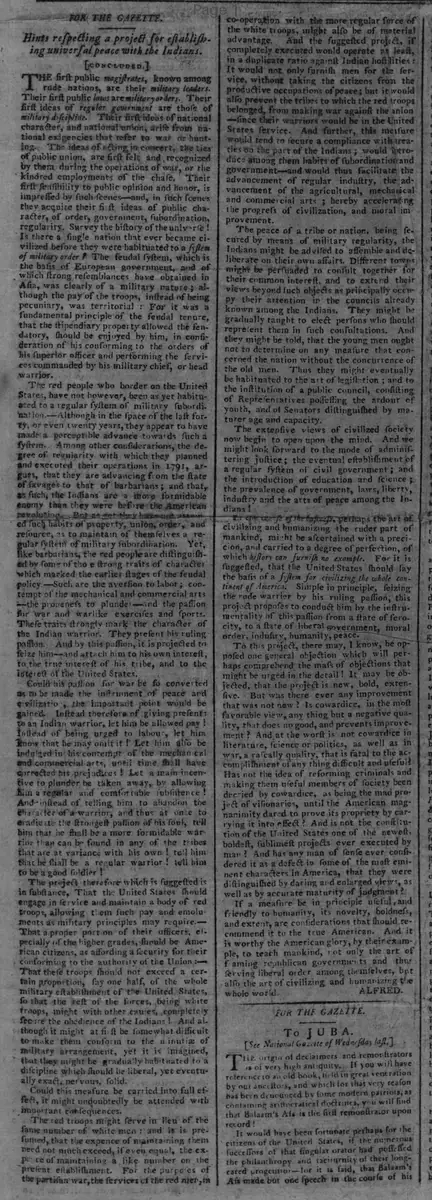
The first public magistrates, known among the rude nations, are their military leaders. Their first public laws are military orders. Their first ideas of regular government are those of military discipline. Their first ideas of national character, and national union, arise from national exigencies that refer to war or hunting. The ideas of acting in concert, the ties of public union, are first felt and recognized by them during the operations of war, or the kindred employments of the chase. Their first sensibility to public opinion and honor, is impressed by such scenes—and, in such scenes they acquire their first ideas of public character, of order, government, subordination, regularity. Survey the history of the universe! Is there a single nation that ever became civilized before they were habituated to a system of military order? The feudal system, which is the basis of European government, and of which strong resemblances have obtained in Asia, was clearly of a military nature; although the pay of the troops, instead of being pecuniary, was territorial: For it was a fundamental principle of the feudal tenure, that the stipendiary property allowed the feudatory, should be enjoyed by him, in consideration of his conforming to the orders of his superior officer and performing the services commanded by his military chief, or head warrior.
The red people who border on the United States, have not however, been as yet habituated to a regular system of military subordination.—Although in the space of the last forty, or even twenty years, they appear to have made a perceptible advance towards such a system. Among other considerations, the degree of regularity with which they planned and executed their operations in 1791, argues, that they are advancing from the state of savages to that of barbarians; and that, as such, the Indians are a more formidable enemy than they were before the American revolution.—But as yet they have not attained such habits of property, union, order, and resource, as to maintain of themselves a regular system of military subordination. Yet, like barbarians, the red people are distinguished by some of those strong traits of character which marked the earlier stages of the feudal policy.—Such are the aversion to labor; contempt of the mechanical and commercial arts—the proneness to plunder and the passion for war and warlike exercises and sports. These traits strongly mark the character of the Indian warrior. They present his ruling passion. And by this passion, it is projected to seize him—and attach him to his own interest, to the true interest of his tribe, and to the interest of the United States.
Could his passion for war be so converted as to be made the instrument of peace and civilization, the important point would be gained. Instead therefore of giving presents to an Indian warrior, let him be allowed pay! Instead of being urged to labour, let him know that he may omit it! Let him also be indulged in his contempt of the mechanical and commercial arts, until time shall have corrected his prejudices! Let a main incentive to plunder be taken away, by allowing him a regular and comfortable subsistence! And—instead of telling him to abandon the character of a warrior, and thus at once to eradicate the strongest passion of his soul, tell him that he shall be a more formidable warrior than can be found in any of the tribes that are at variance with his own! Tell him that he shall be a regular warrior! Tell him to be a good soldier!
The project therefore which is suggested is in substance, That the United States should engage in service and maintain a body of red troops, allowing them such pay and emoluments as military principles may require.—That a proper portion of their officers, especially of the higher grades, should be American citizens, as affording a security for their conforming to the authority of the Union:—That these troops should not exceed a certain proportion, say one half, of the whole military establishment of the United States, so that the rest of the forces, being white troops, might with other causes, completely secure the obedience of the Indians! And although it might at first be somewhat difficult to make them conform to the minutia of military arrangement, yet it is imagined, that they might be gradually habituated to a discipline which should be liberal, yet eventually exact, nervous, solid.
Could this measure be carried into full effect, it might undoubtedly be attended with important consequences. The red troops might serve in lieu of the same number of white men: and it is presumed, that the expense of maintaining them need not much exceed, if even equal, the expense of maintaining a like number on the present establishment. For the purposes of the partisan war, the services of the red men, in co-operation with the more regular force of the white troops, might also be of material advantage. And the suggested project, if completely executed would operate at least, in a duplicate ratio against Indian hostilities: It would not only furnish men for the service, without taking the citizens from the productive occupations of peace; but it would also prevent the tribes to which the red troops belonged, from making war against the union—since their warriors would be in the United States service. And further, this measure would tend to secure a compliance with treaties on the part of the Indians; would introduce among them habits of subordination and government—and would thus facilitate the advancement of regular industry, the advancement of the agricultural, mechanical and commercial arts; hereby accelerating the progress of civilization, and moral improvement.
The peace of a tribe or nation, being secured by means of military regularity, the Indians might be advised to assemble and deliberate on their own affairs. Different towns might be persuaded to consult together for their common interest, and to extend their views beyond such objects as principally occupy their attention in the councils already known among the Indians. They might be gradually taught to elect persons who should represent them in such consultations. And they might be told, that the young men ought not to determine on any measure that concerned the nation without the concurrence of the old men. Thus they might eventually be habituated to the art of legislation; and to the institution of a public council, consisting of Representatives possessing the ardour of youth, and of Senators distinguished by mature age and capacity.
The extensive views of civilized society now begin to open upon the mind. And we might look forward to the mode of administering justice; the eventual establishment of a regular system of civil government; and the introduction of education and science; the prevalence of government, laws, liberty, industry and the arts of peace among the Indians!
As thus cease the boisterous, perhaps the art of civilizing and humanizing the ruder part of mankind, might be ascertained with a precision, and carried to a degree of perfection, of which history can furnish no example. For it is suggested, that the United States should lay the basis of a system for civilizing the whole continent of America. Simple in principle, seizing the rude warrior by his ruling passion, this project proposes to conduct him by the instrumentality of this passion from a state of ferocity, to a state of liberal government, moral order, industry, humanity, peace.
To this project, there may, I know, be opposed one general objection which will perhaps comprehend the mass of objections that might be urged in the detail! It may be objected, that the project is new, bold, extensive. But was there ever any improvement that was not new? Is cowardice, in the most favorable view, any thing but a negative quality, that does no good, and prevents improvement? And at the worst is not cowardice in literature, science or politics, as well as in war, a radically quality, that is fatal to the accomplishment of any thing difficult and useful? Has not the idea of reforming criminals and making them useful members of society been decried by cowardice, as being the mad project of visionaries, until the American magnanimity dared to prove its propriety by carrying it into effect? And is not the constitution of the United States one of the newest, boldest, sublimest projects ever executed by man? And has any man of sense ever considered it as a defect in some of the most eminent characters in America, that they were distinguished by daring and enlarged views, as well as by accurate maturity of judgment?
If a measure be in principle useful and friendly to humanity, its novelty, boldness, and extent, are considerations that should recommend it to the true American. And it is worthy the American glory, by their example, to teach mankind, not only the art of framing republican governments and thus serving liberal order among themselves, but also the art of civilizing and humanizing the whole world.
ALFRED.
Echuacoodsail.
The first public magistrates, known among the rude nations, are their military leaders. Their first public laws are military orders. Their first ideas of regular government are those of military discipline. Their first ideas of national character, and national union, arise from national exigencies that refer to war or hunting. The ideas of acting in concert, the ties of public union, are first felt and recognized by them during the operations of war, or the kindred employments of the chase. Their first sensibility to public opinion and honor, is impressed by such scenes—and, in such scenes they acquire their first ideas of public character, of order, government, subordination, regularity. Survey the history of the universe! Is there a single nation that ever became civilized before they were habituated to a system of military order? The feudal system, which is the basis of European government, and of which strong resemblances have obtained in Asia, was clearly of a military nature; although the pay of the troops, instead of being pecuniary, was territorial: For it was a fundamental principle of the feudal tenure, that the stipendiary property allowed the feudatory, should be enjoyed by him, in consideration of his conforming to the orders of his superior officer and performing the services commanded by his military chief, or head warrior.
The red people who border on the United States, have not however, been as yet habituated to a regular system of military subordination.—Although in the space of the last forty, or even twenty years, they appear to have made a perceptible advance towards such a system. Among other considerations, the degree of regularity with which they planned and executed their operations in 1791, argues, that they are advancing from the state of savages to that of barbarians; and that, as such, the Indians are a more formidable enemy than they were before the American revolution.—But as yet they have not attained such habits of property, union, order, and resource, as to maintain of themselves a regular system of military subordination. Yet, like barbarians, the red people are distinguished by some of those strong traits of character which marked the earlier stages of the feudal policy.—Such are the aversion to labor; contempt of the mechanical and commercial arts—the proneness to plunder and the passion for war and warlike exercises and sports. These traits strongly mark the character of the Indian warrior. They present his ruling passion. And by this passion, it is projected to seize him—and attach him to his own interest, to the true interest of his tribe, and to the interest of the United States.
Could his passion for war be so converted as to be made the instrument of peace and civilization, the important point would be gained. Instead therefore of giving presents to an Indian warrior, let him be allowed pay! Instead of being urged to labour, let him know that he may omit it! Let him also be indulged in his contempt of the mechanical and commercial arts, until time shall have corrected his prejudices! Let a main incentive to plunder be taken away, by allowing him a regular and comfortable subsistence! And—instead of telling him to abandon the character of a warrior, and thus at once to eradicate the strongest passion of his soul, tell him that he shall be a more formidable warrior than can be found in any of the tribes that are at variance with his own! Tell him that he shall be a regular warrior! Tell him to be a good soldier!
The project therefore which is suggested is in substance, That the United States should engage in service and maintain a body of red troops, allowing them such pay and emoluments as military principles may require.—That a proper portion of their officers, especially of the higher grades, should be American citizens, as affording a security for their conforming to the authority of the Union:—That these troops should not exceed a certain proportion, say one half, of the whole military establishment of the United States, so that the rest of the forces, being white troops, might with other causes, completely secure the obedience of the Indians! And although it might at first be somewhat difficult to make them conform to the minutia of military arrangement, yet it is imagined, that they might be gradually habituated to a discipline which should be liberal, yet eventually exact, nervous, solid.
Could this measure be carried into full effect, it might undoubtedly be attended with important consequences. The red troops might serve in lieu of the same number of white men: and it is presumed, that the expense of maintaining them need not much exceed, if even equal, the expense of maintaining a like number on the present establishment. For the purposes of the partisan war, the services of the red men, in co-operation with the more regular force of the white troops, might also be of material advantage. And the suggested project, if completely executed would operate at least, in a duplicate ratio against Indian hostilities: It would not only furnish men for the service, without taking the citizens from the productive occupations of peace; but it would also prevent the tribes to which the red troops belonged, from making war against the union—since their warriors would be in the United States service. And further, this measure would tend to secure a compliance with treaties on the part of the Indians; would introduce among them habits of subordination and government—and would thus facilitate the advancement of regular industry, the advancement of the agricultural, mechanical and commercial arts; hereby accelerating the progress of civilization, and moral improvement.
The peace of a tribe or nation, being secured by means of military regularity, the Indians might be advised to assemble and deliberate on their own affairs. Different towns might be persuaded to consult together for their common interest, and to extend their views beyond such objects as principally occupy their attention in the councils already known among the Indians. They might be gradually taught to elect persons who should represent them in such consultations. And they might be told, that the young men ought not to determine on any measure that concerned the nation without the concurrence of the old men. Thus they might eventually be habituated to the art of legislation; and to the institution of a public council, consisting of Representatives possessing the ardour of youth, and of Senators distinguished by mature age and capacity.
The extensive views of civilized society now begin to open upon the mind. And we might look forward to the mode of administering justice; the eventual establishment of a regular system of civil government; and the introduction of education and science; the prevalence of government, laws, liberty, industry and the arts of peace among the Indians!
As thus cease the boisterous, perhaps the art of civilizing and humanizing the ruder part of mankind, might be ascertained with a precision, and carried to a degree of perfection, of which history can furnish no example. For it is suggested, that the United States should lay the basis of a system for civilizing the whole continent of America. Simple in principle, seizing the rude warrior by his ruling passion, this project proposes to conduct him by the instrumentality of this passion from a state of ferocity, to a state of liberal government, moral order, industry, humanity, peace.
To this project, there may, I know, be opposed one general objection which will perhaps comprehend the mass of objections that might be urged in the detail! It may be objected, that the project is new, bold, extensive. But was there ever any improvement that was not new? Is cowardice, in the most favorable view, any thing but a negative quality, that does no good, and prevents improvement? And at the worst is not cowardice in literature, science or politics, as well as in war, a radically quality, that is fatal to the accomplishment of any thing difficult and useful? Has not the idea of reforming criminals and making them useful members of society been decried by cowardice, as being the mad project of visionaries, until the American magnanimity dared to prove its propriety by carrying it into effect? And is not the constitution of the United States one of the newest, boldest, sublimest projects ever executed by man? And has any man of sense ever considered it as a defect in some of the most eminent characters in America, that they were distinguished by daring and enlarged views, as well as by accurate maturity of judgment?
If a measure be in principle useful and friendly to humanity, its novelty, boldness, and extent, are considerations that should recommend it to the true American. And it is worthy the American glory, by their example, to teach mankind, not only the art of framing republican governments and thus serving liberal order among themselves, but also the art of civilizing and humanizing the whole world.
ALFRED.
What sub-type of article is it?
Indian Affairs
Military Affairs
Social Reform
What keywords are associated?
Indian Peace
Military Integration
Civilization Project
Warrior Employment
Tribal Subordination
What entities or persons were involved?
United States
Indians
Red Troops
American Citizens
Editorial Details
Primary Topic
Project For Employing Indian Warriors In Us Military To Achieve Peace And Civilization
Stance / Tone
Advocatory And Optimistic
Key Figures
United States
Indians
Red Troops
American Citizens
Key Arguments
Indians Lack Regular Military Subordination But Are Advancing Toward It
Convert Indian Passion For War Into Service For Peace By Employing Them As Paid Soldiers
Use American Officers To Ensure Loyalty And Discipline
This Would Reduce Hostilities, Secure Treaties, And Promote Civilization
Gradually Introduce Habits Of Government, Legislation, And Industry Among Indians