Thank you for visiting SNEWPapers!
Sign up free
Domestic News
February 22, 1894
The Philipsburg Mail
Philipsburg, Granite County, Montana
What is this article about?
Governor John E. Rickards of Montana, interviewed in San Francisco, expresses confidence in silver's restoration via the Republican Party in the 1896 presidential campaign, discusses impacts on Montana's mining and agriculture, and advocates for government aid in irrigating arid lands.
Clipping
OCR Quality
98%
Excellent
Full Text
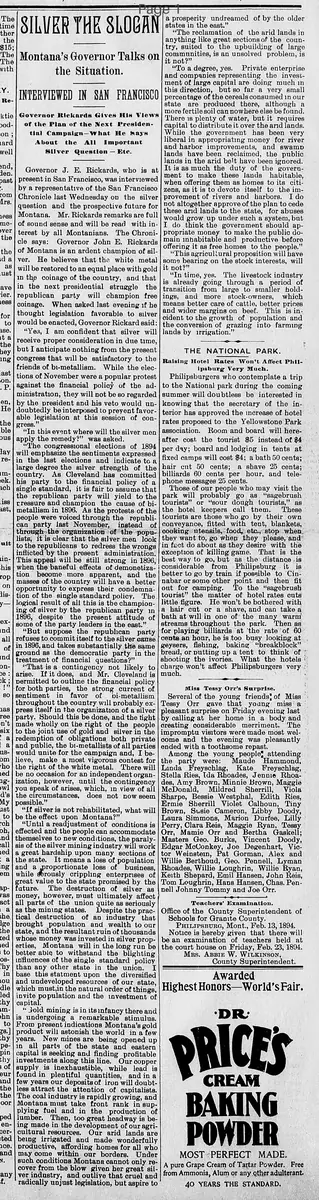
SILVER THE SLOGAN
Montana's Governor Talks on the Situation.
INTERVIEWED IN SAN FRANCISCO
Governor Rickards Gives His Views of the Plan of the Next Presidential Campaign—What He Says About the All Important Silver Question—Etc.
Governor J. E. Rickards, who is at present in San Francisco, was interviewed by a representative of the San Francisco Chronicle last Wednesday on the silver question and the prospective future for Montana. Mr. Rickards' remarks are full of sound sense and will be read with interest by all Montanians. The Chronicle says: Governor John E. Rickards of Montana is an ardent champion of silver. He believes that the white metal will be restored to an equal place with gold in the coinage of the country, and that in the next presidential struggle the republican party will champion free coinage. When asked last evening if he thought legislation favorable to silver would be enacted, Governor Rickards said:
"Yes, I am confident that silver will receive proper consideration in due time, but I anticipate nothing from the present congress that will be satisfactory to the friends of bi-metallism. While the elections of November were a popular protest against the financial policy of the administration, they will not be so regarded by the president and his veto would undoubtedly be interposed to prevent favorable legislation at this session of congress."
"In this event where will the silver men apply the remedy?" was asked.
"The congressional elections of 1894 will emphasize the sentiments expressed in the last elections and indicate to a large degree the silver strength of the country. As Cleveland has committed his party to the financial policy of a single standard, it is fair to assume that the republican party will yield to the pressure and champion the cause of bi-metallism in 1896. As the protests of the people were voiced through the republican party last November, instead of through the organization of the populists, it is clear that the silver men look to the republicans to redress the wrongs inflicted by the present administration. This appeal will be still strong in 1896 when the baneful effects of demonetization become more apparent, and the masses of the country will have a better opportunity to express their condemnation of the single standard policy. The logical result of all this is the championing of silver by the republican party in 1896, despite the present attitude of some of the party leaders in the east."
"But suppose the republican party refuses to commit itself to the silver cause in 1896, and takes substantially the same ground as the democratic party in the treatment of financial questions?"
"That is a contingency not likely to arise. If it does, and Mr. Cleveland is permitted to outline the financial policy for both parties, the strong current of sentiment in favor of bi-metallism throughout the country will probably express itself in the organization of a silver party. Should this be done, and the fight made wholly on the right of the people to the joint use of gold and silver in the redemption of obligations both private and public, the bi-metallists of all parties would unite for the campaign and, I believe, make a most vigorous contest for the right of the white metal. There will be no occasion for an independent organization, however, until the contingency you speak of arises, which, in view of all the circumstances, does not now seem possible."
"If silver is not rehabilitated, what will be the effect upon Montana?"
"Until a readjustment of conditions is effected and the people can accommodate themselves to new conditions, the paralysis of the silver mining industry will work a great hardship upon many sections of the state. It means a loss of population and a proportionate loss of business, while seriously crippling enterprises of great value to the state promised by the future. The destruction of silver as money, however, must ultimately affect all parts of the union quite as seriously as the mining states. Despite the practical destruction of an industry that brought population and wealth to our state, and the resultant ruin of thousands whose money was invested in silver properties, Montana will in the long run be better able to withstand the blighting influences of the single standard policy than any other state in the union. I base this statement upon the diversified and undeveloped resources of our state, which must, in the natural order of things, invite population and the investment of capital.
"Gold mining is in its infancy there and is undergoing a remarkable stimulus. From present indications Montana's gold product will astonish the world in a few years. New mines are being opened up in all parts of the state and eastern capital is seeking and finding profitable investments along this line. Our copper supply is inexhaustible, while lead is found in plentiful quantities, and in a few years our deposits of iron will doubtless attract the attention of capitalists. The coal industry is rapidly growing, and Montana must take front rank in supplying fuel and in the production of lumber. Then, too great headway is being made in the development of our agricultural resources. Our arid lands are being irrigated and made wonderfully productive, affording homes for all who may come within our borders. Under such conditions Montana cannot only recover from the blow given her great silver industry, and outlive that cruel and radically unjust legislation, but aspire to a prosperity undreamed of by the older states in the east."
"The reclamation of the arid lands in anything like great sections of the country, suited to the upbuilding of large communities, is an unsolved problem, is it not?"
"To a degree, yes. Private enterprise and companies representing the investment of large capital are doing much in this direction, but so far a very small percentage of the cereals consumed in our state are produced there, although a more fertile soil can nowhere else be found. There is plenty of water, but it requires capital to distribute it over the arid lands. While the government has been very liberal in appropriating money for river and harbor improvements, and swamp lands have been reclaimed, the public lands in the arid belt have been ignored. It is as much the duty of the government to make these lands habitable, when offering them as homes to its citizens, as it is to devote itself to the improvement of rivers and harbors. I do not altogether approve of the plan to cede these arid lands to the state, for abuses would grow up under such a system, but I do think the government should appropriate money to make the public domain inhabitable and productive before offering it as free homes to the people."
"This agricultural proposition will have some bearing on the stock interests, will it not?"
"In time, yes. The livestock industry is already going through a period of transition from large to smaller holdings, and more stock-owners, which means better care of cattle, better prices and wider margins on beef. This is incident to the growth of population and the conversion of grazing into farming lands by irrigation."
Montana's Governor Talks on the Situation.
INTERVIEWED IN SAN FRANCISCO
Governor Rickards Gives His Views of the Plan of the Next Presidential Campaign—What He Says About the All Important Silver Question—Etc.
Governor J. E. Rickards, who is at present in San Francisco, was interviewed by a representative of the San Francisco Chronicle last Wednesday on the silver question and the prospective future for Montana. Mr. Rickards' remarks are full of sound sense and will be read with interest by all Montanians. The Chronicle says: Governor John E. Rickards of Montana is an ardent champion of silver. He believes that the white metal will be restored to an equal place with gold in the coinage of the country, and that in the next presidential struggle the republican party will champion free coinage. When asked last evening if he thought legislation favorable to silver would be enacted, Governor Rickards said:
"Yes, I am confident that silver will receive proper consideration in due time, but I anticipate nothing from the present congress that will be satisfactory to the friends of bi-metallism. While the elections of November were a popular protest against the financial policy of the administration, they will not be so regarded by the president and his veto would undoubtedly be interposed to prevent favorable legislation at this session of congress."
"In this event where will the silver men apply the remedy?" was asked.
"The congressional elections of 1894 will emphasize the sentiments expressed in the last elections and indicate to a large degree the silver strength of the country. As Cleveland has committed his party to the financial policy of a single standard, it is fair to assume that the republican party will yield to the pressure and champion the cause of bi-metallism in 1896. As the protests of the people were voiced through the republican party last November, instead of through the organization of the populists, it is clear that the silver men look to the republicans to redress the wrongs inflicted by the present administration. This appeal will be still strong in 1896 when the baneful effects of demonetization become more apparent, and the masses of the country will have a better opportunity to express their condemnation of the single standard policy. The logical result of all this is the championing of silver by the republican party in 1896, despite the present attitude of some of the party leaders in the east."
"But suppose the republican party refuses to commit itself to the silver cause in 1896, and takes substantially the same ground as the democratic party in the treatment of financial questions?"
"That is a contingency not likely to arise. If it does, and Mr. Cleveland is permitted to outline the financial policy for both parties, the strong current of sentiment in favor of bi-metallism throughout the country will probably express itself in the organization of a silver party. Should this be done, and the fight made wholly on the right of the people to the joint use of gold and silver in the redemption of obligations both private and public, the bi-metallists of all parties would unite for the campaign and, I believe, make a most vigorous contest for the right of the white metal. There will be no occasion for an independent organization, however, until the contingency you speak of arises, which, in view of all the circumstances, does not now seem possible."
"If silver is not rehabilitated, what will be the effect upon Montana?"
"Until a readjustment of conditions is effected and the people can accommodate themselves to new conditions, the paralysis of the silver mining industry will work a great hardship upon many sections of the state. It means a loss of population and a proportionate loss of business, while seriously crippling enterprises of great value to the state promised by the future. The destruction of silver as money, however, must ultimately affect all parts of the union quite as seriously as the mining states. Despite the practical destruction of an industry that brought population and wealth to our state, and the resultant ruin of thousands whose money was invested in silver properties, Montana will in the long run be better able to withstand the blighting influences of the single standard policy than any other state in the union. I base this statement upon the diversified and undeveloped resources of our state, which must, in the natural order of things, invite population and the investment of capital.
"Gold mining is in its infancy there and is undergoing a remarkable stimulus. From present indications Montana's gold product will astonish the world in a few years. New mines are being opened up in all parts of the state and eastern capital is seeking and finding profitable investments along this line. Our copper supply is inexhaustible, while lead is found in plentiful quantities, and in a few years our deposits of iron will doubtless attract the attention of capitalists. The coal industry is rapidly growing, and Montana must take front rank in supplying fuel and in the production of lumber. Then, too great headway is being made in the development of our agricultural resources. Our arid lands are being irrigated and made wonderfully productive, affording homes for all who may come within our borders. Under such conditions Montana cannot only recover from the blow given her great silver industry, and outlive that cruel and radically unjust legislation, but aspire to a prosperity undreamed of by the older states in the east."
"The reclamation of the arid lands in anything like great sections of the country, suited to the upbuilding of large communities, is an unsolved problem, is it not?"
"To a degree, yes. Private enterprise and companies representing the investment of large capital are doing much in this direction, but so far a very small percentage of the cereals consumed in our state are produced there, although a more fertile soil can nowhere else be found. There is plenty of water, but it requires capital to distribute it over the arid lands. While the government has been very liberal in appropriating money for river and harbor improvements, and swamp lands have been reclaimed, the public lands in the arid belt have been ignored. It is as much the duty of the government to make these lands habitable, when offering them as homes to its citizens, as it is to devote itself to the improvement of rivers and harbors. I do not altogether approve of the plan to cede these arid lands to the state, for abuses would grow up under such a system, but I do think the government should appropriate money to make the public domain inhabitable and productive before offering it as free homes to the people."
"This agricultural proposition will have some bearing on the stock interests, will it not?"
"In time, yes. The livestock industry is already going through a period of transition from large to smaller holdings, and more stock-owners, which means better care of cattle, better prices and wider margins on beef. This is incident to the growth of population and the conversion of grazing into farming lands by irrigation."
What sub-type of article is it?
Politics
Economic
What keywords are associated?
Silver Question
Bi Metallism
Republican Party
Montana Economy
Gold Mining
Arid Lands Irrigation
What entities or persons were involved?
Governor J. E. Rickards
John E. Rickards
Mr. Cleveland
Where did it happen?
San Francisco
Domestic News Details
Primary Location
San Francisco
Event Date
Last Wednesday
Key Persons
Governor J. E. Rickards
John E. Rickards
Mr. Cleveland
Event Details
Governor John E. Rickards interviewed on silver question, bi-metallism, Republican Party's role in 1896 presidential campaign, impacts on Montana's silver mining, gold mining, agriculture, irrigation, and livestock industry.