Thank you for visiting SNEWPapers!
Sign up free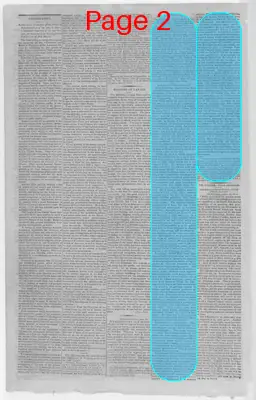
Foreign News
June 1, 1818
Daily National Intelligencer
Washington, District Of Columbia
What is this article about?
A review praises 'Rambles in Italy, 1816-17' by an American, excerpting reflections on Italy's scenery contrasting with America's vast nature, highlighting refined beauties in Tuscany, Sicily, and Calabria despite historical decay.
Clipping
OCR Quality
98%
Excellent
Full Text
ITALY
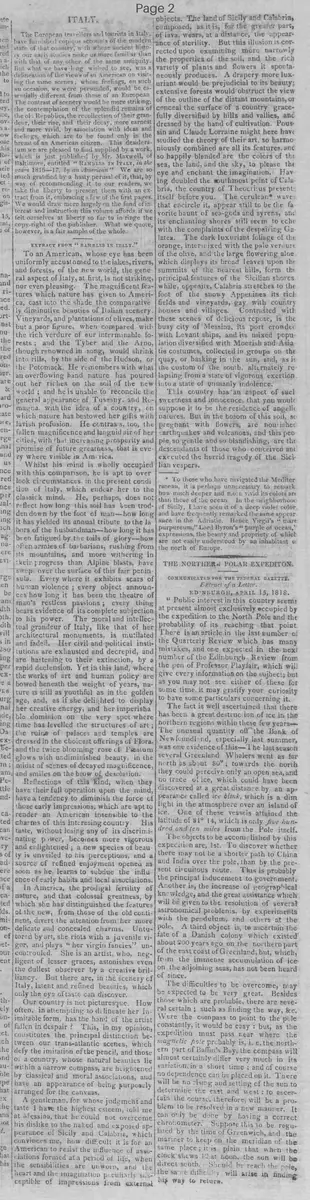
The European travellers and tourists in Italy, have furnished copious accounts of the modern state of that country, with whose ancient history our early studies make us more familiar than with that of any other of the same antiquity. But what we have long wished to see, was a delineation of the views of an American on visiting the same scenes; whose feelings, on such an occasion, we were persuaded, would be essentially different from those of an European. The contrast of scenery would be more striking; the contemplation of the splendid remains of the old Republics, the recollection of their grandeur, their rise, and their decay, more earnest and more vivid, by association with ideas and feelings, which are to be found only in the breast of an American citizen. This desideratum we are pleased to find supplied by a work, which is just published by Mr. Maxwell, of Baltimore, entitled "Rambles in Italy, in the years 1816-17, by an American." We are so much gratified by a hasty perusal of it, that, by way of recommending it to our readers, we take the liberty to present them with an extract from it, embracing a few of the first pages. We would draw more largely on the fund of interest and instruction this volume affords, if we felt ourselves at liberty so far to infringe the copy-right of the publisher. What we quote, however, is a fair sample of the whole.
EXTRACT FROM "RAMBLES IN ITALY."
To an American, whose eye has been uniformly accustomed to the lakes, rivers, and forests, of the new world, the general aspect of Italy, at first, is not striking nor even pleasing. The magnificent features which nature has given to America, cast into the shade the comparatively diminutive beauties of Italian scenery. Vineyards, and plantations of olives, make but a poor figure, when compared with the rich verdure of our interminable forests; and the Tyber and the Arno, though renowned in song, would shrink into rills, by the side of the Hudson, or the Potomack. He remembers with what an overflowing hand nature has poured out her riches on the soil of the new world; and he is unable to reconcile the general appearance of Tuscany and Romaagna, with the idea of a country, on which nature has bestowed her gifts with lavish profusion. He contrasts, too, the fallen magnificence and languid air of her cities, with that increasing prosperity and promise of future greatness, that is every where visible in America.
Whilst his mind is wholly occupied with this comparison, he is apt to overlook circumstances, in the present condition of Italy, which endear her to the classic mind. He, perhaps, does not reflect how long this soil has been trodden down by the foot of man—how long it has yielded its annual tribute to the labors of the husbandman—how long it has been fatigued by the toils of glory—how often armies of barbarians, rushing from its mountains, and more withering in their progress than Alpine blasts, have swept over the surface of this fair peninsula. Every where it exhibits scars of human violence; every object announces how long it has been the theatre of man's restless passions; every thing bears evidence of its complete subjection to his power. The moral and intellectual grandeur of Italy, like that of her architectural monuments, is mutilated and faded. Her civil and political institutions are exhausted and decrepid, and are hastening to their extinction, by a rapid declension. Yet in this land, where the works of art and human policy are bowed beneath the weight of years, nature is still as youthful as in the golden age, and, as if she delighted to display her creative energy, and her imperishable dominion on the very spot where time has levelled the structures of art; the ruins of palaces and temples are creased in the choicest offerings of Flora, and the twice blooming rose of Paestum glows with undiminished beauty, in the midst of scenes of decayed magnificence, and smiles on the brow of desolation.
Reflections of this kind, when they have their full operation upon the mind, have a tendency to diminish the force of those early impressions, which are apt to render an American insensible to the charms of this interesting country. His taste, without losing any of its discriminating power, becomes more vigorous and enlightened; a new species of beauty is unveiled to his perceptions, and a source of refined enjoyment opened as soon as he learns to subdue the influence of early habits and local associations.
In America, the prodigal fertility of nature, and that colossal greatness, by which she has distinguished the features of the new, from those of the old continent, divert the attention from her more delicate and concealed charms. Untutored by art, she riots with a juvenile vigor, and plays "her virgin fancies" uncontrouled. She is an artist, who, negligent of lesser graces, astonishes even the dullest observer by a creative brilliancy. But there are, in the scenery of Italy, latent and refined beauties, which only the eye of taste can discover.
Our country is not picturesque. How often, in attempting to delineate her inimitable form, has the hand of the artist fallen in despair? This, in my opinion, constitutes the principal distinction between our trans-atlantic scenes, which defy the imitation of the pencil, and those of a country, whose natural beauties lie within a narrow compass, are heightened by classical and moral associations, and have an appearance of being purposely arranged for the canvass.
A gentleman, for whose judgment and taste I have the highest esteem, told me at Messina, that he could not overcome his dislike to the naked and exposed appearance of Sicily and Calabria, which convinces me, how difficult it is for an American to resist the influence of associations formed at a period of life, when the sensibilities are unworn, and the heart and the imagination peculiarly susceptible of impressions from external objects.
The land of Sicily and Calabria, composed, as it is, for the greater part, of lava, wears, at a distance, the appearance of sterility. But this illusion is corrected upon examining more narrowly the properties of the soil, and the rich variety of plants and flowers it spontaneously produces. A drapery more luxuriant would be prejudicial to its beauty: extensive forests would obstruct the view of the outline of the distant mountains, or conceal the surface of a country gracefully diversified by hills and vallies, and dressed by the hand of cultivation. Poussin and Claude Lorraine might here have studied the theory of their art, so harmoniously combined are all its features, and so happily blended are the colors of the sea, the land, and the sky, to please the eye and enchant the imagination. Having doubled the southmost point of Calabria, the country of Theocritus presents itself before you. The cerulean waves that encircle it, appear still to be the favorite haunt of sea-gods and syrens, and its enchanting shores still seem to echo with the complaints of the despaining Galatea. The dark luxuriant foliage of the orange, intermingled with the pale verdure of the olive, and the large flowering aloe which displays its broad leaves upon the summits of the nearest hills, form the principal features of the Sicilian shores while, opposite, Calabria stretches to the foot of the snowy Appenines its rich fields and vineyards, gay with country houses and villages. Contrasted with these scenes of delicious repose, is the busy city of Messina, its port crowded with Levant ships, and its mixed population diversified with Moorish and Asiatic costumes, collected in groups on the quay, or basking in the sun, and, as is the custom of the south, alternately relapsing from a state of vigorous exertion into a state of unmanly indolence.
This country has an aspect of such sweetness and innocence, that you would suppose it to be the residence of angelic natures. But in the bosom of this soil, so pregnant with flowers, are nourished earthquakes and volcanoes, and this people so gentle and so blandishing, are the descendants of those who conceived and executed the horrid tragedy of the Sicilian vespers.
To those who have navigated the Mediterranean, it is perhaps unnecessary to remark how much deeper and more vivid its colors are than those of the ocean. In the neighborhood of Sicily, I have seen it of a deep violet color and have frequently remarked the same appearance in the Adriatic. Hence Virgil's "mare purpureum," Lord Byron's "purple of ocean," expressions, the beauty and propriety of which are not easily understood by an inhabitant of the north of Europe.
The European travellers and tourists in Italy, have furnished copious accounts of the modern state of that country, with whose ancient history our early studies make us more familiar than with that of any other of the same antiquity. But what we have long wished to see, was a delineation of the views of an American on visiting the same scenes; whose feelings, on such an occasion, we were persuaded, would be essentially different from those of an European. The contrast of scenery would be more striking; the contemplation of the splendid remains of the old Republics, the recollection of their grandeur, their rise, and their decay, more earnest and more vivid, by association with ideas and feelings, which are to be found only in the breast of an American citizen. This desideratum we are pleased to find supplied by a work, which is just published by Mr. Maxwell, of Baltimore, entitled "Rambles in Italy, in the years 1816-17, by an American." We are so much gratified by a hasty perusal of it, that, by way of recommending it to our readers, we take the liberty to present them with an extract from it, embracing a few of the first pages. We would draw more largely on the fund of interest and instruction this volume affords, if we felt ourselves at liberty so far to infringe the copy-right of the publisher. What we quote, however, is a fair sample of the whole.
EXTRACT FROM "RAMBLES IN ITALY."
To an American, whose eye has been uniformly accustomed to the lakes, rivers, and forests, of the new world, the general aspect of Italy, at first, is not striking nor even pleasing. The magnificent features which nature has given to America, cast into the shade the comparatively diminutive beauties of Italian scenery. Vineyards, and plantations of olives, make but a poor figure, when compared with the rich verdure of our interminable forests; and the Tyber and the Arno, though renowned in song, would shrink into rills, by the side of the Hudson, or the Potomack. He remembers with what an overflowing hand nature has poured out her riches on the soil of the new world; and he is unable to reconcile the general appearance of Tuscany and Romaagna, with the idea of a country, on which nature has bestowed her gifts with lavish profusion. He contrasts, too, the fallen magnificence and languid air of her cities, with that increasing prosperity and promise of future greatness, that is every where visible in America.
Whilst his mind is wholly occupied with this comparison, he is apt to overlook circumstances, in the present condition of Italy, which endear her to the classic mind. He, perhaps, does not reflect how long this soil has been trodden down by the foot of man—how long it has yielded its annual tribute to the labors of the husbandman—how long it has been fatigued by the toils of glory—how often armies of barbarians, rushing from its mountains, and more withering in their progress than Alpine blasts, have swept over the surface of this fair peninsula. Every where it exhibits scars of human violence; every object announces how long it has been the theatre of man's restless passions; every thing bears evidence of its complete subjection to his power. The moral and intellectual grandeur of Italy, like that of her architectural monuments, is mutilated and faded. Her civil and political institutions are exhausted and decrepid, and are hastening to their extinction, by a rapid declension. Yet in this land, where the works of art and human policy are bowed beneath the weight of years, nature is still as youthful as in the golden age, and, as if she delighted to display her creative energy, and her imperishable dominion on the very spot where time has levelled the structures of art; the ruins of palaces and temples are creased in the choicest offerings of Flora, and the twice blooming rose of Paestum glows with undiminished beauty, in the midst of scenes of decayed magnificence, and smiles on the brow of desolation.
Reflections of this kind, when they have their full operation upon the mind, have a tendency to diminish the force of those early impressions, which are apt to render an American insensible to the charms of this interesting country. His taste, without losing any of its discriminating power, becomes more vigorous and enlightened; a new species of beauty is unveiled to his perceptions, and a source of refined enjoyment opened as soon as he learns to subdue the influence of early habits and local associations.
In America, the prodigal fertility of nature, and that colossal greatness, by which she has distinguished the features of the new, from those of the old continent, divert the attention from her more delicate and concealed charms. Untutored by art, she riots with a juvenile vigor, and plays "her virgin fancies" uncontrouled. She is an artist, who, negligent of lesser graces, astonishes even the dullest observer by a creative brilliancy. But there are, in the scenery of Italy, latent and refined beauties, which only the eye of taste can discover.
Our country is not picturesque. How often, in attempting to delineate her inimitable form, has the hand of the artist fallen in despair? This, in my opinion, constitutes the principal distinction between our trans-atlantic scenes, which defy the imitation of the pencil, and those of a country, whose natural beauties lie within a narrow compass, are heightened by classical and moral associations, and have an appearance of being purposely arranged for the canvass.
A gentleman, for whose judgment and taste I have the highest esteem, told me at Messina, that he could not overcome his dislike to the naked and exposed appearance of Sicily and Calabria, which convinces me, how difficult it is for an American to resist the influence of associations formed at a period of life, when the sensibilities are unworn, and the heart and the imagination peculiarly susceptible of impressions from external objects.
The land of Sicily and Calabria, composed, as it is, for the greater part, of lava, wears, at a distance, the appearance of sterility. But this illusion is corrected upon examining more narrowly the properties of the soil, and the rich variety of plants and flowers it spontaneously produces. A drapery more luxuriant would be prejudicial to its beauty: extensive forests would obstruct the view of the outline of the distant mountains, or conceal the surface of a country gracefully diversified by hills and vallies, and dressed by the hand of cultivation. Poussin and Claude Lorraine might here have studied the theory of their art, so harmoniously combined are all its features, and so happily blended are the colors of the sea, the land, and the sky, to please the eye and enchant the imagination. Having doubled the southmost point of Calabria, the country of Theocritus presents itself before you. The cerulean waves that encircle it, appear still to be the favorite haunt of sea-gods and syrens, and its enchanting shores still seem to echo with the complaints of the despaining Galatea. The dark luxuriant foliage of the orange, intermingled with the pale verdure of the olive, and the large flowering aloe which displays its broad leaves upon the summits of the nearest hills, form the principal features of the Sicilian shores while, opposite, Calabria stretches to the foot of the snowy Appenines its rich fields and vineyards, gay with country houses and villages. Contrasted with these scenes of delicious repose, is the busy city of Messina, its port crowded with Levant ships, and its mixed population diversified with Moorish and Asiatic costumes, collected in groups on the quay, or basking in the sun, and, as is the custom of the south, alternately relapsing from a state of vigorous exertion into a state of unmanly indolence.
This country has an aspect of such sweetness and innocence, that you would suppose it to be the residence of angelic natures. But in the bosom of this soil, so pregnant with flowers, are nourished earthquakes and volcanoes, and this people so gentle and so blandishing, are the descendants of those who conceived and executed the horrid tragedy of the Sicilian vespers.
To those who have navigated the Mediterranean, it is perhaps unnecessary to remark how much deeper and more vivid its colors are than those of the ocean. In the neighborhood of Sicily, I have seen it of a deep violet color and have frequently remarked the same appearance in the Adriatic. Hence Virgil's "mare purpureum," Lord Byron's "purple of ocean," expressions, the beauty and propriety of which are not easily understood by an inhabitant of the north of Europe.
What sub-type of article is it?
Travel Impressions
Cultural Reflections
What keywords are associated?
Italy Scenery
American Traveler
Sicily Calabria
Classical Associations
Mediterranean Colors
Where did it happen?
Italy
Foreign News Details
Primary Location
Italy
Event Date
1816 17
Event Details
An American traveler describes initial disappointment with Italy's scenery compared to America's vast nature, but appreciates its refined, classical beauties in Tuscany, Romagna, Sicily, and Calabria, reflecting on historical decay and natural resilience amid ruins and volcanoes.