Thank you for visiting SNEWPapers!
Sign up free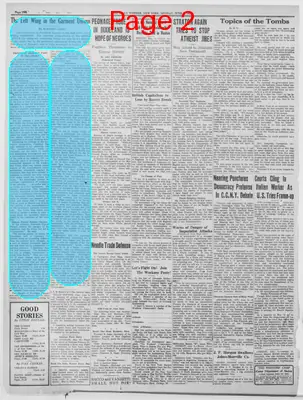
The Daily Worker
Chicago, Cook County, Illinois
What is this article about?
Historical account of President Morris Sigman's role in the 1926 New York cloak and suit industry strike, initially supporting it as legitimate in affidavits and speeches, achieving better settlements than the Governor's Commission proposed, but later denouncing it as illegal and communist-led after right-wing interference.
Clipping
OCR Quality
Full Text
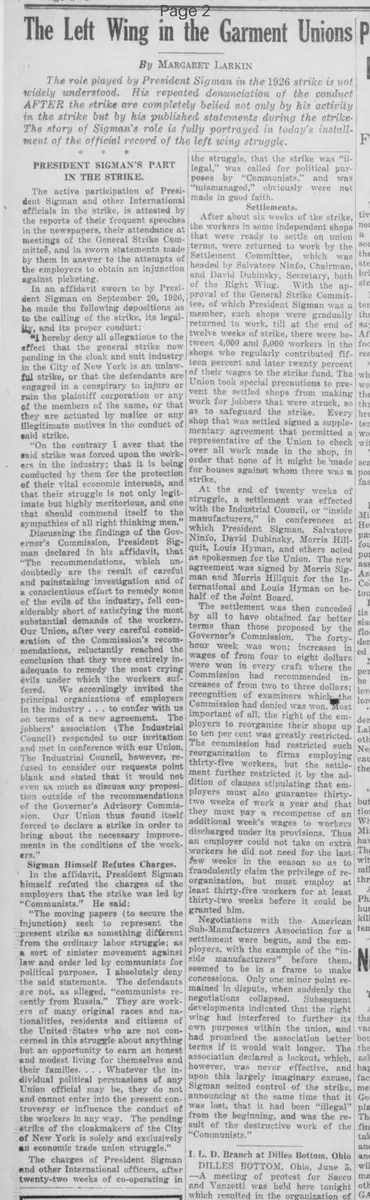
By MARGARET LARKIN
The role played by President Sigman in the 1926 strike is not widely understood. His repeated denunciation of the conduct after the strike are completely belied not only by his activity in the strike but by his published statements during the strike.
The story of Sigman's role is fully portrayed in today's installment of the official record of the left wing struggle.
PRESIDENT SIGMAN'S PART IN THE STRIKE.
The active participation of President Sigman and other International officials in the strike is attested by the reports of their frequent speeches in the newspapers, their attendance at meetings of the General Strike Committee, and in sworn statements made by them in answer to the attempts of the employers to obtain an injunction against picketing.
In an affidavit sworn to by President Sigman on September 20, 1926, he made the following depositions as to the calling of the strike, its legality, and its proper conduct:
"I hereby deny all allegations to the effect that the general strike now pending in the cloak and suit industry in the City of New York is an unlawful strike, or that the defendants are engaged in a conspiracy to injure or ruin the plaintiff corporation or any of the members of the same, or that they are actuated by malice or any illegitimate motives in the conduct of said strike.
"On the contrary I aver that the said strike was forced upon the workers in the industry; that it is being conducted by them for the protection of their vital economic interests, and that their struggle is not only legitimate but highly meritorious, and one that should commend itself to the sympathies of all right thinking men."
Discussing the findings of the Governor's Commission, President Sigman declared in his affidavit, that
"The recommendations, which undoubtedly are the result of careful and painstaking investigation and of a conscientious effort to remedy some of the evils of the industry, fell considerably short of satisfying the most substantial demands of the workers.
Our Union, after very careful consideration of the Commission's recommendations, reluctantly reached the conclusion that they were entirely inadequate to remedy the most crying evils under which the workers suffered. We accordingly invited the principal organizations of employers in the industry . . . to confer with us on terms of a new agreement. The jobbers' association (The Industrial Council) responded to our invitation and met in conference with our Union.
The Industrial Council, however, refused to consider our requests point blank and stated that it would not even as much as discuss any proposition outside of the recommendations of the Governor's Advisory Commission. Our Union thus found itself forced to declare a strike in order to bring about the necessary improvements in the conditions of the workers."
Sigman Himself Refutes Charges.
In the affidavit, President Sigman himself refuted the charges of the employers that the strike was led by "Communists." He said:
"The moving papers (to secure the injunction) seek to represent the present strike as something different from the ordinary labor struggle: as a sort of sinister movement against law and order led by communists for political purposes. I absolutely deny the said statements. The defendants are not, as alleged, "communists recently from Russia." They are workers of many original races and nationalities, residents and citizens of the United States who are not concerned in this struggle about anything but an opportunity to earn an honest and modest living for themselves and their families. . . . Whatever the individual political persuasions of any Union official may be, they do not and cannot enter into the present controversy or influence the conduct of the workers in any way. The pending strike of the cloakmakers of the City of New York is solely and exclusively an economic trade union struggle."
The charges of President Sigman and other International officers, after twenty-two weeks of co-operating in the struggle, that the strike was "illegal," was called for political purposes by "Communists," and was "mismanaged," obviously were not made in good faith.
Settlements.
After about six weeks of the strike, the workers in some independent shops that were ready to settle on union terms, were returned to work by the Settlement Committee, which was headed by Salvatore Ninfo, Chairman, and David Dubinsky, Secretary, both of the Right Wing. With the approval of the General Strike Committee, of which President Sigman was a member, such shops were gradually returned to work, till at the end of twelve weeks of strike, there were between 4,000 and 5,000 workers in the shops who regularly contributed fifteen percent and later twenty percent of their wages to the strike fund. The Union took special precautions to prevent the settled shops from making work for jobbers that were struck, so as to safeguard the strike. Every shop that was settled signed a supplementary agreement that permitted a representative of the Union to check over all work made in the shop, in order that none of it might be made for houses against whom there was a strike.
At the end of twenty weeks of struggle, a settlement was effected with the Industrial Council, or "inside manufacturers," in conferences at which President Sigman, Salvatore Ninfo, David Dubinsky, Morris Hillquit, Louis Hyman, and others acted as spokesmen for the Union. The new agreement was signed by Morris Sigman and Morris Hillquit for the International and Louis Hyman on behalf of the Joint Board.
The settlement was then conceded by all to have obtained far better terms than those proposed by the Governor's Commission. The forty-hour week was won; increases in wages of from four to eight dollars were won in every craft where the Commission had recommended increases of from two to three dollars; recognition of examiners which the Commission had denied was won. Most important of all, the right of the employers to reorganize their shops up to ten per cent was greatly restricted.
The commission had restricted such reorganization to firms employing thirty-five workers, but the settlement further restricted it by the addition of clauses stipulating that employers must also guarantee thirty-two weeks of work a year and that they must pay a recompense of an additional week's wages to workers discharged under its provisions. Thus an employer could not take on extra workers he did not need for the last few weeks in the season so as to fraudulently claim the privilege of reorganization, but must employ at least thirty-five workers for at least thirty-two weeks before it could be granted him.
Negotiations with the American Sub-Manufacturers Association for a settlement were begun, and the employers, with the example of the "inside manufacturers" before them, seemed to be in a frame to make concessions. Only one minor point remained in dispute, when suddenly the negotiations collapsed. Subsequent developments indicated that the right wing had interfered to further its own purposes within the union, and had promised the association better terms if it would wait longer. The association declared a lockout, which, however, was never effective, and upon this largely imaginary excuse, Sigman seized control of the strike, announcing at the same time that it was lost, that it had been "illegal" from the beginning, and was the result of the destructive work of the "Communists."
What sub-type of article is it?
What themes does it cover?
What keywords are associated?
What entities or persons were involved?
Where did it happen?
Story Details
Key Persons
Location
City Of New York
Event Date
1926
Story Details
President Sigman actively participated in and defended the 1926 cloak and suit strike as legitimate and economic, refuting communist allegations; settlements achieved superior terms including 40-hour week and wage increases; right-wing interference led to Sigman's later denunciation of the strike as illegal and communist-driven.