Thank you for visiting SNEWPapers!
Sign up free
Editorial
January 15, 1807
Alexandria Daily Advertiser
Alexandria, Virginia
What is this article about?
An editorial arguing that a nation's character is its true power, enabling heroism in war and deterring aggression, exemplified by France and Britain. It criticizes the current administration for eroding this national patrimony of honor and independence.
Clipping
OCR Quality
98%
Excellent
Full Text
FROM THE BALANCE.
NATIONAL CHARACTER IS NATIONAL POWER.
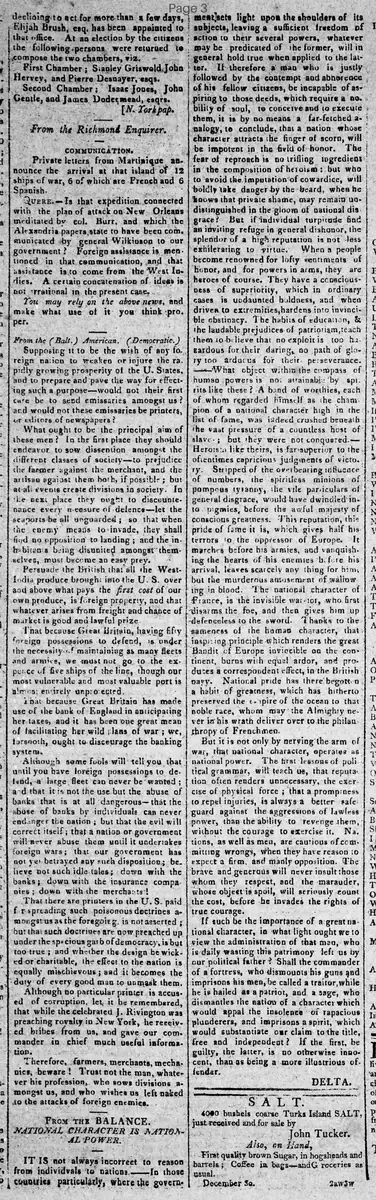
IT IS not always incorrect to reason from individuals to nations. In those countries particularly, where the government sets light upon the shoulders of its subjects, leaving a sufficient freedom of action to their several powers, whatever may be predicated of the former, will in general hold true when applied to the latter. If therefore a man who is justly followed by the contempt and abhorrence of his fellow citizens, be incapable of aspiring to those deeds, which require a nobility of soul, to conceive and to execute them, it is by no means a far-fetched analogy, to conclude, that a nation whose character attracts the finger of scorn, will be impotent in the field of honor. The fear of reproach is no trifling ingredient in the composition of heroism: but who to avoid the imputation of cowardice, will boldly take danger by the beard, when he knows that private shame, may remain undistinguished in the gloom of national disgrace? But if individual turpitude find an inviting refuge in general dishonor, the splendor of a high reputation is not less exhilarating to virtue. When a people become renowned for lofty generous sentiments of honor, and for powers in arms, they are heroes of course. They have a consciousness of superiority, which in ordinary cases is undaunted boldness, and when driven to extremities, hardens into invincible obstinacy. The habits of education, & the laudable prejudices of patriotism, teach them to believe that no exploit is too hazardous for their daring, no path of glory too arduous for their perseverance. What object within the compass of human powers is not attainable by spirits like these? A band of worthies, each of whom regarded himself as the champion of a national character high in the list of fame, was indeed crushed beneath the vast pressure of a countless host of slaves; but they were not conquered. Heroism like theirs, is far superior to the oftentimes capricious judgments of victory. Stripped of the overbearing influence of numbers, the spiritless minions of pompous tyranny, the vile participators of general disgrace, would have dwindled into pigmies, before the awful majesty of conscious greatness. This reputation, this pride of fame it is, which gives half his terrors to the oppressor of Europe. It marches before his armies, and vanquishing the hearts of his enemies before his arrival, leaves scarcely any thing for him but the murderous amusement of wallowing in blood. The national character of France, is the invisible warrior, who first disarms the foe, and then gives him up defenceless to the sword. Thanks to the sameness of the human character, that inspiring principle which renders the great Bandit of Europe invincible on the continent, burns with equal ardor, and produces a correspondent effect, in the British navy. National pride has there begotten a habit of greatness, which has hitherto preserved the empire of the ocean to that noble race, whom may the Almighty never in his wrath deliver over to the philanthropy of Frenchmen.
But it is not only by nerving the arm of war, that national character, operates as national power. The first lessons of political grammar, will teach us, that reputation often renders unnecessary, the exercise of physical force; that a promptness to repel injuries, is always a better safeguard against the aggressions of lawless power, than the ability to revenge them, without the courage to exercise it. Nations, as well as men, are cautious of committing wrongs, when they have reason to expect a firm, and manly opposition. The brave and generous will never insult those whom they respect, and the marauder, whose object is spoil, will seriously count the cost, before he invades the rights of true courage.
If such be the importance of a great national character, in what light ought we to view the administration of that man, who is daily wasting this patrimony left us by our political fathers? Shall the commander of a fortress, who dismounts his guns and imprisons his men, be called a traitor, while he is hailed as a patriot, and a sage, who dismantles the nation of a character which would appal the insolence of rapacious plunderers, and imprisons a spirit, which would substantiate our claim to the title, free and independent? If the first, be guilty, the latter, is no otherwise innocent, than as being a more illustrious offender.
DELTA.
NATIONAL CHARACTER IS NATIONAL POWER.
IT IS not always incorrect to reason from individuals to nations. In those countries particularly, where the government sets light upon the shoulders of its subjects, leaving a sufficient freedom of action to their several powers, whatever may be predicated of the former, will in general hold true when applied to the latter. If therefore a man who is justly followed by the contempt and abhorrence of his fellow citizens, be incapable of aspiring to those deeds, which require a nobility of soul, to conceive and to execute them, it is by no means a far-fetched analogy, to conclude, that a nation whose character attracts the finger of scorn, will be impotent in the field of honor. The fear of reproach is no trifling ingredient in the composition of heroism: but who to avoid the imputation of cowardice, will boldly take danger by the beard, when he knows that private shame, may remain undistinguished in the gloom of national disgrace? But if individual turpitude find an inviting refuge in general dishonor, the splendor of a high reputation is not less exhilarating to virtue. When a people become renowned for lofty generous sentiments of honor, and for powers in arms, they are heroes of course. They have a consciousness of superiority, which in ordinary cases is undaunted boldness, and when driven to extremities, hardens into invincible obstinacy. The habits of education, & the laudable prejudices of patriotism, teach them to believe that no exploit is too hazardous for their daring, no path of glory too arduous for their perseverance. What object within the compass of human powers is not attainable by spirits like these? A band of worthies, each of whom regarded himself as the champion of a national character high in the list of fame, was indeed crushed beneath the vast pressure of a countless host of slaves; but they were not conquered. Heroism like theirs, is far superior to the oftentimes capricious judgments of victory. Stripped of the overbearing influence of numbers, the spiritless minions of pompous tyranny, the vile participators of general disgrace, would have dwindled into pigmies, before the awful majesty of conscious greatness. This reputation, this pride of fame it is, which gives half his terrors to the oppressor of Europe. It marches before his armies, and vanquishing the hearts of his enemies before his arrival, leaves scarcely any thing for him but the murderous amusement of wallowing in blood. The national character of France, is the invisible warrior, who first disarms the foe, and then gives him up defenceless to the sword. Thanks to the sameness of the human character, that inspiring principle which renders the great Bandit of Europe invincible on the continent, burns with equal ardor, and produces a correspondent effect, in the British navy. National pride has there begotten a habit of greatness, which has hitherto preserved the empire of the ocean to that noble race, whom may the Almighty never in his wrath deliver over to the philanthropy of Frenchmen.
But it is not only by nerving the arm of war, that national character, operates as national power. The first lessons of political grammar, will teach us, that reputation often renders unnecessary, the exercise of physical force; that a promptness to repel injuries, is always a better safeguard against the aggressions of lawless power, than the ability to revenge them, without the courage to exercise it. Nations, as well as men, are cautious of committing wrongs, when they have reason to expect a firm, and manly opposition. The brave and generous will never insult those whom they respect, and the marauder, whose object is spoil, will seriously count the cost, before he invades the rights of true courage.
If such be the importance of a great national character, in what light ought we to view the administration of that man, who is daily wasting this patrimony left us by our political fathers? Shall the commander of a fortress, who dismounts his guns and imprisons his men, be called a traitor, while he is hailed as a patriot, and a sage, who dismantles the nation of a character which would appal the insolence of rapacious plunderers, and imprisons a spirit, which would substantiate our claim to the title, free and independent? If the first, be guilty, the latter, is no otherwise innocent, than as being a more illustrious offender.
DELTA.
What sub-type of article is it?
Foreign Affairs
War Or Peace
Partisan Politics
What keywords are associated?
National Character
National Power
Honor
France
Britain
Administration
War
Reputation
What entities or persons were involved?
France
British Navy
Oppressor Of Europe
Great Bandit Of Europe
Administration
Editorial Details
Primary Topic
National Character As Source Of Power And Defense
Stance / Tone
Advocacy For Preserving National Honor, Critical Of Administration
Key Figures
France
British Navy
Oppressor Of Europe
Great Bandit Of Europe
Administration
Key Arguments
National Character Inspires Heroism And Deters Enemies
France's Reputation Conquers Before Battle
British Naval Pride Preserves Sea Empire
Reputation Prevents Need For Physical Force
Current Administration Wastes National Character Like A Traitor