Thank you for visiting SNEWPapers!
Sign up free
Editorial
June 25, 1804
Jenks' Portland Gazette
Portland, Cumberland County, Maine
What is this article about?
This editorial defends the Federalist administrations of Washington and Adams against Democratic-Republican criticisms, detailing their financial achievements in reducing the national debt from over 74 million to about 70 million dollars despite wars and insurrections, and contrasts this with the incoming Jefferson administration, accusing predecessors of seditious falsehoods.
Clipping
OCR Quality
95%
Excellent
Full Text
POLITICS.
FROM THE CENTINEL.
HUME. No. II.
Review of JEFFERSON's Administration
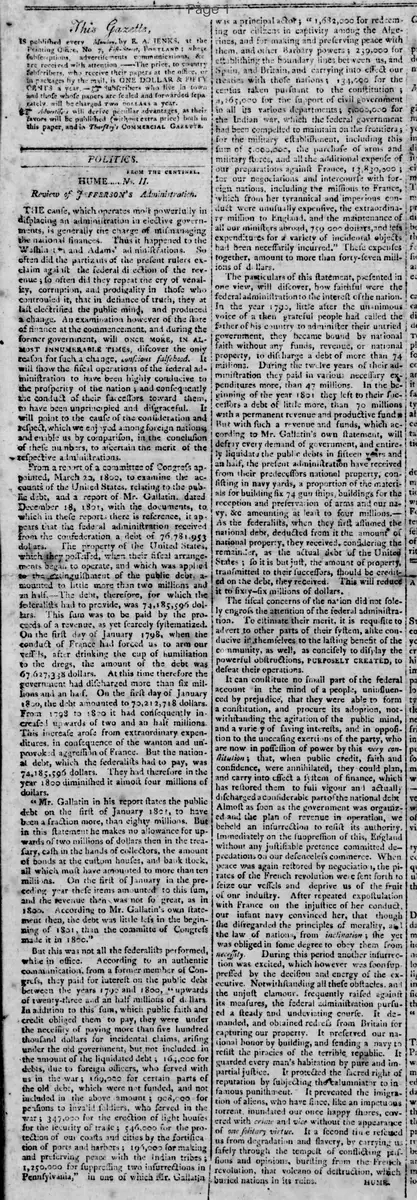
The cause, which operates most powerfully in displacing an administration in elective governments, is generally the charge of misnanaging the national finances. Thus it happened to the Washington and Adams' administrations. So often did the partizans of the present rulers exclaim against the federal direction of the revenue; so often did they repeat the cry of venality, corruption, and prodigality in those who controuled it, that in defiance of truth, they at last electrified the public mind, and produced a change. An examination however of the state of finance at the commencement, and during the former government, will once more, in all most innumerable times, discover the only reason for such a change. Seditious falsehood. It will show the fiscal operations of the federal administration to have been highly conducive to the prosperity of the nation; and consequently the conduct of their successors toward them, to have been unprincipled and disgraceful. It will point to the cause of the consideration and respect, which we enjoyed among foreign nations; and enable us by comparison, in the conclusion of these numbers, to ascertain the merit of the respective administrations.
From a report of a committee of Congress appointed, March 23, 1800, to examine the accounts of the United States, relating to the public debt, and a report of Mr. Gallatin, dated December 18, 1801, with the documents, to which in these reports there is reference, it appears that the federal administration received from the confederation a debt of 76,781,953 dollars. The property of the United States, which they possessed, when their fiscal arrangements began to operate, and which was applied to the extinguishment of the public debt, amounted to little more than two millions and an half.—The debt, therefore, for which the federalists had to provide, was 74,185,596 dollars. This sum was to be paid by the proceeds of a revenue, as yet scarcely systematized.
On the first day of January 1798, when the conduct of France had forced us to arm our vessels, after drinking the cup of humiliation to the dregs, the amount of the debt was 67,627,338 dollars. At this time therefore the government had discharged more than six millions and an half. On the first day of January 1800, the debt amounted to 70,212,718 dollars. From 1798 to 1800 it had consequently increased upwards of two and an half millions. This increase arose from extraordinary expenditures, in consequence of the wanton and unprovoked aggression of France. But the national debt, which the federalists had to pay, was 74,185,596 dollars. They had therefore in the year 1800 diminished it almost four millions of dollars.
Mr. Gallatin in his report states the public debt on the first of January 1801, to have been a fraction more than eighty millions. But in this statement he makes no allowance for upwards of two millions of dollars then in the treasury, cash in the hands of collectors, the amount of bonds at the custom houses, and bank stock, all which must have amounted to more than ten millions. On the first of January in the preceding year these items amounted to this sum, and the revenue then was not so great, as in 1800. According to Mr. Gallatin's own statement then, the debt was little less in the beginning of 1801, than the committee of Congress made it in 1800.
But this was not all the federalists performed, while in office. According to an authentic communication, from a former member of Congress, they paid for interest on the public debt between the years 1795 and 1800, "upwards of twenty-three and an half millions of dollars. In addition to this sum, which public faith and credit obliged them to pay, they were under the necessity of paying more than five hundred thousand dollars for incidental claims, arising under the old government, but not included in the amount of the liquidated debt; 164,000 for debts, due to foreign officers, who served with us in the war; 75,000 for certain parts of the old debt, which were not funded, and not included in the above amount; 600,000 for pensions to invalid soldiers, who served in the war; 347,000 for the erection of light houses for the security of trade; 546,000 for the protection of our coasts and cities by the fortification of ports and harbors; 193,000 for making and preserving peace with the Indian tribes; 1,250,000 for suppressing two insurrections in Pennsylvania," in one of which Mr. Gallatin was a principal actor; "1,632,000 for redeeming our citizens in captivity among the Algerines, and for making and preserving peace with them, and other Barbary powers; 239,000 for establishing the boundary lines between us, and Spain, and Britain, and carrying into effect our treaties with those nations; 734,000 for the census taken pursuant to the constitution; 4,650,000 for the support of civil government in all its various departments; 2,000,000 for the Indian war, which the federal government had been compelled to maintain on the frontiers; for the military establishment, including this sum of 2,000,000, the purchase of arms and military stores, and all the additional expense of our preparations against France, 13,830,000; for our negotiations and intercourse with foreign nations, including the missions to France, which from her tyrannical and imperious conduct were unusually expensive, the extraordinary mission to England, and the maintenance of all our ministers abroad, 756,000 dollars, and less expenditures for a variety of incidental objects had been necessarily incurred." These expenses together, amount to more than forty-seven millions of dollars.
The particulars of this statement, presented in one view, will discover, how faithful were the federal administration to the interest of the nation. In the year 1790, little after the unanimous voice of a then grateful people had called the father of his country to administer their untried government, they became bound by national faith without any funds, revenue, or national property, to discharge a debt of more than 74 millions. During the twelve years of their administration they paid in various necessary expenditures more than 47 millions. In the beginning of the year 1801 they left to their successors a debt of little more than 70 millions with a permanent revenue and productive funds. But with such a revenue and funds, which according to Mr. Gallatin's own statement, will defray every demand of government, and entirely liquidate the public debts in fifteen years and an half, the present administration have received from their predecessors national property, consisting in navy yards, a proportion of the materials for building six 74 gun ships, buildings for the reception and preservation of arms and our navy, &c. amounting at least to four millions.—
As the federalists, when they first assumed the national debt, deducted from it the amount of national property, they received, considering the remainder, as the actual debt of the United States; so it is but just, the amount of property transmitted to their successors, should be credited on the debt, they received. This will reduce it to sixty-six millions of dollars.
The fiscal concerns of the nation did not only engross the attention of the federal administration. To estimate their merit, it is requisite to advert to other parts of their system, alike conducive in themselves to the lasting benefit of the community, as well, as concisely to display the powerful obstructions, purposely created, to defeat their operations.
It can constitute no small part of the federal account in the mind of a people, uninfluenced by prejudice, that they were able to form a constitution, and procure its adoption, notwithstanding the agitation of the public mind, and a variety of clashing interests, and in opposition to the unceasing exertions of the party, who are now in possession of power by this very constitution; that, when public credit, faith and confidence, were annihilated, they could plan, and carry into effect a system of finance, which has restored them to full vigour and actually discharged a considerable part of the national debt. Almost as soon as the government was organized and the plan of revenue in operation, we beheld an insurrection to resist its authority. Immediately on the suppression of this, England without any justifiable pretence committed depredations on our defenceless commerce. When peace was again restored by negotiation, the pirates of the French revolution were sent forth to seize our vessels and deprive us of the fruit of our industry. After repeated expostulation with France on the injustice of her conduct, our infant navy convinced her, that though she disregarded the principles of morality, and the law of nations, from inclination; she yet was obliged in some degree to obey them from necessity. During this period another insurrection was excited, which however was soon suppressed by the decision and energy of the executive. Notwithstanding all these obstacles, and the unjust clamour, frequently raised against its measures, the federal administration pursued a steady and undeviating course. It demanded, and obtained redress from Britain for capturing our property. It preserved our national honor by building, and sending a navy to resist the piracies of the terrible republic. It guarded every man's habitation by pure and impartial justice. It protected the sacred right of reputation by subjecting the calumniator to infamous punishment. It prevented the immigration of aliens, who have since, like an impetuous torrent, inundated our once happy shores, covered with crime and vice without the appearance of one solitary virtue. It a second time rescued us from degradation and slavery, by carrying us safely through the tempest of conflicting passions and opinions, bursting from the French revolution, that volcano of destruction, which buried nations in its ruins.
HUME
FROM THE CENTINEL.
HUME. No. II.
Review of JEFFERSON's Administration
The cause, which operates most powerfully in displacing an administration in elective governments, is generally the charge of misnanaging the national finances. Thus it happened to the Washington and Adams' administrations. So often did the partizans of the present rulers exclaim against the federal direction of the revenue; so often did they repeat the cry of venality, corruption, and prodigality in those who controuled it, that in defiance of truth, they at last electrified the public mind, and produced a change. An examination however of the state of finance at the commencement, and during the former government, will once more, in all most innumerable times, discover the only reason for such a change. Seditious falsehood. It will show the fiscal operations of the federal administration to have been highly conducive to the prosperity of the nation; and consequently the conduct of their successors toward them, to have been unprincipled and disgraceful. It will point to the cause of the consideration and respect, which we enjoyed among foreign nations; and enable us by comparison, in the conclusion of these numbers, to ascertain the merit of the respective administrations.
From a report of a committee of Congress appointed, March 23, 1800, to examine the accounts of the United States, relating to the public debt, and a report of Mr. Gallatin, dated December 18, 1801, with the documents, to which in these reports there is reference, it appears that the federal administration received from the confederation a debt of 76,781,953 dollars. The property of the United States, which they possessed, when their fiscal arrangements began to operate, and which was applied to the extinguishment of the public debt, amounted to little more than two millions and an half.—The debt, therefore, for which the federalists had to provide, was 74,185,596 dollars. This sum was to be paid by the proceeds of a revenue, as yet scarcely systematized.
On the first day of January 1798, when the conduct of France had forced us to arm our vessels, after drinking the cup of humiliation to the dregs, the amount of the debt was 67,627,338 dollars. At this time therefore the government had discharged more than six millions and an half. On the first day of January 1800, the debt amounted to 70,212,718 dollars. From 1798 to 1800 it had consequently increased upwards of two and an half millions. This increase arose from extraordinary expenditures, in consequence of the wanton and unprovoked aggression of France. But the national debt, which the federalists had to pay, was 74,185,596 dollars. They had therefore in the year 1800 diminished it almost four millions of dollars.
Mr. Gallatin in his report states the public debt on the first of January 1801, to have been a fraction more than eighty millions. But in this statement he makes no allowance for upwards of two millions of dollars then in the treasury, cash in the hands of collectors, the amount of bonds at the custom houses, and bank stock, all which must have amounted to more than ten millions. On the first of January in the preceding year these items amounted to this sum, and the revenue then was not so great, as in 1800. According to Mr. Gallatin's own statement then, the debt was little less in the beginning of 1801, than the committee of Congress made it in 1800.
But this was not all the federalists performed, while in office. According to an authentic communication, from a former member of Congress, they paid for interest on the public debt between the years 1795 and 1800, "upwards of twenty-three and an half millions of dollars. In addition to this sum, which public faith and credit obliged them to pay, they were under the necessity of paying more than five hundred thousand dollars for incidental claims, arising under the old government, but not included in the amount of the liquidated debt; 164,000 for debts, due to foreign officers, who served with us in the war; 75,000 for certain parts of the old debt, which were not funded, and not included in the above amount; 600,000 for pensions to invalid soldiers, who served in the war; 347,000 for the erection of light houses for the security of trade; 546,000 for the protection of our coasts and cities by the fortification of ports and harbors; 193,000 for making and preserving peace with the Indian tribes; 1,250,000 for suppressing two insurrections in Pennsylvania," in one of which Mr. Gallatin was a principal actor; "1,632,000 for redeeming our citizens in captivity among the Algerines, and for making and preserving peace with them, and other Barbary powers; 239,000 for establishing the boundary lines between us, and Spain, and Britain, and carrying into effect our treaties with those nations; 734,000 for the census taken pursuant to the constitution; 4,650,000 for the support of civil government in all its various departments; 2,000,000 for the Indian war, which the federal government had been compelled to maintain on the frontiers; for the military establishment, including this sum of 2,000,000, the purchase of arms and military stores, and all the additional expense of our preparations against France, 13,830,000; for our negotiations and intercourse with foreign nations, including the missions to France, which from her tyrannical and imperious conduct were unusually expensive, the extraordinary mission to England, and the maintenance of all our ministers abroad, 756,000 dollars, and less expenditures for a variety of incidental objects had been necessarily incurred." These expenses together, amount to more than forty-seven millions of dollars.
The particulars of this statement, presented in one view, will discover, how faithful were the federal administration to the interest of the nation. In the year 1790, little after the unanimous voice of a then grateful people had called the father of his country to administer their untried government, they became bound by national faith without any funds, revenue, or national property, to discharge a debt of more than 74 millions. During the twelve years of their administration they paid in various necessary expenditures more than 47 millions. In the beginning of the year 1801 they left to their successors a debt of little more than 70 millions with a permanent revenue and productive funds. But with such a revenue and funds, which according to Mr. Gallatin's own statement, will defray every demand of government, and entirely liquidate the public debts in fifteen years and an half, the present administration have received from their predecessors national property, consisting in navy yards, a proportion of the materials for building six 74 gun ships, buildings for the reception and preservation of arms and our navy, &c. amounting at least to four millions.—
As the federalists, when they first assumed the national debt, deducted from it the amount of national property, they received, considering the remainder, as the actual debt of the United States; so it is but just, the amount of property transmitted to their successors, should be credited on the debt, they received. This will reduce it to sixty-six millions of dollars.
The fiscal concerns of the nation did not only engross the attention of the federal administration. To estimate their merit, it is requisite to advert to other parts of their system, alike conducive in themselves to the lasting benefit of the community, as well, as concisely to display the powerful obstructions, purposely created, to defeat their operations.
It can constitute no small part of the federal account in the mind of a people, uninfluenced by prejudice, that they were able to form a constitution, and procure its adoption, notwithstanding the agitation of the public mind, and a variety of clashing interests, and in opposition to the unceasing exertions of the party, who are now in possession of power by this very constitution; that, when public credit, faith and confidence, were annihilated, they could plan, and carry into effect a system of finance, which has restored them to full vigour and actually discharged a considerable part of the national debt. Almost as soon as the government was organized and the plan of revenue in operation, we beheld an insurrection to resist its authority. Immediately on the suppression of this, England without any justifiable pretence committed depredations on our defenceless commerce. When peace was again restored by negotiation, the pirates of the French revolution were sent forth to seize our vessels and deprive us of the fruit of our industry. After repeated expostulation with France on the injustice of her conduct, our infant navy convinced her, that though she disregarded the principles of morality, and the law of nations, from inclination; she yet was obliged in some degree to obey them from necessity. During this period another insurrection was excited, which however was soon suppressed by the decision and energy of the executive. Notwithstanding all these obstacles, and the unjust clamour, frequently raised against its measures, the federal administration pursued a steady and undeviating course. It demanded, and obtained redress from Britain for capturing our property. It preserved our national honor by building, and sending a navy to resist the piracies of the terrible republic. It guarded every man's habitation by pure and impartial justice. It protected the sacred right of reputation by subjecting the calumniator to infamous punishment. It prevented the immigration of aliens, who have since, like an impetuous torrent, inundated our once happy shores, covered with crime and vice without the appearance of one solitary virtue. It a second time rescued us from degradation and slavery, by carrying us safely through the tempest of conflicting passions and opinions, bursting from the French revolution, that volcano of destruction, which buried nations in its ruins.
HUME
What sub-type of article is it?
Partisan Politics
Economic Policy
Foreign Affairs
What keywords are associated?
Federalist Administration
National Debt
Public Finances
Partisan Criticism
Debt Reduction
Foreign Aggressions
Insurrections
What entities or persons were involved?
Washington
Adams
Jefferson
Gallatin
Federalists
France
Britain
Congress
Editorial Details
Primary Topic
Defense Of Federalist Financial Management And Achievements
Stance / Tone
Pro Federalist, Anti Jeffersonian, Accusatory Of Seditious Falsehoods
Key Figures
Washington
Adams
Jefferson
Gallatin
Federalists
France
Britain
Congress
Key Arguments
Federalists Reduced National Debt From 74 Million To 70 Million Despite Challenges
Critics Spread Seditious Falsehoods About Corruption To Gain Power
Federalists Paid Over 47 Million In Necessary Expenditures Including Interest, Military, And Diplomacy
Handled Insurrections, Foreign Aggressions, And Built National Institutions Successfully
Left Successors With Productive Revenue And Property Worth Millions
Jefferson Administration Inherited Stable Finances But Accused Predecessors Unjustly