Thank you for visiting SNEWPapers!
Sign up free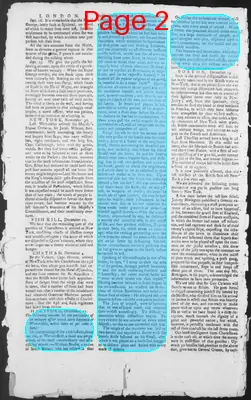
The New Hampshire Gazette And General Advertiser
Portsmouth, Exeter, Rockingham County, New Hampshire
What is this article about?
In Wethersfield, Connecticut, on December 11, William Beadle, influenced by Deist beliefs rejecting revelation and viewing humans as machines, murdered his wife and four young children with a knife and axe while they slept, then shot himself. The jury deemed him of sound mind. The family was buried respectfully, his body infamously.
Clipping
OCR Quality
Full Text
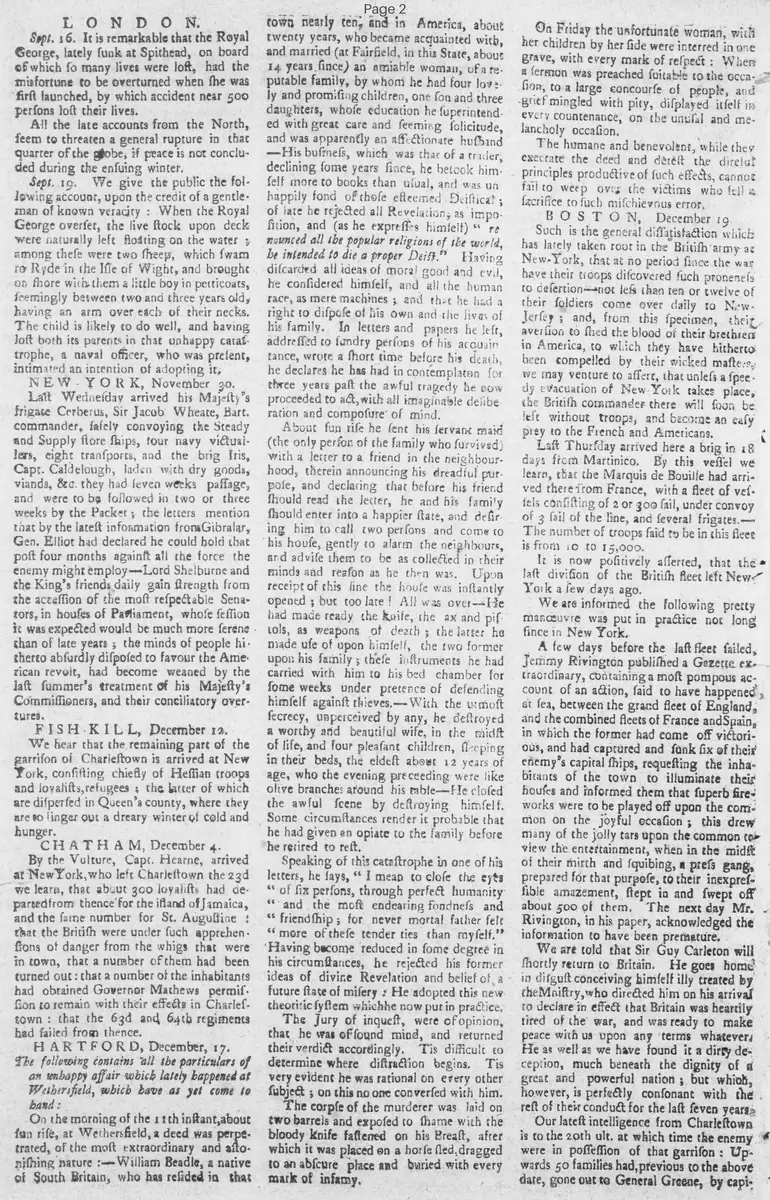
The following contains all the particulars of an unhappy affair which lately happened at Wethersfield, which have as yet come to hand:
On the morning of the 11th instant, about sun rise, at Wethersfield, a deed was perpetrated, of the most extraordinary and astonishing nature: William Beadle, a native of South Britain, who has resided in that town nearly ten, and in America, about twenty years, who became acquainted with, and married (at Fairfield, in this State, about 14 years since) an amiable woman, of a respectable family, by whom he had four lovely and promising children, one son and three daughters, whose education he superintended with great care and seeming solicitude, and was apparently an affectionate husband—His business, which was that of a trader, declining some years since, he betook himself more to books than usual, and was unhappily fond of those esteemed Deistical; of late he rejected all Revelation as imposition, and (as he expresses himself) "renounced all the popular religions of the world. He intended to die a proper Deist." Having discarded all ideas of moral good and evil, he considered himself, and all the human race, as mere machines; and that he had a right to dispose of his own and the lives of his family. In letters and papers he left, addressed to sundry persons of his acquaintance, wrote a short time before his death, he declares he has had in contemplation for three years past the awful tragedy he now proceeded to act, with all imaginable deliberation and composure of mind.
About sun rise he sent his servant maid (the only person of the family who survived) with a letter to a friend in the neighbourhood, therein announcing his dreadful purpose, and declaring that before his friend should read the letter, he and his family should enter into a happier state, and desiring him to call two persons and come to his house, gently to alarm the neighbours, and advise them to be as collected in their minds and reason as he then was. Upon receipt of this line the house was instantly opened: but too late! All was over—He had made ready the knife, the ax and pistols, as weapons of death: the latter he made use of upon himself, the two former upon his family; these instruments he had carried with him to his bed chamber for some weeks under pretence of defending himself against thieves.—With the utmost secrecy, unperceived by any, he destroyed a worthy and beautiful wife, in the midst of life, and four pleasant children, sleeping in their beds, the eldest about 12 years of age, who the evening preceding were like olive branches around his table—He closed the awful scene by destroying himself.
Some circumstances render it probable that he had given an opiate to the family before he retired to rest. Speaking of this catastrophe in one of his letters, he says, "I mean to close the system of six persons, through perfect humanity and the most endearing fondness and friendship; for never mortal father felt more of these tender ties than myself."
Having become reduced in some degree in his circumstances, he rejected his former ideas of divine Revelation and belief of a future state of misery: He adopted this new theoretic system which he now put in practice. The Jury of inquest, were of opinion, that he was of sound mind, and returned their verdict accordingly. Tis difficult to determine where distraction begins. Tis very evident he was rational on every other subject: on this no one conversed with him.
The corpse of the murderer was laid on two barrels and exposed to shame with the bloody knife fastened on his breast, after which it was placed on a horse sled, dragged to an obscure place and buried with every mark of infamy.
On Friday the unfortunate woman, with her children by her side were interred in one grave, with every mark of respect: When a sermon was preached suitable to the occasion, to a large concourse of people, and grief mingled with pity, displayed itself in every countenance, on the unusual and melancholy occasion.
The humane and benevolent, while they execrate the deed and detest the direful principles productive of such effects, cannot fail to weep over the victims who fell a sacrifice to such mischievous error.
What sub-type of article is it?
What themes does it cover?
What keywords are associated?
What entities or persons were involved?
Where did it happen?
Story Details
Key Persons
Location
Wethersfield
Event Date
December 11
Story Details
William Beadle, a trader turned Deist who rejected revelation and saw humans as machines, murdered his sleeping wife and four children (aged up to 12) with knife and axe, possibly after opiating them, then shot himself, viewing it as humane release from misery. He had planned this for three years amid financial decline.