Thank you for visiting SNEWPapers!
Sign up free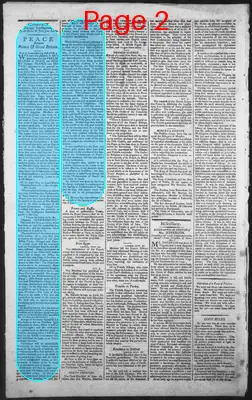
The New Hampshire Gazette
Portsmouth, Rockingham County, New Hampshire
What is this article about?
The London Morning Post reports the signing of preliminaries of peace between Great Britain and France on October 1, 1801, by Lord Hawkesbury and M. Otto. This ends the war contrary to expectations, with funds rising sharply. Conjectural terms include evacuations, restorations, and cessions; ratification expected soon, Parliament to be summoned.
Clipping
OCR Quality
Full Text
Foreign Intelligence,
By the Henry Fane from London.
PEACE
Between
France & Great Britain
From the London Morning Post of Oct. 3.
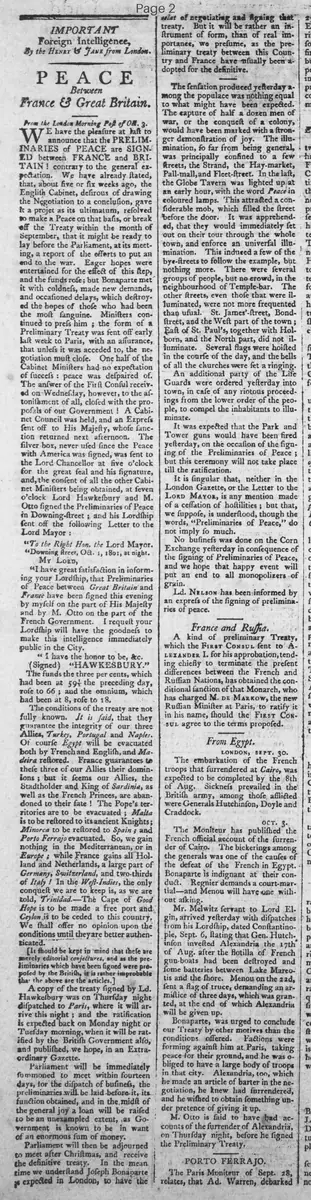
We have the pleasure at last to announce that the PRELIMINARIES of PEACE are SIGNED between FRANCE and BRITAIN! contrary to the general expectation. We have already stated, that, about five or six weeks ago, the English Cabinet, desirous of drawing the Negotiation to a conclusion, gave it a projet as its ultimatum, resolved to make a Peace on that basis, or break off the Treaty within the month of September, that it might be ready to lay before the Parliament, at its meeting, a report of the efforts to put an end to the war. Eager hopes were entertained for the effect of this step, and the funds rose; but Bonaparte met it with coldness, made new demands, and occasioned delays, which destroyed the hopes of those who had been the most sanguine. Ministers continued to press him; the form of a Preliminary Treaty was sent off early last week to Paris, with an assurance, that unless it was acceded to, the negotiation must close. One half of the Cabinet Ministers had no expectation of success: peace was despaired of. The answer of the First Consul received on Wednesday, however, to the astonishment of all, closed with the proposals of our Government! A Cabinet Council was held, and an Express sent off to His Majesty, whose sanction returned next afternoon. The silver box, never used since the Peace with America was signed, was sent to the Lord Chancellor at five o'clock for the great seal and his signature, and, the consent of all the other Cabinet Ministers being obtained, at seven o'clock Lord Hawkesbury and M. Otto signed the Preliminaries of Peace in Downing-street: and his Lordship sent off the following Letter to the Lord Mayor:
"To the Right Hon. the Lord Mayor
"Downing Street, Oct. 1, 1801, at night.
My Lord,
"I have great satisfaction in informing your Lordship, that Preliminaries of Peace between Great Britain and France have been signed this evening by myself on the part of His Majesty and by M. Otto on the part of the French Government. I request your Lordship will have the goodness to make this intelligence immediately public in the City.
"I have the honor to be, &c.
(Signed) "HAWKESBURY."
The funds the three per cents, which had been at 59 the preceding day, rose to 66: and the omnium, which had been at 8, rose to 18.
The conditions of the treaty are not fully known. It is said, that they guarantee the integrity of our three Allies, Turkey, Portugal and Naples. Of course Egypt will be evacuated both by French and English, and Madeira restored. France guarantees to these three of our Allies their dominions; but it seems our Allies, the Stadtholder and King of Sardinia, as well as the French Princes, are abandoned to their fate! The Pope's territories are to be evacuated; Malta is to be restored to its ancient Knights; Minorca to be restored to Spain; and Porto Ferrajo evacuated. So, we gain nothing in the Mediterranean, or in Europe; while France gains all Holland and Netherlands, a large part of Germany, Switzerland, and two-thirds of Italy! In the West-Indies, the only conquest we are to keep is, as we are told, Trinidad.—The Cape of Good Hope is to be made a free port and Ceylon is to be ceded to this country. We shall offer no opinion upon the conditions until they are better authenticated.
(It should be kept in mind that these are merely editorial conjectures, and as the preliminaries which have been signed were proposed by the British, it is rather improbable that the above are the articles.)
A copy of the treaty signed by Ld. Hawkebury was on Thursday night dispatched to Paris, where it will arrive this night; and the ratification is expected back on Monday night or Tuesday morning, when it will be ratified by the British Government also, and published, we hope, in an Extraordinary Gazette.
Parliament will be immediately summoned to meet within fourteen days, for the dispatch of business, the preliminaries will be laid before it, its approbation obtained, and in the midst of the general joy a loan will be raised to an unexampled extent, as Government is known to be in want of an enormous sum of money.
Parliament will then be adjourned to meet after Christmas, and receive the definitive treaty. In the mean time we understand Joseph Bonaparte is expected in London, to have the last of negotiating and signing that treaty. But it will be rather an instrument of form, than of real importance, we presume, as the preliminary treaty between this country and France have usually been adopted for the definitive.
The sensation produced yesterday among the populace was nothing equal to what might have been expected. The capture of half a dozen men of war, or the conquest of a colony, would have been marked with a stronger demonstration of joy. The illumination, so far from being general, was principally confined to a few streets, the Strand, the Hay-market, Pall-mall, and Fleet-street. In the last, the Globe Tavern was lighted up at an early hour, with the word Peace in coloured lamps. This attracted a considerable mob, which filled the street before the door. It was apprehended, that they would immediately set out on their tour through the whole town, and enforce a universal illumination. This induced a few of the bye-streets to follow the example, but nothing more. There were several groups of people, but no crowd, in the neighbourhood of Temple-bar. The other streets, even those that were illuminated, were not more frequented than usual. St. James'-street, Bond street, and the West part of the town; East of St. Paul's, together with Holborn, and the North part, did not illuminate. Several flags were hoisted in the course of the day, and the bells of all the churches were set a ringing. An additional party of the Life Guards were ordered yesterday into town, in case of any riotous proceedings from the lower order of the people, to compel the inhabitants to illuminate.
It was expected that the Park and Tower guns would have been fired yesterday, on the occasion of the signing of the Preliminaries of Peace; but this ceremony will not take place till the ratification.
It is singular that, neither in the London Gazette, or the Letter to the Lord Mayor, is any mention made of a cessation of hostilities; but that, we suppose, is understood, though the words, "Preliminaries of Peace," do not imply so much.
No business was done on the Corn Exchange yesterday in consequence of the signing of Preliminaries of Peace, and we hope that happy event will put an end to all monopolizers of grain.
Ld. Nelson has been informed by an express of the signing of preliminaries of peace.
What sub-type of article is it?
What keywords are associated?
What entities or persons were involved?
Where did it happen?
Foreign News Details
Primary Location
London
Event Date
October 1, 1801
Key Persons
Outcome
preliminaries of peace signed between great britain and france; funds rose from 59 to 66 for three per cents and omnium from 8 to 18; conjectural terms include guarantees for allies, evacuations of egypt and malta, restoration of minorca to spain, cession of trinidad, ceylon, and cape of good hope as free port; ratification expected soon.
Event Details
The English Cabinet proposed an ultimatum five or six weeks prior, but faced delays from Bonaparte. Despite despair, the First Consul accepted on Wednesday. A Cabinet Council was held, royal sanction obtained, and at 7 PM on October 1, 1801, Lord Hawkesbury and M. Otto signed in Downing Street. Letter sent to Lord Mayor; copy dispatched to Paris for ratification. Parliament to be summoned; public reaction muted with limited illuminations and bell ringing.