Thank you for visiting SNEWPapers!
Sign up free
Alexandria Advertiser And Commercial Intelligencer
Alexandria, Virginia
What is this article about?
Letter from a young gentleman in Antwerp, Sept. 1, 1802, describing his yacht and carriage journey from Amsterdam via Utrecht and Rotterdam, reflections on Holland's history, French subjugation, and Antwerp's past glory, current decay, and revival efforts.
Clipping
OCR Quality
Full Text
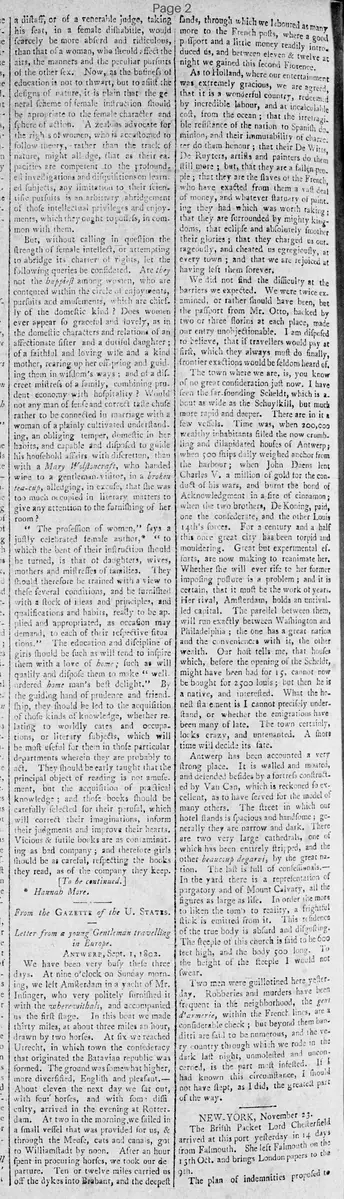
Letter from a young Gentleman travelling in Europe.
ANTWERP, Sept. 1, 1802.
We have been very busy these three days. At nine o'clock on Sunday morning, we left Amsterdam in a yacht of Mr. Hoffnung, who very politely furnished it with the wherewithals, and accompanied us the first stage. In this boat we made thirty miles, at about three miles an hour, drawn by two horses. At six we reached Utrecht, in which town the confederacy that originated the Batavian republic was formed. The ground was somewhat higher, more diversified, English and pleasant. About eleven the next day we set out, with four horses, and with some difficulty, arrived in the evening at Rotterdam. At two in the morning we sailed in a small vessel that was provided for us, & through the Meuse, cuts and canals, got to Willemstadt by noon. After an hour spent in procuring horses, we took our departure. Ten or twelve miles carried us off the dykes into Brabant, and the deepest sands, through which we laboured as many more to the French posts, where a good passport and a little money readily introduced us, and between eleven & twelve at night we gained this second Florence.
As to Holland, where our entertainment was extremely gracious, we are agreed, that it is a wonderful country, redeemed by incredible labour, and at incalculable cost, from the ocean; that the irrefragable resistance of the nation to Spanish dominion, and their immutability of character do them honour; that their De Witts De Ruyters, artists and painters do them still more; but, that they are a fallen people; that they are the slaves of the French, who have exacted from them a vast deal of money, and whatever statuary of painting they had which was worth taking; that they are surrounded by mighty kingdoms, that eclipse and absolutely smother their glories; that they charged us outrageously, and cheated us egregiously, at every town; and that we are rejoiced at having left them forever.
We did not find the difficulty at the barriers we expected. We were twice examined, or rather should have been, but the passport from Mr. Otto, backed by two or three florins at each place, made our entry unobjectionable. I am disposed to believe, that if travellers would pay at first, which they always must do finally, frontier exactions would be seldom heard of. The town where we are, is, you know of no great consideration just now. I have seen the far-sounding Scheldt, which is about as wide as the Schuylkill, but much more rapid and deeper. There are in it a few vessels. Time was, when 200,000 wealthy inhabitants filled the now crumbling and dilapidated houses of Antwerp; when 500 ships daily weighed anchor from the harbour; when John Diens lent Charles V. a million of gold for the conduct of his wars, and burnt the bond of acknowledgment in a fire of cinnamon; when the two brothers, De Koning, paid, one the confederate, and the other Louis 14th's forces. For a century and a half this once great city has been torpid and mouldering. Great but experimental efforts, are now making to reanimate her. Whether she will ever rise to her former imposing posture is a problem; and it is certain, that it must be the work of years. Her rival, Amsterdam, holds an unrivalled capital. The parallel between them, will run exactly between Washington and Philadelphia: the one has a great nation and the conveniences with it, the other wealth. Our host tells me, that houses which, before the opening of the Scheldt, might have been had for 15, cannot now be bought for 2500 louis; but then he is a native, and interested. What the honest statement is I cannot precisely understand, or whether the emigrations have been many of late. The town certainly, looks crazy, and untenanted. A short time will decide its fate.
Antwerp has been accounted a very strong place. It is walled and moated, and defended besides by a fortress constructed by Van Coen, which is reckoned so excellent, as to have served for the model of many others. The street in which our hotel stands is spacious and handsome; generally they are narrow and dark. There are two very large cathedrals, one of which has been entirely stripped, and the other beautifully degarnished, by the great nation. The last is full of confessionals. In the yard there is a representation of purgatory and of Mount Calvary, all the figures as large as life. In order the more to liken the scenes to reality, a frightful stink is emitted from it. This residence of the true body is absurd and disgusting. The steeple of this church is said to be 600 feet high, and the body 500 long. To the height of the steeple I would not swear.
Two men were guillotined here yesterday. Robberies and murders have been frequent in the neighborhood, the gendarmes, within the French lines, are a considerable check; but beyond them banditti are said to be numerous, and the very country through which we rode in the dark last night, unmolested and unconcerned, is the part most infested. If I had known this circumstance, I should not have slept, as I did, the greatest part of the way.
What sub-type of article is it?
What themes does it cover?
What keywords are associated?
What entities or persons were involved?
Where did it happen?
Story Details
Key Persons
Location
Antwerp, Holland, Amsterdam, Utrecht, Rotterdam, Brabant
Event Date
Sept. 1, 1802
Story Details
Traveler describes multi-day journey by yacht, carriage, and vessel from Amsterdam to Antwerp, praising Dutch history but lamenting their subjugation by France and commercial decline; notes Antwerp's historical prosperity, current dilapidation, revival attempts, fortifications, cathedrals, and local crime including recent guillotinings.