Thank you for visiting SNEWPapers!
Sign up free
The Enquirer
Richmond, Henrico County, Virginia
What is this article about?
Biographical sketch of Henry Pestalozzi, Swiss educator born in 1746 in Zurich, detailing his early life, failed agricultural and educational ventures, publications, and establishments at Stantz and Berthoud amid personal hardships and political upheavals in Switzerland.
Merged-components note: Continuation of the biographical sketch of Pestalozzi's life across sections on the same page.
Clipping
OCR Quality
Full Text
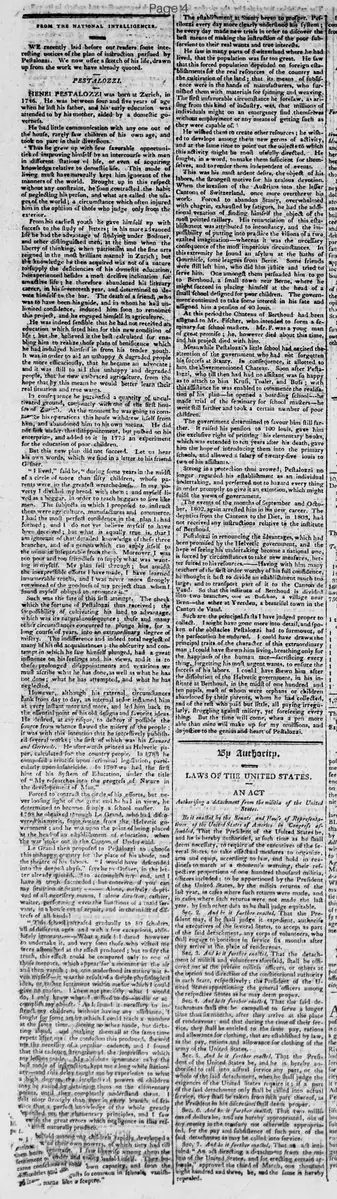
WE recently laid before our readers some interesting notices of the plan of instruction pursued by Pestalozzi. We now offer a sketch of his life, drawn up from the works we have already quoted.
PESTALOZZI.
HENRY PESTALOZZI was born at Zurich, in 1746. He was between four and five years of age when he lost his father, and his early education was attended to by his mother, aided by a domestic governess.
He had little communication with any one out of the house, rarely saw children of his own age, and took no part in their diversions.
Thus he grew up with few favorable opportunities of improving himself by an intercourse with men in different stations of life, or even of acquiring knowledge relative to domestic life. This mode of living must have naturally kept him ignorant of the manners of the world. Brought up in this respect without any constraint, he soon contracted the habit of neglecting his person, and what are called the usages of the world; a circumstance which often injured him in the opinion of those who judge only from the exterior.
From his earliest youth he gave himself up with success to the study of letters; in his more advanced life he had the advantage of studying under Bodmer, and other distinguished men, at the time when the liberty of thinking, when patriotism and the fine arts reigned in the most brilliant manner in Zurich; but the knowledge he then acquired was not of a nature to supply the deficiencies of his domestic education he experienced besides a most decisive inclination for active life; he therefore abandoned his literary career, in his twentieth year, and determined to devote himself to the bar. The death of a friend, who was to have been his guide, and in whom he had unlimited confidence, induced him soon to renounce this project, and he engaged himself in agriculture....
He was indeed sensible that he had not received an education which fitted him for this new condition of life; but he believed it the best calculated for enabling him to realize those plans of beneficence which he had indulged himself in from his tender youth.
It was in order to aid an unhappy & degraded people the more efficaciously, that he became an advocate and it was still to aid this unhappy and degraded people, that he now embraced agriculture, from the hope that by this means he would better learn their real situation and true wants.
In consequence he purchased a quantity of uncultivated ground, conjointly with one of the first houses of Zurich. At the moment he was going to commence his operations this house withdrew itself from him, and abandoned him to his own means. He did not sink under this disappointment, but pushed on his enterprise, and added to it in 1775 an experiment for the education of poor children.
But this new plan did not succeed. Let us hear his own words, which we find in a letter to his friend Gessner.
"I lived," said he, "during some years in the midst of a circle of more than fifty children, whose parents were in the greatest wretchedness. In my poverty I divided my bread with them: and myself lived as a beggar, in order to teach beggars to live like men. The subjects in which I proposed to instruct them were agriculture, manufactures and commerce.
I had the most perfect confidence in the plan I had formed; and I do not yet believe myself to have been deceived; but what is equally true, is, that I am ignorant of that detailed knowledge of these three branches, and of a genius which can apply itself to the minutiae inseparable from them. Moreover, I was too poor and too sleepless to supply what was wanting in myself. My plan fell through; but amidst the inexpressible efforts I have made, I have learned innumerable truths, and I was never more strongly convinced of the goodness of my project than when I found myself obliged to renounce it."
Such was the fate of this first attempt. The check which the fortune of Pestalozzi thus received; the impossibility of cultivating his land to advantage, which was its natural consequence: these and many other circumstances concurred to plunge him, for a long course of years, into an extraordinary degree of misery. The indifference and indeed total neglect of many of his old acquaintances; the obscurity and contempt in which he saw himself plunged, had a great influence on his feelings and his views, and it is to these prolonged disappointments and vexations we must ascribe what he has done, as well as what he has not done; what he has attempted, and what he has neglected.
However, although his external circumstances sunk from day to day, an internal ardor inflamed him at every instant more and more, and led him back to the essential point of his old designs and favorite ideas.
He desired, at any risk, to destroy if possible the source from whence flowed the misery of the people; it was with this intention that he successively published several works; the first of which was his Leonard and Gertrude. He afterwards printed an Helvetic paper, calculated for the country people. In 1780 he composed a treatise upon criminal legislation, particularly upon infanticide. In 1797 we had the first hint of his System of Education, under the title of "My researches into the progress of Nature in the development of Man."
Forced to contract the circle of his efforts, but never losing sight of the great end he had in view, he determined to become simply a school master. In 1799 he obtained through Le Grand, who had discovered his merit, some notice from the Helvetic government; and he was upon the point of being placed at the head of an establishment of education, when the war broke out in the Canton of Underwald.
Le Grand then proposed to Pestalozzi to choose this unhappy country for the place of his abode, and the theatre of his labors. "I would have descended into the deepest abyss," said he to Gessner, in the letter already quoted, "to accomplish my end, and I have in truth succeeded; but conceive if you can my situation at Stantz--Alone, entirely deprived of all necessary means, I alone director, cashier, waiter, performing even the functions of a maid or servant, in a house out of repair, and in the midst of distresses of all kinds."
"This establishment gradually increased to 80 scholars, all of different ages and with a few exceptions, absolutely ignorant. What a task! I dared however to undertake it, and very soon those who visited me were astonished at the effect produced; but to say the truth, this effect could be compared only to one of those meteors, which appear for a moment in the air and then vanish; no one understood its nature not even myself--it was the result of a simple physiologic idea, or rather sentiment within me for which I could give no reason. I knew not precisely, what I would do, I only knew what I wished to do--to die or accomplish my object. As I found it necessary to instruct my children, without having any assistance, I sought out some art by which I could teach a number at the same time. Seeing no other mode, but dictating aloud, and making them all at the same time repeat after me: the confusion this produced, showed me the necessity of a peculiar cadence, and I found that this cadence arranged the impression which my lessons made. My absolute ignorance as to the best mode of instruction kept me a long while stationary--and this delay taught me by experience to what a high degree, the intellectual powers of children may be raised by detaining them on the elementary points, until they completely understand them.
I felt more strongly than ever in every branch of exercise that a perfect knowledge of the whole greatly depended on the elementary principles, and I saw the great errors which negligence in this respect naturally produce.
I beheld among my children rapidly developed a consciousness of their own powers, of which they had till then no idea--a sentiment of order and industry unfolded itself. Then by difficulties and mistakes I became conscious of their own capacity, and soon the gusts so common in schools vanish--
like a sceptre.
The establishment at Stantz began to prosper. Pestalozzi every day more clearly understood his system; he every day made new trials in order to discover the best means of making the instruction of the poor subservient to their real wants and true interests.
He saw in many parts of Switzerland where he had lived, that the population was far too great. He saw that this forced population depended on foreign establishments for the real resources of the country and the cultivation of the land; that its means of subsistence were in the hands of manufacturers, who furnished them with materials for spinning and weaving.
The first unfavorable circumstance he foresaw, as arising from this kind of industry, was, that millions of individuals might on an emergency find themselves without employment or any means of getting such as they were capable of.
He wished them to create other resources; he wished to develope among them new germs of activity, and at the same time to point out the objects to which this activity might be most usefully directed. He ought, in a word, to make them sufficient for themselves, and to render them independent of events.
This was his most ardent desire, the object of his labors, the strongest motive for his zealous devotion.
When the invasion of the Austrians into the free Cantons of Switzerland, once more overthrew his work. Forced to abandon Stantz, overwhelmed with chagrin, exhausted by fatigues, he had the additional vexation of finding himself the object of the most pointed raillery. His renunciation of this establishment was attributed to inconstancy, and the impossibility of putting into practice the visions of a too exalted imagination—whereas it was the necessary consequence of the most imperious circumstances. In this extremity he found an asylum at the baths of Gournicle, some leagues from Berne. Some friends were still left him, who did him justice and tried to serve him. One amongst them persuaded him to go to Berthoud, a small town near Berne, where he might succeed in placing himself at the head of a small school designed for poor children. The government continued to take some interest in his fate and assigned him a pension of 40 louis.
At this period the Chateau of Berthoud had been assigned to Mr. Fischer, who intended to form a seminary or school masters. Mr. F. was a young man of great promise; he, however died about this time, and his project died with him.
Meanwhile Pestalozzi's little school had excited the attention of the government who had not forgotten his success at Stantz. In consequence, it allotted to him the abovementioned Chateau. Soon after Pestalozzi, who till then had had no assistant was so happy as to attach to him Krusi, Tolder, and Buss; with this assistance he was enabled to commence the realization of his plan--he opened a boarding school--he made trial of the seminary for school masters--he went still farther and took a certain number of poor children.
The government determined to favour him still farther. It raised his pension to 100 louis, gave him the exclusive right of printing his elementary books, which was extended to ten years after his death, gave him the hope of introducing them into the primary schools, and allowed a salary of twenty-five louis to two of his assistants...
Strong in a protection thus avowed; Pestalozzi no longer regarded his establishment as an individual undertaking, and preferred not to hazard every thing in order promptly to give it an extension, which might fulfil the views of government.
The events of the months of September and October, 1802, again arrested him in his new career. The deputies from the Cantons to the Diet, in 1803, had not received any instructions relative to the institute of Berthoud.
Pestalozzi in renouncing the advantages, which had been promised by the Helvetic government, and the hope of seeing his undertaking become a national one, is forced by circumstances to take new measures, better suited to his resources.---Having with him many teachers of the first order worthy of his full confidence, he thought it best to divide an establishment much too large; and to transport part of it to the Canton de Vaud. So that the institute of Berthoud is divided into two branches, one at Duchese, a village near Bern--the other at Yverdon, a beautiful town in the Canton de Vaud.
Such are the principal facts I have judged proper to collect. I might have gone more into detail; and spoken of the obstacles Pestalozzi had to surmount, of the persecution he endured. I could have drawn the principal traits of the character of this extraordinary man; I could have shown him living, breathing only for the happiness of the human race--sacrificing every thing, forgetting his most urgent wants, to ensure the success of his labors. I could have shown him after the dissolution of the Helvetic government, in his institute at Berthoud, in the midst of one hundred and ten pupils, most of whom were orphans or children abandoned by their parents, whom he had collected, and of the rest who paid but little, all paying irregularly, struggling against misery, yet foreseeing every thing. But the time will come, when a pen more able than mine will make up for my omissions, and do justice to the genius and heart of Pestalozzi.
What sub-type of article is it?
What themes does it cover?
What keywords are associated?
What entities or persons were involved?
Where did it happen?
Story Details
Key Persons
Location
Zurich, Switzerland; Stantz; Berthoud; Yverdon
Event Date
1746 Onwards
Story Details
Henry Pestalozzi, born in Zurich in 1746, pursued education reform for the poor despite early losses, failed agricultural ventures, and political disruptions; he established schools at Stantz and Berthoud, published works on education and social issues, and developed innovative teaching methods amid personal hardships.