Thank you for visiting SNEWPapers!
Sign up free
Daily National Intelligencer
Washington, District Of Columbia
What is this article about?
April 19, 1820s report from Lebanon, Ohio, on a recent council at Fort Harrison where Wea and Kickapoo tribes objected to surveying lands northwest of the Wabash over boundary disputes, despite admitting U.S. ownership. Grand council planned for May 23. Warnings issued about potential Potawatomi hostility, but no imminent threats.
Clipping
OCR Quality
Full Text
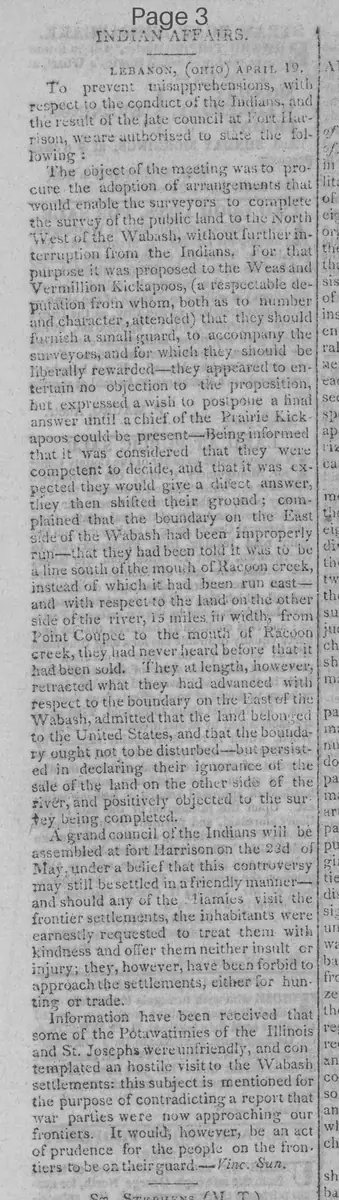
LEBANON, (OHIO) APRIL 19.
To prevent misapprehensions, with respect to the conduct of the Indians, and the result of the late council at Fort Harrison, we are authorised to state the following:
The object of the meeting was to procure the adoption of arrangements that would enable the surveyors to complete the survey of the public land to the North West of the Wabash, without further interruption from the Indians. For that purpose it was proposed to the Weas and Vermillion Kickapoos, (a respectable deputation from whom, both as to number and character, attended) that they should furnish a small guard, to accompany the surveyors, and for which they should be liberally rewarded—they appeared to entertain no objection to the proposition, but expressed a wish to postpone a final answer until a chief of the Prairie Kickapoos could be present—Being informed that it was considered that they were competent to decide, and that it was expected they would give a direct answer. they then shifted their ground; complained that the boundary on the East side of the Wabash had been improperly run—that they had been told it was to be a line south of the mouth of Racoon creek, instead of which it had been run east—and with respect to the land on the other side of the river, 15 miles in width, from Point Coupee to the mouth of Racoon creek, they had never heard before that it had been sold. They at length, however, retracted what they had advanced with respect to the boundary on the East of the Wabash, admitted that the land belonged to the United States, and that the boundary ought not to be disturbed—but persisted in declaring their ignorance of the sale of the land on the other side of the river, and positively objected to the survey being completed.
A grand council of the Indians will be assembled at fort Harrison on the 23d of May, under a belief that this controversy may still be settled in a friendly manner—and should any of the Indians visit the frontier settlements, the inhabitants were earnestly requested to treat them with kindness and offer them neither insult or injury; they, however, have been forbid to approach the settlements, either for hunting or trade.
Information have been received that some of the Potawatimies of the Illinois and St. Josephs were unfriendly, and contemplated an hostile visit to the Wabash settlements: this subject is mentioned for the purpose of contradicting a report that war parties were now approaching our frontiers. It would, however, be an act of prudence for the people on the frontiers to be on their guard.—Vinc. Sun.
What sub-type of article is it?
What keywords are associated?
Where did it happen?
Domestic News Details
Primary Location
Fort Harrison
Event Date
Late Council; 23d Of May
Outcome
indians objected to completing the survey; grand council to be assembled; indians forbidden to approach settlements; no war parties approaching frontiers
Event Details
Council at Fort Harrison to procure Indian guard for surveyors of public lands northwest of the Wabash. Weas and Vermillion Kickapoos attended, initially wished to postpone, then complained about boundary lines and ignorance of land sale west of Wabash, but retracted some claims and admitted land belonged to United States. Persisted in objecting to survey. Information received of unfriendly Potawatimies contemplating hostile visit to Wabash settlements, but contradicting reports of approaching war parties. Inhabitants requested to treat visiting Indians kindly.