Thank you for visiting SNEWPapers!
Sign up free
Story
August 21, 1860
The Western Democrat
Charlotte, Mecklenburg County, North Carolina
What is this article about?
Essay on how diet and digestive issues affect mood, judgment, and behavior, using Bonaparte's battle loss from poor dinner as example; warns of indigestion leading to selfishness and loss of charity.
Clipping
OCR Quality
98%
Excellent
Full Text
The Stomach and the Mind.
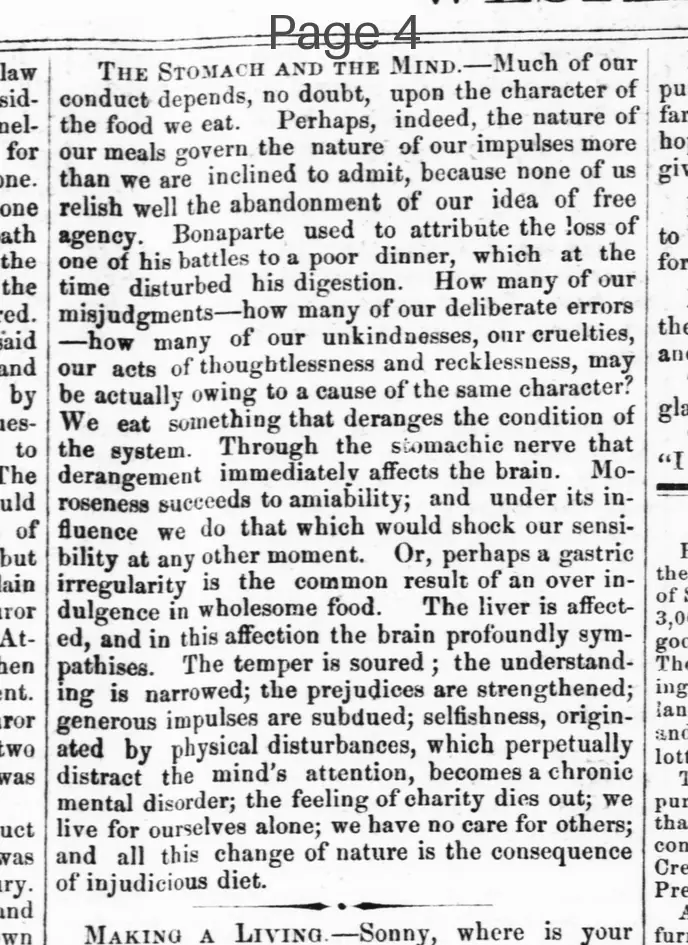
Much of our conduct depends, no doubt, upon the character of the food we eat. Perhaps, indeed, the nature of our meals govern the nature of our impulses more than we are inclined to admit, because none of us relish well the abandonment of our idea of free agency. Bonaparte used to attribute the loss of one of his battles to a poor dinner, which at the time disturbed his digestion. How many of our misjudgments—how many of our deliberate errors —how many of our unkindnesses, our cruelties, our acts of thoughtlessness and recklessness, may be actually owing to a cause of the same character?
We eat something that deranges the condition of the system. Through the stomachic nerve that derangement immediately affects the brain. Moroseness succeeds to amiability; and under its influence we do that which would shock our sensibility at any other moment. Or, perhaps a gastric irregularity is the common result of an over indulgence in wholesome food. The liver is affected, and in this affection the brain profoundly sympathises. The temper is soured; the understanding is narrowed; the prejudices are strengthened; generous impulses are subdued; selfishness, originated by physical disturbances, which perpetually distract the mind's attention, becomes a chronic mental disorder; the feeling of charity dies out; we live for ourselves alone; we have no care for others; and all this change of nature is the consequence of injudicious diet.
Much of our conduct depends, no doubt, upon the character of the food we eat. Perhaps, indeed, the nature of our meals govern the nature of our impulses more than we are inclined to admit, because none of us relish well the abandonment of our idea of free agency. Bonaparte used to attribute the loss of one of his battles to a poor dinner, which at the time disturbed his digestion. How many of our misjudgments—how many of our deliberate errors —how many of our unkindnesses, our cruelties, our acts of thoughtlessness and recklessness, may be actually owing to a cause of the same character?
We eat something that deranges the condition of the system. Through the stomachic nerve that derangement immediately affects the brain. Moroseness succeeds to amiability; and under its influence we do that which would shock our sensibility at any other moment. Or, perhaps a gastric irregularity is the common result of an over indulgence in wholesome food. The liver is affected, and in this affection the brain profoundly sympathises. The temper is soured; the understanding is narrowed; the prejudices are strengthened; generous impulses are subdued; selfishness, originated by physical disturbances, which perpetually distract the mind's attention, becomes a chronic mental disorder; the feeling of charity dies out; we live for ourselves alone; we have no care for others; and all this change of nature is the consequence of injudicious diet.
What sub-type of article is it?
Curiosity
Medical Curiosity
What themes does it cover?
Moral Virtue
Misfortune
What keywords are associated?
Diet Influence
Digestion Effects
Mental Health
Impulses
Indigestion
Behavior Change
Stomach Mind
What entities or persons were involved?
Bonaparte
Story Details
Key Persons
Bonaparte
Story Details
The article argues that food and digestion profoundly influence conduct, impulses, and mental states, potentially causing misjudgments, unkindness, and selfishness. It cites Bonaparte attributing a battle loss to indigestion and explains how stomachic derangements affect the brain, leading to moroseness, soured temper, and narrowed understanding from injudicious diet.