Thank you for visiting SNEWPapers!
Sign up free
Daily National Intelligencer
Washington, District Of Columbia
What is this article about?
Extract of a letter from Buenos Ayres, dated March 3, 1818, describing the republican simplicity, political enthusiasm, and defensive strength of the region amid independence struggles. The American writer contrasts it favorably with despotic Rio de Janeiro and urges U.S. recognition to guide their government.
Clipping
OCR Quality
Full Text
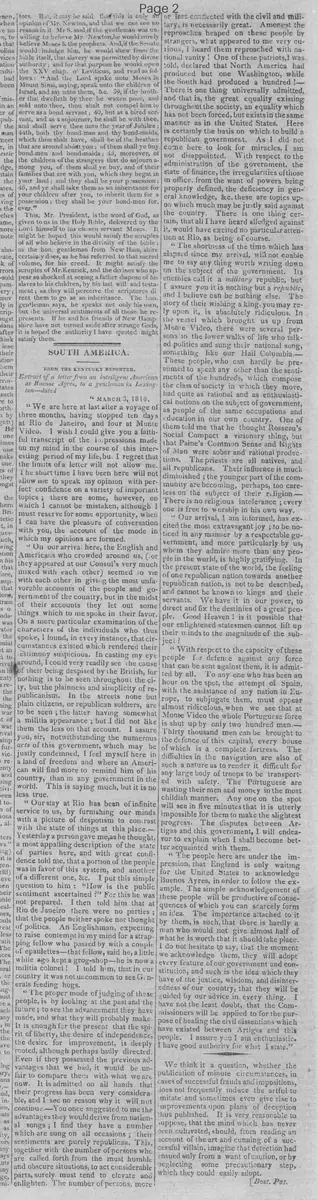
FROM THE KENTUCKY REPORTER.
Extract of a letter from an intelligent American at Buenos Ayres, to a gentleman in Lexington—dated
"March 3, 1818."
"We are here at last after a voyage of three months, having stopped ten days at Rio de Janeiro, and four at Monte Video. I wish I could give you a faithful transcript of the impressions made on my mind in the course of this interesting period of my life, but I regret that the limits of a letter will not allow me. The short time I have been here will not allow me to speak my opinion with perfect confidence on a variety of important topics; there are some, however, on which I cannot be mistaken, although I must reserve for some opportunity, when I can have the pleasure of conversation with you, the account of the mode in which my opinions are formed.
"On our arrival here, the English and Americans who crowded around us, (or they appeared at our Consul's very much mixed with each other) seemed to vie with each other in giving the most unfavorable accounts of the people and government of the country, but in the midst of their accounts they let out some things which to me spoke in their favor. On a more particular examination of the characters of the individuals who thus spoke, I found, in every instance, that circumstances existed which rendered their testimony suspicious. In casting my eye around, I could very readily see the cause of their being despised by the British, for nothing is to be seen throughout the city, but the plainness and simplicity of republicanism. In the streets none but plain citizens, or republican soldiers, are to be seen; the latter having somewhat a militia appearance; but I did not like them the less on that account. I assure you, sir, notwithstanding the numerous acts of this government, which may be justly condemned, I feel myself here in a land of freedom and where an American will find more to remind him of his country, than in any government in the world." This is saying much, but it is no less true.
"Our stay at Rio has been of infinite service to us, by furnishing our minds with a picture of despotism to contrast with the state of things at this place.—Yesterday a person gave me, as he thought, a most appalling description of the state of parties here, and with great confidence told me, that a portion of the people was in favor of this system, and another of a different one, &c. I put this simple question to him: "How is the public sentiment ascertained?" For this he was not prepared. I then told him that at Rio de Janeiro there were no parties; that the people neither spoke nor thought of politics. An Englishman, expecting to raise contempt in my mind for a strapping fellow who passed by with a couple of epaulettes—that fellow, said he, a little while ago kept a grog-shop—he is now a militia colonel! I told him, that in our country it was not uncommon to see Generals feeding hogs.
"The proper mode of judging of these people, is by looking at the past and the future; to see the advancement they have made, and what they will probably make. It is enough for the present that the spirit of liberty, the desire of independence, the desire for improvement, is deeply rooted, although perhaps badly directed. Even if they possessed the previous advantages that we had, it would be unfair to compare them with what we are now. It is admitted on all hands that their progress has been very considerable, and I see no reason why it will not continue.—You once suggested to me the advantages they would derive from national songs; I find they have a number which are sung on all occasions; their sentiments are purely republican. This, together with the number of persons who are called forth from the most humble and obscure situations, to act considerable parts, surely must tend to elevate and enlighten. The number of persons, more or less connected with the civil and military, is necessarily great. Amongst the reproaches heaped on these people by strangers, what appeared to me very curious, I heard them reproached with national vanity! One of these patriots, I was told, declared that North America had produced but one Washington, while the South had produced a hundred!—There is one thing universally admitted, and that is, the great equality existing throughout the society, an equality which has not been forced, but exists in the same manner as in the United States. Here is certainly the basis on which to build a republican government. As I did not come here to look for miracles, I am not disappointed. With respect to the administration of the government, the state of finance, the irregularities of those in office, from the want of powers being properly defined, the deficiency in general knowledge, &c. these are topics upon which much may be justly said against the country. There is one thing certain, that all I have heard alledged against it, would have excited no particular attention at Rio, as being of course.
"The shortness of the time which has elapsed since my arrival, will not enable me to say any thing worth writing down on the subject of the government. Its enemies call it a military republic, but I assure you it is nothing but a republic, and I believe can be nothing else. The story of their wishing a king you may rely upon it, is absolutely ridiculous. In the vessel which brought us up from Monte Video, there were several persons in the lower walks of life who talked politics and sung their national song something like our Hail Columbia.—These people, who can hardly be presumed to speak any other than the sentiments of the hundreds, which compose the class of society in which they move had quite as rational and as enthusiastic notions on the subject of government, as people of the same occupations and education in our own country. One of them told me that he thought Rosseau's Social Compact a visionary thing, but that Paine's Common Sense and Rights of Man were sober and rational productions. The priests are all natives, and all republicans. Their influence is much diminished; the younger part of the community are becoming, perhaps, too careless on the subject of their religion.—There is no religious intolerance; every one is free to worship in his own way.
"Our arrival, I am informed, has excited the most extravagant joy; to be noticed in any manner by a respectable government, and more particularly by us whom they admire more than any people in the world, is highly gratifying. In the present state of the world, the feeling of one republican nation towards another republican nation, is not to be described, and cannot be known to kings and their servants. We have it in our power, to direct and fix the destinies of a great people. Good Heaven! is it possible that our enlightened statesmen cannot lift up their minds to the magnitude of the subject?
"With respect to the capacity of these people for defence against any force that can be sent against them, it is admitted by all. To any one who has been an hour on the spot, the attempt of Spain, with the assistance of any nation in Europe, to subjugate them, must appear almost ridiculous, when we see that at Monte Video the whole Portuguese force is shut up by only two hundred men.—Thirty thousand men can be brought to the defence of this capital, every house of which is a complete fortress. The difficulties in the navigation are also of such a nature as to render it difficult for any large body of troops to be transported with safety. The Portuguese are wasting their men and money in the most childish manner. Any one on the spot will see in five minutes that it is utterly impossible for them to make the slightest progress. The disputes between Artigas and this government, I will endeavor to explain when I shall become better acquainted with them.
"The people here are under the impression, that England is only waiting for the United States to acknowledge Buenos Ayres, in order to follow the example. The simple acknowledgement of these people will be productive of consequences of which you can scarcely form an idea. The importance attached to it by them, is such, that there is hardly a man who would not give almost half of what he is worth that it should take place. I do not hesitate to say, that the moment we acknowledge them, they will adopt every feature of our government and constitution, and such is the idea which they have of the justice, wisdom, and disinterestedness of our country, that they will be guided by our advice in every thing. I have not the least doubt, that the Commissioners will be applied to for the purpose of healing the civil dissentions which have existed between Artigas and this people. I assure you I am enthusiastic. I have good authority for what I state."
We think it a question, whether the publication of minute circumstances, in cases of successful frauds and impositions, does not frequently induce the artful to imitate and sometimes even give rise to improvements upon plans of deception thus published. It is very reasonable to suppose, that the mind which has never been cultivated, should, from reading an account of the art and cunning of a successful villain, imagine that detection had ensued only from a want of caution, or by neglecting some precautionary step, which they could easily adopt.
What sub-type of article is it?
What keywords are associated?
What entities or persons were involved?
Where did it happen?
Foreign News Details
Primary Location
Buenos Ayres
Event Date
March 3, 1818
Key Persons
Outcome
strong defensive capacity against spanish and portuguese forces; potential u.s. recognition expected to lead to adoption of american government model and resolution of civil disputes.
Event Details
An American traveler describes arriving in Buenos Ayres after stops at Rio de Janeiro and Monte Video, noting the republican simplicity, equality, and enthusiasm for independence among the people. He contrasts it with despotic Rio, dismisses negative rumors from English and Americans, highlights national songs and social mobility, and emphasizes the impossibility of European subjugation. He urges U.S. acknowledgment to guide their republican development and heal disputes with Artigas.