Thank you for visiting SNEWPapers!
Sign up free
Burlington Weekly Free Press
Burlington, Chittenden County, Vermont
What is this article about?
The U.S. House adopted a resolution (237-89) for a constitutional amendment allowing direct popular election of senators, after Senate passage; it now awaits state ratification. Southern opposition focused on federal election oversight fears. Introduced by Sen. Bristow in 1911.
Clipping
OCR Quality
Full Text
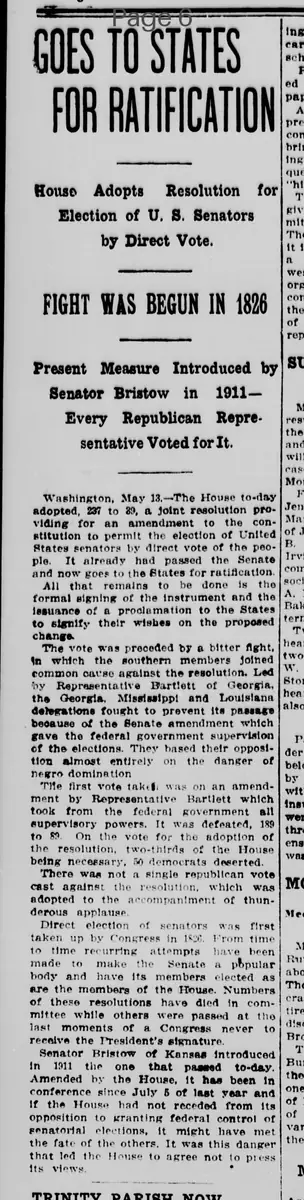
House Adopts Resolution for Election of U. S. Senators by Direct Vote.
FIGHT WAS BEGUN IN 1826
Present Measure Introduced by Senator Bristow in 1911
Every Republican Representative Voted for It.
Washington, May 13.—The House to-day adopted, 237 to 89, a joint resolution providing for an amendment to the constitution to permit the election of United States senators by direct vote of the people. It already had passed the Senate and now goes to the States for ratification.
All that remains to be done is the formal signing of the instrument and the issuance of a proclamation to the States to signify their wishes on the proposed change.
The vote was preceded by a bitter fight. In which the southern members joined common cause against the resolution. Led by Representative Bartlett of Georgia, the Georgia, Mississippi and Louisiana delegations fought to prevent its passage because of the Senate amendment which gave the federal government supervision of the elections. They based their opposition almost entirely on the danger of negro domination.
This first vote taken was on an amendment by Representative Bartlett which took from the federal government all supervisory powers. It was defeated, 189 to 137. On the vote for the adoption of the resolution, two-thirds of the House being necessary, 50 democrats deserted.
There was not a single republican vote cast against the resolution, which was adopted to the accompaniment of thunderous applause.
Direct election of senators was first taken up by Congress in 1826. From time to time recurring attempts have been made to make the Senate a popular body and have its members elected as are the members of the House. Numbers of these resolutions have died in committee while others were passed at the last moments of a Congress never to receive the President's signature.
Senator Bristow of Kansas introduced in 1911 the one that passed to-day. Amended by the House, it has been in conference since July 5 of last year and if the House had not receded from its opposition to granting federal control of senatorial elections, it might have met the fate of the others. It was this danger that led the House to agree not to press its views.
What sub-type of article is it?
What keywords are associated?
What entities or persons were involved?
Where did it happen?
Domestic News Details
Primary Location
Washington
Event Date
May 13
Key Persons
Outcome
adopted by the house 237 to 89; goes to the states for ratification
Event Details
The House adopted a joint resolution providing for a constitutional amendment to permit the election of United States senators by direct vote of the people. It had already passed the Senate. The vote followed a bitter fight, with southern members opposing due to Senate amendment giving federal supervision of elections. Bartlett's amendment to remove federal supervisory powers was defeated 189 to 137. All Republicans voted for it; 50 Democrats deserted. The resolution was introduced by Senator Bristow in 1911 and had been in conference since July 5 of last year.