Thank you for visiting SNEWPapers!
Sign up free
Virginia Argus
Richmond, Virginia
What is this article about?
Coverage from the Virginia Argus of Aaron Burr's 1807 treason trial in Richmond, including the court's opinion on whether certain acts constitute levying war, and detailed proceedings from September 3-8 on evidentiary disputes over Gen. Wilkinson's letters and jury selection challenges.
Merged-components note: Merged continuations of the Aaron Burr trial report across pages 2 and 3 into a single coherent story component.
Clippings
1 of 2
OCR Quality
Full Text
RICHMOND:
WEDNESDAY, SEPTEMBER 9, 1807
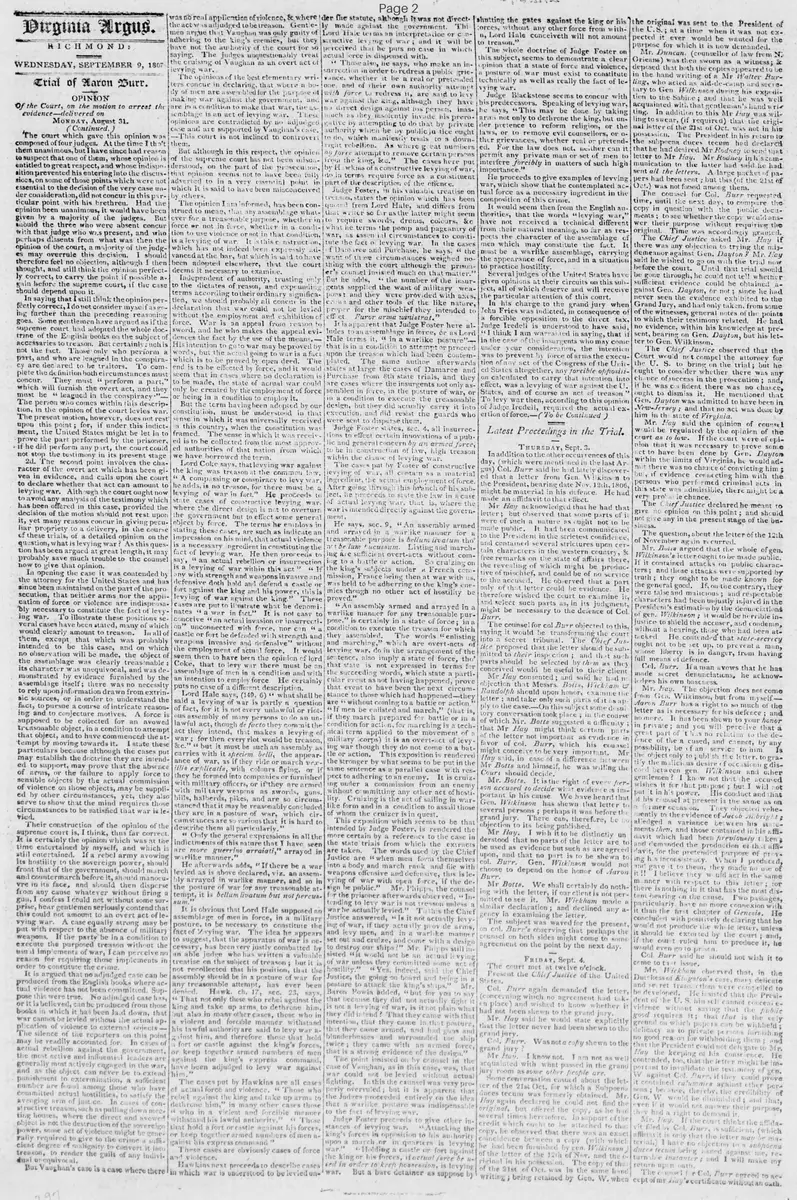
Trial of Aaron Burr.
OPINION
Of the Court, on the motion to arrest the evidence—delivered on
Monday, August 31.
(Continued.)
The court which gave this opinion was composed of four judges. At the time I thought them unanimous, but I have since had reason to suspect that one of them, whose opinion is entitled to great respect, and whose indisposition prevented his entering into the discussion, on some of those points which were not essential to the decision of the very case under consideration, did not concur in this particular point with his brethren. Had the opinion been unanimous, it would have been given by a majority of the judges. But should the three who were absent concur with that judge who was present, and who perhaps dissents from what was then the opinion of the court, a majority of the judges may overrule this decision. I should therefore feel no objection, although I then thought, and still think the opinion perfectly correct, to carry the point if possible again before the supreme court, if the case should depend upon it.
In saying that I still think the opinion perfectly correct, I do not consider myself as going further than the preceding reasoning goes. Some gentlemen have argued as if the supreme court had adopted the whole doctrine of the English books on the subject of accessories to treason. But certainly such is not the fact. Those only who perform a part, and who are leagued in the conspiracy are declared to be traitors. To complete the definition both circumstances must concur. They must "perform a part," which will furnish the overt act, and they must be "leagued in the conspiracy."
The person who comes within this description, in the opinion of the court levies war.
The present motion, however, does not rest upon this point; for, if under this indictment, the United States might be let in to prove the part performed by the prisoner, if he did perform any part, the court could not stop the testimony in its present stage.
2d. The second point involves the character of the overt act which has been given in evidence, and calls upon the court to declare whether that act can amount to levying war. Although the court ought now to avoid any analysis of the testimony which has been offered in this case, provided the decision of the motion should not rest upon it, yet many reasons concur in giving peculiar propriety to a delivery, in the course of these trials, of a detailed opinion on the question, what is levying war? As this question has been argued at great length, it may probably save much trouble to the counsel now to give that opinion.
In opening the case it was contended by the attorney for the United States and has since been maintained on the part of the prosecution, that neither arms nor the application of force or violence are indispensably necessary to constitute the fact of levying war. To illustrate these positions several cases have been stated, many of which would clearly amount to treason. In all of them, except that which was probably intended to be this case, and on which no observation will be made, the object of the assemblage was clearly treasonable: its character was unequivocal, and was demonstrated by evidence furnished by the assemblage itself; there was no necessity to rely upon information drawn from extrinsic sources, or in order to understand the fact, to pursue a course of intricate reasoning and to conjecture motives. A force is supposed to be collected for an avowed treasonable object, in a condition to attempt that object, and to have commenced the attempt by moving towards it. I state these particulars because although the cases put may establish the doctrine they are intended to support, may prove that the absence of arms, or the failure to apply force to sensible objects by the actual commission of violence on those objects, may be supplied by other circumstances, yet, they also serve to show that the mind requires those circumstances to be satisfied that war is levied.
Their construction of the opinion of the supreme court is, I think, thus far correct. It is certainly the opinion which was at the time entertained by myself, and which is still entertained. If a rebel army avowing its hostility to the sovereign power, should front that of the government, should march and countermarch before it, should manoeuvre in its face, and should then disperse from any cause whatever without firing a gun, I confess I could not without some surprise, hear gentlemen seriously contend that this could not amount to an overt act of levying war. A case equally strong may be put with respect to the absence of military weapons. If the party be in a condition to execute the purposed treason without the usual implements of war, I can perceive no reason for requiring those implements in order to constitute the crime.
It is argued that no adjudged case can be produced from the English books where actual violence has not been committed. Suppose this were true. No adjudged case has, or it is believed, can be produced from those books in which it has been laid down, that war cannot be levied without the actual application of violence to external objects. The silence of the reporters on this point may be readily accounted for. In cases of actual rebellion against the government, the most active and influential leaders are generally most actively engaged in the war, and as the object can never be to extend punishment to extermination, a sufficient number are found among those who have committed actual hostilities, to satisfy the avenging arm of justice. In cases of constructive treason, such as pulling down meeting houses, where the direct and avowed object is not the destruction of the sovereign power, some act of violence might be generally required to give to the crime a sufficient degree of malignity to convert it into treason, to render the guilt of any individual unequivocal.
But Vaughan's case is a case where there was no real application of violence, & where the act was adjudged to be treason. Gentlemen argue that Vaughan was only guilty of adhering to the king's enemies, but they have not the authority of the court for so saying. The judges unquestionably treat the cruising of Vaughan as an overt act of levying war.
The opinions of the best elementary writers concur in declaring, that where a body of men are assembled for the purpose of making war against the government, and are in a condition to make that war, the assemblage is an act of levying war. These opinions are contradicted by no adjudged case and are supported by Vaughan's case. This court is not inclined to controvert them.
But although in this respect, the opinion of the supreme court has not been misunderstood, on the part of the prosecution, that opinion seems not to have been fully adverted to in a very essential point in which it is said to have been misconceived by others.
The opinion I am informed, has been construed to mean, that any assemblage whatever for a treasonable purpose, whether in force or not in force, whether in a condition to use violence or not in that condition, is a levying of war. It is this construction, which has not indeed been expressly advanced at the bar, but which is said to have been adopted elsewhere, that the court deems it necessary to examine.
Independent of authority, trusting only to the dictates of reason, and expounding terms according to their ordinary signification, we should probably all concur in the declaration that war could not be levied without the employment and exhibition of force. War is an appeal from reason to sword, and he who makes the appeal evidences the fact by the use of the means. His intention to go to war may be proved by words, but the actual going to war is a fact which is to be proved by open deed. The end is to be effected by force, and it would seem that in cases where no declaration is to be made, the state of actual war could only be created by the employment of force or being in a condition to employ it.
But the term having been adopted by our constitution, must be understood in that sense in which it was universally received in this country, when the constitution was framed. The sense in which it was received is to be collected from the most approved authorities of that nation from which we have borrowed the term.
Lord Coke says, that levying war against the king was treason at the common law. "A compassing or conspiracy to levy war," he adds, is no treason, for there must be a levying of war in fact." He proceeds to state cases of constructive levying war, where the direct design is not to overturn the government but to effect some general object by force. The terms he employs in stating these cases, are such as indicate an impression on his mind, that actual violence is a necessary ingredient in constituting the fact of levying war. He then proceeds to say, "an actual rebellion or insurrection is a levying of war within this act" "If any with strength and weapons invasive and defensive doth hold and defend a castle or fort against the king and his power, this is levying of war against the king." These cases are put to illustrate what he denominates "a war in fact." It is not easy to conceive "an actual invasion or insurrection" unconnected with force, nor can "a castle or fort be defended with strength and weapons invasive and defensive" without the employment of actual force. It would seem then to have been the opinion of Lord Coke, that to levy war there must be an assemblage of men in a condition and with an intention to employ force He certainly puts no case of a different description.
Lord Hale says, (149, 6) "what shall be said a levying of war is partly a question of fact, for it is not every unlawful or riotous assembly of many persons to do an unlawful act, though de facto they commit the act they intend, that makes a levying of war ; for then every riot would be treason, &c." but it must be such an assembly as carries with it sheciem belli, the appearance of war, as if they ride or march vexillis ex/licatis, with colours flying, or if they be formed into companies or furnished with military officers, or if they are armed with mil tary weapons as swords, guns. bills, halberds, pikes, and are so circumstanced that it may be reasonably concluded they are in a posture of war, which circumstances are so various that it is hard to describe them all particularly."
"Only the general expressions in all the indictments of this nature that I have seen are more guerrino arraiati," arrayed in warlike manner."
He afterwards adds, "If there be a war levied as is above declared, viz. an assembly arrayed in warlike manner, and so in the posture of war for any treasonable attempt, it is bellum livatum but not fiercussum."
It is obvious that Lord Hale supposed an assemblage of men in force, in a military posture, to be necessary to constitute the fact of levying war. The idea he appears to suggest, that the apparatus of war is necessary, has been very justly combatted by an able judge who has written a valuable treatise on the subject of treason; but it is not recollected that his position, that the assembly should be in a posture of war for any treasonable attempt, has ever been denied. Hawk. ch. 17, sec. 23, says,
"That not only those who rebel against the king and take up arms to dethrone him, but also in many other cases, those who in a violent and forcible manner withstand his lawful authority are said to levy war against him, and therefore those that hold "fort or castle against the king's forces, or keep together armed numbers of men against the king's express command, have been adjudged to levy war against him."
The cases put by Hawkins are all cases of actual force and violence. "Those who rebel against the king and take up arms to dethrone him," in many other cases those "who in a violent and forcible manner withstand his lawful authority." "Those that hold a fort or castle against his forces, or keep together armed numbers of men against his express command"
These cases are obviously cases of force and violence.
Hawkins next proceeds to describe cases in which war is understood to be levied under the statute, although it was not direct. This Lord Hale terms an interpretation or constructive levying of war ; and it will be perceived that he puts no case in which actual force is dispensed with.
"Those also, he says, who make an insurrection in order to redress a public grievance, whether it be a real or pretended one. and of their own authority attempt with force to redress it, are said to levy war against the king, although they have no direct design against his person, inasmuch as they insolently invade his prerogative by attempting to do that by private authority which he by public justice ought to do, which manifestly tends to a downright rebellion. As where great numbers by force attempt to remove certain persons from the king, &c." The cases here put by Hawkins of a constructive levying of war, do in terms require force as a constituent part of the description: of the offence.
Judge Foster, in his valuable treatise on treason, states the opinion which has been quoted from Lord Hale, and differs from that writer so far as the latter might seem to require swords, drums, colours, &c what he terms the pomp and pageantry of war, as essential circumstances to constitute the fact of levying war. In the cases of Damaree and Purchase, he says. "the want of these circumstances weighed nothing with the court although the prisoner's counsel insisted much on that matter."
But he adds. "the number of the insurgents supplied the want of military weapons: and they were provided with axes, crous and other tools of the like nature, proper for the mischief they intended to effect Furor arma ministrat."
It is apparent that Judge Foster here alludes to an assemblage in force, or as Lord Hale terms it, "in a warlike posture"... that is in a condition to attempt or proceed upon the treason which had been contemplated. The same author afterwards states at large the cases of Damaree and Purchase from 8th state trials, and they are cases where the insurgents not only assembled in force, in the posture of war, or in a condition to execute the treasonable design, but they did actually carry it into execution, and did resist the guards who were sent to disperse them.
Judge Foster states, sec. 4, all insurrections to effect certain innovations of a public and general concern by an armed force, to be in construction of law, high treason within the clause of levying war.
The cases put by Foster of constructive levying of war, all contain as a material ingredient, the actual employment of force.
After going through this branch of his subject, he proceeds to state the law in a case of actual levying war. that is, where the war is intended directly against the government.
He says. sec. 9, "An assembly armed and arrayed in a warlike manner for a treasonable purpose is bellum levatum tho not bellum +ucussum. Listing and marching are sufficient overt-acts without coming to a battle or action. So cruising on the king's subjects under a French commission, France being then at war with us, was held to be adhering to the king's enemies though no other act of hostility be proved."
"An assembly armed and arrayed in a warlike manner for any treasonable purpose." is certainly in a state of force; in a condition to execute the treason for which they assembled. The words "enlisting and marching," which are overt-acts of levying war, do in the arrangement of the sentence, also imply a state of force, tho that state is not expressed in terms for the succeeding words, which state a particular event as not having happened, prove that event to have been the next circumstance to those which had happened—they are without coming to a battle or action."
"If men be enlisted and march," (that is, if they march prepared for battle or in a condition for action, for marching is a technical term applied to the movement of a military corps) it is an overt-act of levying war though they do not come to a battle or action." This exposition is rendered the stronger by what seems to be put in the same sentence as a parallel case with respect to adhering to an enemy. It is cruising under a commission from an enemy without committing any other act of hostility. Cruizing is the act of sailing in warlike form and in a condition to assail those of whom the cruizer is in quest.
This exposition which seems to be that intended by Judge Foster, is rendered the more certain by a reference to the case in the state trials from which the extracts are taken. The words used by the Chief Justice are "when men form themselves into a body and march rank and file with weapons offensive and defensive, this is levying of war with open force, if the design be public." Mr. Phipps, the counsel for the prisoner afterwards observed, "Intending to levy war is not treason unless a war be actually levied." To this the Chief Justice answered, "Is it not actually levying of war, if they actually provide arms, and levy men, and in a warlike manner set out and cruize, and come with a design to destroy our ships?" Mr. Phipps still insisted "it would not be an actual levying of war unless they committed some act of hostility." "Yes, indeed," said the Chief Justice, "the going on board and being in a posture to attack the king's ships." Mr. Baron Powis added, "but for you to say that because they did not actually fight it is not a levying of war, is it not plain what they did intend? That they came with that intention, that they came in that posture, that they came armed, and had guns and blunderbusses and surrounded the ship twice; they came with an armed force, that is a strong evidence of the design."
The point insisted on by counsel in the case of Vaughan, as in this case, was, that war could not be levied without actual fighting. In this the counsel was very properly overruled; but it is apparent that the Judges proceeded entirely on the idea that a warlike posture was indispensable to the fact of levying war.
Judge Foster proceeds to give other instances of levying war. "Attacking the king's forces in opposition to his authority upon a march or in quarters is levying war"
Holding a castle or fort against the king or his forces, if actual force be used in order to keep possession, is levying war,
But a bare retainer as suppose by shutting the gates against the king or his forces, without any other force from with-n, Lord Hale conceiveth will not amount to treason.
The whole doctrine of Judge Foster on this subject, seems to demonstrate a clear opinion that a state of force and violence, a posture of war must exist to constitute technically as well as really the fact of levying war.
Judge Blackstone seems to concur with his predecessors. Speaking of levying war, he says, "This may be done by taking arms not only to dethrone the king, but under pretence to reform religion, or the laws, or to remove evil counsellors, or other grievances, whether real or pretended. For the law does not, neither can it permit any private man or set of men to interfere forcibly in matters of such high importance."
He proceeds to give examples of levying war, which show that he contemplated actual force as a necessary ingredient in the composition of this crime.
It would seem then from the English authorities, that the words "levying war," have not received a technical different from their natural meaning, so far as respects the character of the assemblage of men which may constitute the fact. It must be a warlike assemblage, carrying the appearance of force, and in a situation to practice hostility.
Several judges of the United States have given opinions at their circuits on this subject, all of which deserve and will receive the particular attention of this court.
In his charge to the grand jury when John Fries was indicted, in consequence of a forcible opposition to the direct tax, Judge Iredell is understood to have said, "I think I am warranted in saying, that if in the case of the insurgents who may come under your consideration, the intention was to prevent by force of arms the execution of any act of the Congress of the United States altogether, any forcible opposition calculated to carry that intention into effect, was a levying of war against the U. States, and of course an act of treason"
To levy war then, according to this opinion of Judge Iredell, required the actual exertion of force.—(To be Continued)
Latest Proceedings in the Trial.
THURSDAY, Sept. 3.
In addition to the other occurrences of this day, (which were mentioned in the last Argus) Col. Burr said he had lately discovered that a letter from Gen. Wilkinson to the President, bearing date Nov. 12th, 1806, might be material in his defence. He had made an affidavit to that effect.
Mr Hay acknowledged that he had that letter; but observed that some parts of it were of such a nature as ought not to be made public. It had been communicated to the President in the strictest confidence, and contained several strictures upon certain characters in the western country, & free remarks on the state of affairs there, the revealing of which might be productive of mischief, and could be of no service to the accused. He observed that a part only of that letter could be evidence. He therefore wished the court to examine it, and select such parts as, in its judgment, might be necessary to the defence of Col Burr.
The counsel for col Burr objected to this. saying it would be transforming the court into a secret tribunal. The Chief Justice proposed that the letter should be submitted to their inspection ; and that such parts should be selected by them as they conceived would be useful to their client
Mr Hay consented: and said he had no objection that Messrs. Botts, Wickham & Randolph should upon honor, examine the letter : and take only such parts of it as apply to the case.—On this subject some desultory conversation took place ; in the course of which Mr. Botts suggested a difficulty ; that Mr Hay might think certain parts of the letter not important as evidence in favor of col. Burr, which his counsel might conceive to be very important. Mr Hay said, in case of a difference between Mr Botts and himself, he was willing the Court should decide.
Mr. Botts. It is the right of every person accused to decide what evidence is important in his cause We have heard that Gen. Wilkinson has shewn that letter to several persons ; perhaps it was before the grand jury. There can, therefore, be no objection to its being published.
Mr Hay. I wish it to be distinctly understood that no parts of the letter are to be used as evidence but such as are agreed upon, and that no part is to be shewn to col. Burr. Gen. Wilkinson would not choose to depend on the honor of Aaron Burr.
Mr Botts. We shall certainly do nothing with the letter, if our client is not permitted to see it. Mr. Wickham made a similar declaration; and declined any agency in examining the letter.
The subject was waved for the present, on col. Burr's observing that perhaps the counsel on both sides might come to some agreement on the point by the next day.
FRIDAY, Sept. 4.
The court met at twelve o'clock.
Present the Chief Justice of the United States.
Col. Burr again demanded the letter, (concerning which no agreement had taken place) and wished to know whether it had not been shewn to the grand jury.
Mr. Hay said he would state explicitly that the letter never had been shewn to the grand jury.
Col. Burr. Was not a copy shewn to the grand jury ?
Mr Hay. I know not. I am not as well acquainted with what passed in the grand jury room as some other people are.
Some conversation ensued about the letter of the 21st Oct. for which a Subpoena duces tecum was formerly obtained. Mr. Hay again declared he could not find the original, but offered the copy. as he had several times heretofore. In support of the credit which ought to be attached to that copy, he observed that there was an exact Coincidence between a copy. (with which he had been furnished by Gen. Wilkinson of the letter of the 12th of Nov. and the original in his possession. The copy of that of the 21st of Oct. was in the same hand writing; being retained by Gen. W. when the original was sent to the President of the C.S.; at a time when it was not expected it ever would be wanted for the purpose for which it is now demanded.
Mr. Duncan, (counsellor of law from N: Orleans) was then sworn as a witness; & deposed that both the copies appeared to be in the hand writing of a Mr Walter Burling, who acted as aid-de-camp and secretary to Gen Wilkinson during his expedition to the Sabine; and that he was well acquainted with that gentleman's hand writing. In addition to this Mr Hay was willing to swear, (if required) that the original letter of the 21st of Oct. was not in his possession. The President in his return to the subpoena duces tecum had declared that he had desired Mr Rodney to send that letter to Mr Hay. Mr Rodney in his communication to the latter had said he had sent all the letters. A large packet of papers had been sent ; but this (of the 21st of Oct.) was not found among them.
The counsel for Col. Burr requested time, until the next day, to compare the copy in question with the public documents; to see whether the copy would answer their purpose without requiring the original. Time was accordingly granted.
The Chief Justice asked Mr. Hay if there was any objection to trying the misdemeanor against Gen. Dayton ? Mr. Hay said he wished to go on with the trial now before the court. Until that trial should be gone through, he could not tell whether sufficient evidence could be obtained against Gen. Dayton, or not; since he had never seen the evidence exhibited to the Grand Jury, and had only taken, from some of the witnesses, general notes of the points to which their testimony related. He had no evidence, within his knowledge at present, bearing on Gen. Dayton, but his letter to Gen. Wilkinson.
The Chief Justice observed that the Court would not compel the attorney for the U. S. to bring on the trial; but he ought to consider whether there was any chance of success in the prosecution; and, if he was confident there was no chance, ought to dismiss it. He mentioned that Gen. Dayton was admitted to have been in New-Jersey ; and that no act was done by him in the state of Virginia.
Mr. Hay said the opinion of counsel would be regulated by the opinion of the court as to law. If the court were of opinion that it was necessary to prove some act to have been done by Gen. Dayton within the limits of Virginia, he would admit there was no chance of convicting him; but, if evidence connecting him with the persons who performed criminal acts in this state was admissible, there might be a very probable chance.
The Chief Justice declared he meant to give no opinion on this point; and should not give any in the present stage of the business.
The question, about the letter of the 12th of November again recurred.
Mr. Botts argued that the whole of Gen. Wilkinson's letter ought to be made public. If it contained attacks on public characters; and those attacks were supported by truth; they ought to be made known for the general good. If, on the contrary, they were false and malicious; and respectable characters had been unjustly injured in the President's estimation by the denunciations of Gen. Wilkinson ; it would be horrible injustice to shield the accuser, and condemn, without a hearing, those who had been attacked He contended that state-secrecy ought not to be set up, to prevent a man, whose liberty is in danger, from having full means of defence.
Col. Burr. If a man avows that he has made secret denunciations, he acknowledges his own baseness.
Mr. Hay. The objection does not come from Gen. Wilkinson, but from myself. Aaron Burr has a right to so much of the letter as is necessary for his defence; and no more. It has been shewn to your honor in private; and you will perceive that a great part of it has no relation to the defence of the accused, and cannot, by any possibility, be of any service to him Is the object only to publish the letter, to gratify the malicious desire of occasioning discord between Gen Wilkinson and other gentlemen? I know not that he wishes it for that purpose; but I will not put it in his power. His conduct and that of his counsel at present is the same as on a former occasion. They objected vehemently to the evidence of Jacob Bright; alledged a variance between his statements then, and those contained in his affidavit which had been previously taken; and demanded the production of that affidavit, for the pretended purpose of proving his inconsistency. When I produced, and gave it to them, they made no use of it !! I believe they would act in the same manner with respect to this letter; for there is nothing in it that has the most distant bearing on the cause. Two passages, particularly have no more connexion with it than the first chapter of Genesis. He concluded with positively declaring that he would not produce the whole letter, unless it should be extorted by the court ; and, if the court ruled him to produce it, he would even go to prison.
Col. Burr said he should not wish it to come to that issue.
Mr. Wickham observed that, in the Duchess of Kingston's case, many delicate and secret transactions were compelled to be developed. He insisted that the President of the U. S. himself cannot conceal evidence without saying that the Public good requires it; that that is the only ground on which papers can be withheld; delicacy as to private persons furnishing no good reason for withholding them; and that the President could not delegate to Mr. Hay the keeping of his conscience. He contended, too, that the letter might be important to invalidate the testimony of Gen. W against Col Burr, if they could prove it contained calumnies against other persons ; because, thereby, the credibility of Gen. W would be diminished; and that, even if it would not answer their purpose, they had a right to demand it
Mr. Hay. If the court thinks the affidavit filed by Col. Burr, is sufficient, (which affidavit is only that the letter may be material,) I have no objection to a subpoena duces tecum being issued against me, returnable in an hour; and I will make my return upon oath.
The counsel for Col. Burr agreed to accept of Mr Hay's certificate without an oath.
The Chief Justice. It is not necessary, Mr. Hay, for you to state that certain parts of the letter are withheld. The subpoena duces tecum is only to bring the paper into court. Whether you have a right to withhold any part of it from the jury, is a question which will occur hereafter.
Mr. Hay insisted that the following should be received as his return in writing: which was agreed to.
I hereby acknowledge service of the above subpoena, and herewith return a correct and true copy of the letter mentioned in the same, dated 12th Nov. 1806, excepting such parts thereof as are, in my opinion, not material for the purposes of justice, for the defence of the accused, or pertinent to the issue now about to be joined: the parts excepted being confidentially communicated to the President, and he having devolved on me the exercise of that discretion which constitutionally belongs to himself. The accuracy of this opinion I am willing to refer to the judgment of the Court, by submitting the original letter to its inspection. I further certify, in order to shew, more clearly, the irrelevancy of the parts excepted, to any defence which can be set up in the present case, that those parts contain a communication of the opinion of the writer concerning certain persons; about which opinion, or the fact of his having communicated it, the writer, if a witness before the court, could not legally, as I conceive, be interrogated, and about which no evidence could legally be received from other persons.
GEORGE HAY.
He then offered to read such parts of the letter as were proper for public view; in order to shew the total irrelevancy to the defence of Aaron Burr, even of those parts.
The counsel on the other side would not permit them to be read.
Mr. Botts said it would be painful for them to move for an attachment against Mr. Hay. Another alternative was to make a motion, that the cause should stand continued until the whole letter should be produced.
On this motion an able and animated discussion ensued; conducted by Messrs. Botts & Wickham on one side, and Messrs. McRae and Wirt on the other.
On the part of Col. Burr, it was contended that the Attorney for the U. S. had no discretion to withhold the paper; and that the court had no right to judge in secret upon it. The Attorney for the U. S. ought not to have that discretion; because from the nature of his office, he was inclined against the accused, and wished to have him convicted. The President could not delegate this power to him, even if he possessed it himself. The court ought not to assume the power of examining the paper & judging whether it should be produced; because the counsel for the prisoner would not be possessed of the means of arguing on the opinion to be formed by the court; which they had a right to do.
It was urged that Col. Burr believed that the parts of the letter which were attempted to be withheld were important to his defence; but that the parts which Mr. Hay was willing to shew were unimportant; that in a government like ours, of responsibility, it is nothing of a domestic nature ought to be concealed; and that justice ought not to yield to a delicacy.
The counsel for the U. S. insisted that the affidavit of the accused (that the letter may be material) was too vague and uncertain to furnish a reason for compelling its production; that Mr. Hay's return (which was to be considered as being on oath) shewed that the letter ought not now to be considered as material; since his solemn and positive declarations ought to outweigh the doubtful suppositions or surmises of Col. Burr; that the arguments on the other side only tended to shew what the counsel for the U. S. admitted, that the paper ought not to be withheld, if it was necessary or material to the defence of the prisoner; but, since it related altogether to other persons, and could not be useful for his defence, they contend he had no right to demand it; that the letter having been confidentially written to the President of the U. S. the President had a right to withhold it under the circumstances of this case, and to delegate the power of acting in his stead to Mr. Hay, which he had done; that as the court could not perceive the irrelevancy of the letter to the case of Col. Burr, and of course, the impropriety of its being produced on his motion--it became necessary for the court to read and judge of it, before it could be shewn to him and his counsel; which (if an inconvenience) was unavoidable.
In the course of this debate, Mr. Wickham said that the high trust which the people reposed in the virtues, intelligence and patriotism of the President of the U. S. could not be transferred to Mr. Hay. He meant no disrespect to that gentleman by saying so; but the President, by virtue of his office, was presumed to be superior in talents & every other great qualification to the Attorney for the Virginia District.
Mr. Wirt, in his reply, observed, that the immense inferiority of Mr. Hay (the counsel who here represented the President of the United States) to that exalted character, was readily acknowledged and, in like manner, he would not pretend to say that there was any comparison between the great Aaron Burr, and his representative, Mr. Wickham, in genius, in eloquence, in integrity, and in pure patriotism!
A few minutes before 5 o'clock, the Chief Justice decided that, under the circumstances of this case, it was not in the power of the court to say that the letter should not be produced; that the reasons assigned for withholding it were not sufficient, and that, if it were not produced, the court must either take measures to compel a compliance with its process, or continue the cause. With respect to such parts as were deemed confidential, the court would take measures to prevent their being made public, by providing that no copies should be taken; that no use should be made of the letter, except in relation to the trial; that it should not go out of court; and that those persons who take notes of the proceedings were not to consider themselves at liberty to publish any part of that letter. He concluded by saying that the production of the letter in court might contribute to remove many of those suspicions which its suppression would infallibly excite.
The court then adjourned until Saturday 12 o'clock.
SATURDAY, September 5.
Mr. Hay wished to extend the terms of his return on the subpoena duces tecum; and offered the following addition to the return:
I hereby certify that, upon a more minute examination of the letter above-mentioned, I have observed other passages which are entirely of a public nature, and which, according to my best judgment, ought not to be disclosed, and which, I conceive, would not be disclosed by the President himself, if the return were to be made by him.
GEO: HAY.
He observed that he did not think himself authorised to disclose such parts of the letter as the president himself would refuse, and proposed to send an express to the President, who is now at Monticello, to consult him on the subject. The express might return by Tuesday, at which time the trial could perhaps proceed.
Col. Burr said he tho't it probable some arrangement could be made among the counsel by which the trial might take place on Monday. If the panel of the jury should be approved of, perhaps he might waive insisting on the production of the letter.
Mr. Hay declared that, no other arrangement could be made but that of furnishing a copy of such parts as were proper for the public eye.
The Chief Justice said that, as to such parts as were considered to be secrets of state, they certainly could not be compelled to be produced.
Mr. Martin. We can compel the President to appear and produce the whole letter!
Mr. Botts observed, he wished Mr. Hay to understand that the counsel for Col. Burr did not mean to commit themselves absolutely. They were willing to go to trial under the prospect that the letter might be furnished by the time it would be wanting in the course of proceeding; but, if it should be ultimately withheld, they meant to reserve the right of insisting hereafter on its production.
Col. Burr: At present I know of no objection to the trial on Monday.
Mr. Martin mentioned the case of Israel Smith. Mr. Hay, under the opinion of the court heretofore pronounced, entered a nolle prosequi on the indictment against Mr. Smith, for the treason charged to have been committed in Virginia.
The session of the court was suspended till half after 2 o'clock; at which time bail was to be offered by Col. Burr. Gen. Jonathan Dayton of New-Jersey, and Major Thomas Langston of this city, were accepted as his bail.
The court then adjourned until Monday 10 o'clock.
Monday, Sept. 7.
Mr. Botts observed, the court would recollect that, when the motion was made for a continuance, counsel for Col. Burr deprecated the serious inconvenience of delay. It was to be regretted that they should be driven into trial without the letter; but as it might probably be received in the course of the trial, they would consent to begin it.
Mr. Hay: I should not wish the trial to be gone into with such a declaration on the part of the accused. I have sent an express to Monticello, and expect him to return by to-morrow 12 o'clock. I therefore, wish the jury not to be fully sworn to-day.
The Chief Justice. There is no necessity for delay on that account. As the paper will probably be here by the time it is wanting (which will not be the case until the defence is opened) the trial had better now be commenced.
Mr. Hay: I wish every preparation for the trial to be made to day, but that it may not commence until to-morrow. I expect some communication from the President, which may have considerable influence on me, with respect to my conduct in the trial.
A Nolle Prosequi was entered on the indictment for treason against Herman Blennerhassett: and Dudley Woodbridge of Marietta (state of Ohio) was accepted as his bail. The sum in which they were each bound was five thousand dollars.
The jury summoned to try Aaron Burr on the indictment for a misdemeanor were called over.
Mr. Orris Paine being called, Mr. Hay stated that he was a very near connexion of his. He had frequently heard him express opinions on the subject. Col. Burr said he might get a worse man. Mr. Hay was certain he could not get a better; but, through motives of delicacy, wished him to be excused. He was set aside for the present.
Mr. Thomas Underwood, sen. was challenged by the accused. The Chief Justice. No peremptory challenge is allowed in this case. Col. Burr. I admit it; but I understand this gentleman has formed and expressed opinions unfavorable to me. Mr. Underwood. It is very true. I have formed and expressed opinions very unfavorable to you. He was rejected.
Mr. Nicholas Hatton was excused on account of his bad state of health, and being engaged in public business.
Messrs. James Boutright and Obadiah Gathright were accepted, without objection, or examination.
Mr. John Murphy was asked by Col. Burr if he had formed any opinion on his case. He answered he did not recollect that he had ever expressed one; but it was more than probable; as there were few persons who had not. He was accepted.
Mr. Burd Pearce wished to be excused on account of his health; having then a high fever. Col. Burr observed that perhaps he might be better to morrow. The Chief Justice. If he is not sick to-morrow, he will attend. If he does not attend, however, his non-attendance will not be noticed by the court.
Mr. William Vice was objected to by Col. Burr, on the ground that he had formed opinions against him. He acknowledged he had done so, and had probably expressed them. He was therefore rejected.
Mr. John J. Rae was excused on motives of delicacy; being the brother of one of the counsel for the United States.
Mr. Francis K. Walker (of Mecklenburg county) was challenged by Col. Burr. He said he was about to make objections to himself. He believed the plans generally attributed to Col. Burr (of a design to seize New-Orleans, and invade Mexico) were his real plans. Mr. Walker was rejected.
Mr. Benjamin J. Harris being called, Col. Burr observed that the gentleman was a stranger to him. He would rely on his candor to say whether he had imbibed prejudices against him. Mr. Harris said, that from what he had heard, he was impressed with a belief there was something improper. He had strong impressions, and still retained them. He was rejected.
Mr. Jacob Ege was considered by Col. Burr to have imbibed strong prejudices against him. He acknowledged that he had imbibed, and had also expressed them. He was therefore rejected.
A Mr. Williams was set aside, being not a freeholder.
Mr. Robert Adams was rejected on the same grounds with Mr. Ege.
Col. Nathaniel Wilkinson of Henrico being called, was asked by Col. Burr whether he had imbibed a prejudice against him. He answered I have—Col. Burr: A strong one? A. Very strong.—Q. do you still retain it? A. Yes. I am only sorry that I can't have a touch at you for the Treason.
Mr. Abraham Corley, a Mr. Tucker, and Mr. James Whitlaw severally made objections to themselves, on the ground that they had formed and freely expressed very unfavourable opinions of the accused. They were excused from serving.
Col. William Bentley of Powhatan, Mr. Yeamans Smith and Mr. Richard Young were accepted by Col. Burr, without objection, or examination.
Mr. John Underwood was excused: having been three months absent from his family on a journey to Kentucky, and being now on his return.
Mr. John Austin declared he had a strong prejudice against Col. Burr; having heard that he went in disguise. He had said that no good man could do so.—It would be difficult to remove his impressions.—He was excused.
Mr. Joseph P. Owen was set aside for the present: having been summoned as a Juror to attend the District Court of Richmond now sitting.
The Jury not being completed, the Court adjourned until Tuesday, one o'clock P. M. to enable Mr. Hay to receive the communication expected from the President of the U. S. before its session should again commence.
TUESDAY, September 8.
The weather being very wet; (which it is supposed prevented some of the persons summoned on Monday as jurors from attending to day;) it being found very difficult to get a sufficient number who had not formed and declared opinions unfavorable to Col. Burr, to constitute a jury; and the express, which Mr. Hay had sent to the President of the United States, not having returned; the trial was postponed.
A small progress was made in getting the jury; Messrs. Carter Berkley and Robert M'Kim (the former declaring that he had formed no definitive opinion, and the latter that he had formed none at all, as to the guilt or innocence of the accused,) being added to the list of persons accepted as jurors.
Messrs. Daniel Price, John Richard, John Harris, William M'Kim, Joseph Mano, Robert Hight, Benjamin Stetson and George W. Dixon were severally rejected on the ground that they had formed and expressed opinions unfavorable to the accused.
Mr. Israel Smith was admitted to bail; and entered into a recognizance, in the sum of five thousand dollars; with John B. Walton and John Alcock his securities, in the sum of two thousand five hundred dollars each.
The court adjourned; to sit again on this day (Wednesday) at eleven o'clock.
What sub-type of article is it?
What themes does it cover?
What keywords are associated?
What entities or persons were involved?
Where did it happen?
Story Details
Key Persons
Location
Richmond, Virginia
Event Date
1807 08 31 To 1807 09 08
Story Details
The article details the Circuit Court's opinion on the definition of 'levying war' in treason cases, citing English authorities and U.S. precedents, emphasizing the need for force or warlike posture. It then reports daily trial proceedings, including disputes over producing Gen. Wilkinson's confidential letters to the President, authentication of copies, discussions on trying Gen. Dayton, and challenges during jury selection for the misdemeanor charge, with many potential jurors excused due to preconceived opinions against Burr.