Thank you for visiting SNEWPapers!
Sign up free
Virginia Argus
Richmond, Virginia
What is this article about?
U.S. Congress debates and passes a bill to enforce the embargo, with Senate agreeing to House amendments on January 7 and House voting 71-32 in favor after extensive debate on January 5. Additional resolution on earlier Congress meeting agreed to 62-21 on December 7.
Merged-components note: Continuation of congressional proceedings from page 1 to page 2, with sequential reading order and text flow indicating a single logical unit.
Clippings
1 of 2
OCR Quality
Full Text
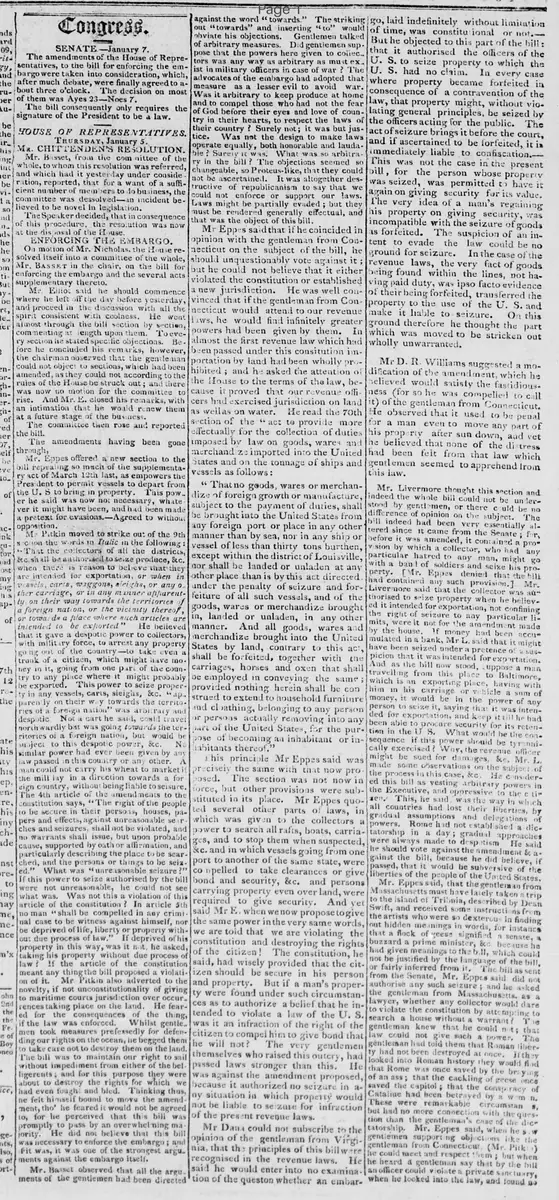
SENATE.—January 7.
The amendments of the House of Representatives, to the bill for enforcing the embargo were taken into consideration, which, after much debate, were finally agreed to about three o'clock. The decision on most of them was Ayes 23—Noes 7.
The bill consequently only requires the signature of the President to be a law.
HOUSE OF REPRESENTATIVES.
Thursday, January 5.
MR. CHITTENDEN'S RESOLUTION.
Mr. Basset, from the committee of the whole, to whom this resolution was referred, and which had it yesterday under considerations, reported, that for a want of a sufficient number of members to do business, the committee was dissolved—an incident believed to be novel in legislation.
The Speaker decided, that in consequence of this procedure, the resolution was now at the disposal of the House.
ENFORCING THE EMBARGO.
On motion of Mr. Nicholas, the House resolved itself into a committee of the whole, Mr. Bassett in the chair, on the bill for enforcing the embargo and the several acts supplementary thereto.
Mr. Elliott said he should commence where he left off the day before yesterday, and proceed in the discussion with all the spirit consistent with coolness. He went almost through the bill section by section, commenting at length upon them. To every section he stated specific objections. Before he concluded his remarks, however, the chairman observed that the gentleman could not object to sections, which had been amended, as they could not according to the rules of the House be struck out; and there was now no motion for the committee to rise. And Mr. E. closed his remarks, with an intimation that he would renew them at a future stage of the business.
The committee then rose and reported the bill.
The amendments having been gone through,
Mr. Eppes offered a new section to the bill repealing so much of the supplementary act of March 12th last, as empowers the President to permit vessels to depart from the U. S. to bring in property. This power he said was now not necessary, whatever it might have been, and had been made a pretext for evasions.—Agreed to without opposition.
Mr. Pitkin moved to strike out of the 9th section the words in Italic in the following:
"That the collectors of all the districts, &cc. shall be authorized to seize produce, &c. when there is reason to believe that they are intended for exportation, or when in vessels, carts, waggons, sleighs, or any other carriage, or in any manner apparently on their way towards the territories of a foreign nation, or the vicinity thereof, or towards a place where such articles are intended to be exported" He believed that it gave a despotic power to collectors, with military force, to arrest any property going out of the country—to take even a trunk of a citizen, which might have money in it, going from one part of the country to any place where it might probably be exported. This power to seize property in any vessels, carts, sleighs, &c. "apparently on their way towards the territories of a foreign nation" was arbitrary and despotic Not a cart he said, could travel northwardly but was going towards the territories of a foreign nation, but would be subject to this despotic power, &c. No similar power had ever been given by any law passed in this country or any other. A man could not carry his wheat to market if the mill lay in a direction towards a foreign country, without being liable to seizure.
The 4th article of the amendments to the constitution says, "The right of the people to be secure in their persons, houses, papers and effects, against unreasonable searches and seizures, shall not be violated, and no warrants shall issue, but upon probable cause, supported by oath or affirmation, and particularly describing the place to be searched, and the persons or things to be seized." What was "unreasonable seizure?" If this power to seize authorized by the bill were not unreasonable, he could not see what was. Was not this a violation of this article of the constitution? In article 5th no man "shall be compelled in any criminal case to be witness against himself, nor be deprived of life, liberty or property without due process of law." "If deprived of his property in this way, was it not, he asked, taking his property without due process of law? If the article of the constitution meant any thing the bill proposed a violation of it. Mr Pitkin also adverted to the novelty, if not unconstitutionality of giving to maritime courts jurisdiction over occurrences taking place on the land. He feared for the consequences of the thing, if the law was enforced. Whilst gentlemen took measures professedly for defending our rights on the ocean, he begged them to take care not to destroy them on the land.
The bill was to maintain our right to sail without impediment from either of the belligerents; and for this purpose they were about to destroy the rights for which we had even fought and bled. Thinking thus, he felt himself bound to move the amendment, tho' he feared it would not be agreed to, for he perceived that this bill was promptly to pass by an overwhelming majority. He did not believe that this bill was necessary to enforce the embargo; and if it was, it was one of the strongest arguments against the embargo itself.
Mr. Basset observed that all the arguments of the gentlemen had been directed against the word "towards." The striking out "towards" and inserting "to" would obviate his objections.
Gentlemen talked of arbitrary measures. Did gentlemen suppose that the powers here given to collectors was any way as arbitrary as must exist in military officers in case of war? The advocates of the embargo had adopted that measure as a lesser evil to avoid war.
Was it arbitrary to keep produce at home and to compel those who had not the fear of God before their eyes and love of country in their hearts, to respect the laws of their country? Surely not: it was but justice. Was not the design to make laws operate equally, both honorable and laudable? Surely it was. What was so arbitrary in the bill? The objections seemed so changeable, so Proteus-like, that they could not be ascertained. It was altogether destructive of republicanism to say that we could not enforce or support our laws.
Laws might be partially evaded; but they must be rendered generally effectual, and that was the object of this bill.
Mr Eppes said that if he coincided in opinion with the gentleman from Connecticut on the subject of the bill, he should unquestionably vote against it; but he could not believe that it either violated the constitution or established a new jurisdiction. He was well convinced that if the gentleman from Connecticut would attend to our revenue laws, he would find infinitely greater powers had been given by them. In almost the first revenue law which had been passed under this constitution importation by land had been wholly prohibited: and he asked the attention of the House to the terms of the law, because it proved that our revenue officers had exercised jurisdiction on land as well as on water. He read the 70th section of the "act to provide more effectually for the collection of duties imposed by law on goods, wares and merchandize imported into the United States and on the tonnage of ships and vessels as follows:
"That no goods, wares or merchandize of foreign growth or manufacture, subject to the payment of duties, shall be brought into the United States from any foreign port or place in any other manner than by sea, nor in any ship or vessel of less than thirty tons burthen, except within the district of Louisville, nor shall be landed or unladen at any other place than is by this act directed. under the penalty of seizure and forfeiture of all such vessels, and of the goods, wares or merchandize brought in, landed or unladen, in any other manner. And all goods, wares and merchandize brought into the United States by land, contrary to this act, shall be forfeited, together with the carriages, horses and oxen that shall be employed in conveying the same; provided nothing herein shall be construed to extend to household furniture and clothing, belonging to any person or persons actually removing into any part of the United States, for the purpose of becoming an inhabitant or inhabitants thereof."
This principle Mr Eppes said was precisely the same with that now proposed. The section was not now in force, but other provisions were substituted in its place. Mr Eppes quoted several other parts of laws, in which was given to the collectors a power to search all rafts, boats, carriages, and to stop them when suspected, &c. and in which vessels going from one port to another of the same state, were compelled to take clearances or give bond and security, &c. and persons carrying property even over land, were required to give security. And yet said Mr E. when we now propose to give the same power in the very same words, we are told that we are violating the constitution and destroying the rights of the citizen! The constitution, he said, had wisely provided that the citizen should be secure in his person and property. But if a man's property were found under such circumstances as to authorize a belief that he intended to violate a law of the U. S. was it an infraction of the right of the citizen to compel him to give bond that he will not?" The very gentlemen themselves who raised this outcry, had passed laws stronger than this. He was against the amendment proposed, because it authorized no seizure in any situation in which property would not be liable to seizure for infraction of the present revenue laws.
Mr Dana could not subscribe to the opinion of the gentleman from Virginia, that the principles of this bill were recognised in the revenue laws. He said he would enter into no examination of the question whether an embargo, laid indefinitely without limitation of time, was constitutional or not.—But he objected to this part of the bill: that it authorized the officers of the U. S. to seize property to which the U. S. had no claim. In every case where property became forfeited in consequence of a contravention of the law, that property might, without violating general principles, be seized by the officers acting for the public. The act of seizure brings it before the court, and if ascertained to be forfeited, it is immediately liable to confiscation.—This was not the case in the present bill, for the person whose property was seized, was permitted to have it again on giving security for its value.
The very idea of a man's regaining his property on giving security, was incompatible with the seizure of goods as forfeited. The suspicion of an intent to evade the law could be no ground for seizure. In the case of the revenue laws, the very fact of goods being found within the lines, not having paid duty, was ipso facto evidence of their being forfeited, transferred the property to the use of the U. S. and make it liable to seizure. On this ground therefore he thought the part which was moved to be stricken out wholly unwarranted.
Mr D. R. Williams suggested a modification of the amendment, which he believed would satisfy the fastidiousness (for so he was compelled to call it) of the gentleman from Connecticut.
He observed that it used to be penal for a man even to move any part of his property after sun down, and yet he believed that none of the distress had been felt from that law which gentlemen seemed to apprehend from this law.
Mr. Livermore thought this section and indeed the whole bill could not be understood by gentlemen, or there could be no difference of opinion on the subject. The bill indeed had been very essentially altered since it came from the Senate; for, before it was amended, it contained a provision by which a collector, who had any particular hatred to any man, might go with a band of soldiers and seize his property. [Mr. Eppes denied that the bill had contained any such provision.] Mr. Livermore said that the collector was authorized to seize property when he believed it intended for exportation, not confining the right of seizure to any particular limits, were it not for the amendment made by the house. If money had been accumulated in a bank, Mr L. said that it might have been seized under a pretence of a suspicion that it was intended for exportation.
And as the bill now stood, suppose a man travelling from this place to Baltimore, which is an exporting place, having with him in his carriage or vehicle a sum of money, it would be in the power of any person to seize it, saying that it was intended for exportation, and keep it till he had been able to procure security for its retention in the U S. What would be the consequence if this power should be tyrannically exercised? Why, the revenue officer might be sued for damages, &c. Mr. L. made some observations on the subject of the process in this case, &c. He considered this bill as vesting arbitrary powers in the Executive, and oppressive to the citizen. This, he said, "was the way in which all countries had lost their liberties, by gradual assumptions and delegations of powers. Rome had not established a dictatorship in a day; gradual approaches were always made to despotism He said he should vote against the amendment & against the bill, because he did believe, if passed, that it would be subversive of the liberties of the people of the United States.
Mr. Eppes said, that the gentleman from Massachusetts must have lately taken a trip to the island of Tribnia, described by Dean Swift, and received some instructions from the artists who were so dexterous in finding out hidden meanings in words, for instance that a flock of geese signified a senate, a buzzard a prime minister, &c. because he had given meanings to the bill, which could not be justified by the language of the bill. or fairly inferred from it. The bill as sent from the Senate, Mr. Eppes said did not authorize any such seizure; and he asked the gentleman from Massachusetts, as a lawyer, whether any collector would dare to violate the constitution by attempting to search a house without a warrant? The gentleman knew that he could not; that law could not give such a power. The gentleman had told them that Roman liberty had not been destroyed at once. if they looked into Roman history they would find that Rome was once saved by the braying of an ass; that the cackling of geese once saved the capitol; that the conspiracy of Catiline had been betrayed by a woman.
These were remarkable circumstances, but had no more connection with the question than the gentleman's case of the dictatorship. Mr. Eppes said, when he saw gentlemen supporting objections like the gentleman from Connecticut, (Mr. Pitkin) he could meet and respect them; but when he heard a gentleman say that by the bill an officer could violate a private sanctuary, when he looked into the law, and found no Mr. Duckworth provision, he could not treat his observations with attention.
Mr. Livermore said that the gentleman could not have understood him as alluding to the bill as it now stood, but as it had come from the Senate. The gentleman had asked him as a lawyer, whether a man could enter a house without a warrant and seize property? He could not by virtue of a law, and why? Because the constitution would prevent him. But this did not take away the impropriety of passing such a law. He did not believe that the courts of justice had become so corrupt, or would display such a vile submission to any authority as to submit to carry into effect a law which was unconstitutional.
He said, that he attributed no wrong intention to gentlemen; but he conceived it possible that their feelings might hide from them the true construction of the law. He warned gentlemen against it. Gentlemen might talk about asses and geese, for he supposed the gentleman meant to be severe upon him—if so, he would return the compliment.—[Mr. Eppes said, he had not applied the observation to any one; if there was any application in the case, the gentleman had certainly taken it to himself.]
Mr. L. said, he had expressed no opinion, but such as were founded on mature reflection.
After some remarks in explanation from Mr. Dana,
The question on Mr. Pitkin's amendment was taken: and it was negatived—Yeas 41—Nays 51.
Mr. Sturges moved to amend the last section, by striking out the term of limitation of the law to the duration of the embargo, and inserting as the period at which this bill should expire, "the first day of June next."
Mr. G. W. Campbell observed, that although he was decidedly opposed to this motion, he wished it to be understood that long before the first of June, he might not be willing to adopt a stronger measure, if no change of our situation took place.
The question was taken on striking out the words in the bill, to make room for the amendment, and lost—Yeas 27—Nays 75.
Mr. Sturges' amendment of course fell with it.
Mr. Sturges then offered the following, as a new section to the bill; "And be it further enacted, that this act, and the act laying an embargo, and the laws supplementary to it, be repealed on the fourth of March next."
Mr. Cook moved to adjourn—Ayes 26.
Mr. Blount said, he was not prepared to say that there might not be a time when the embargo ought to be removed, even if our difficulties were not removed; but he was certain, that whenever it was removed, some other measure must be adopted.
He moved as an amendment to the gentleman's motion the following: "and that from and after the fourth day of March next, it shall be lawful for the President of the U. States, to issue letters of marque and reprisal to such citizens of the U. S. as shall apply for them, against the nations having edicts in force violating the lawful commerce of the U. States."
Mr. Livermore said, it was true that the Congress of the U. States had the power of declaring war; but he did not know that they could delegate the power to the President of the U. States. He said he was not surprised at it; for they seemed to have arrived at a period when they should choose a dictator, and vest him with the power of life and death.
Mr. Eppes said, that the gentleman from North-Carolina, had expressed clearly his idea: that he was not prepared to vote on the amendment of Mr. Sturges, and merely meant to express his idea that if the embargo was taken off at this moment, letters of marque ought to be granted. In this opinion, Mr. Eppes coincided with him exactly. The gentleman from Massachusetts (Mr. Livermore) did not pretend to say that Congress had not the power to issue letters of marque and reprisal. Who then, (said he) is to sign them? Our Speaker? No, sir; most probably the executive, to whom the gentleman is so tender of granting power. I shall vote for the amendment of the gentleman from North Carolina, but do not consider it as pledging me to vote for the whole section of the gentleman from Connecticut (Mr. Sturges) as proposed to be amended; tho' I will not say that on the fourth of March, it might not be proper to do so.
Mr. Blount rose to correct an impression which appeared to exist, that he was anxious to go to war. There was not a man in the house that was less disposed for it; in voting for the embargo he had been actuated by a desire to avert it. He was all in favor of a continuance of the embargo, and hoped it would yet avert war. He introduced this amendment to register his vote, that our injuries had been such as could not be passed over, and that if the embargo was taken off, war must be resorted to. He should vote for the amendment and for the section as amended. He modified his argument to suit the taste of the gentleman from Massachusetts (Mr. Livermore) so as to read, "it shall be lawful for the United States to issue letters, &c."
Mr. D. R. Williams said, it was very easy to discover what was the object of the gentleman from Connecticut, to call the Yeas and Nays on one question or other, till the empty seats on his side of the house were filled, and then they would not get the question. He was sorry that the gentleman from North Carolina, had made an object so unimportant, as important as he did. He really wished that he would withdraw his amendment. Every consideration of policy was against its being decided tonight.
Mr. Sturges assured the gentleman from South-Carolina, that he had no chicanery in his nature; his only object was to obtain a direct decision of the question. He disclaimed the motive attributed to him.
Mr. J. G. Jackson said if the gentleman from Connecticut intended to vote for his own amendment, he must certainly vote for that of the gentleman from North-Carolina.
Mr. Blount withdrew his amendment, with a declaration that if Mr. Sturges' amendment were adopted, he should move it as a new section.
After some observations from Mr. Quinsey in favor of, and Mr. Macon against the new section proposed,
Mr. Culpepper moved to adjourn—Ayes 25, Noes 68.
Mr. G. W. Campbell opposed the resolution in a speech of few minutes.
Mr. Dana spoke about an hour in favor of it. Mr. Macon spoke in reply for half an hour.
Mr. Lyon spoke in favor of the amendments about twenty minutes.
Mr. Smilie spoke in reply about the same time.
8 o'clock—Mr. Stanford moved to adjourn—Ayes 26.
Mr. Livermore spoke in favor of the amendment and in reply to Mr. Smilie about twenty minutes.
Mr. Masters commenced a speech in favor of the amendment. After having spoken about twenty minutes, he was called to order, in the midst of a history of the trial of Louis XVI, and resumed his seat.
9 o'clock—Mr. Eliot rose and commenced a speech in favor of the resolution. Before he had been speaking many minutes, he was called to order by Mr. J. G. Jackson: the Speaker decided that he was not in order. Mr. Gardenier appealed from his decision, which was confirmed by a large majority. Mr. Elliot proceeded in reading through the documents communicated this session. He was repeatedly called to order; but the Speaker uniformly decided that if the gentleman chose to make any pamphlet or book a part of his speech, keeping to the question, he had a right to do so. He was afterwards called to order by the Speaker, when giving an account of his political life and the regret he felt at some votes which he had given. He concluded his remarks a little after 12 o'clock.
The clerk then proceeded to call the Yeas and Nays on the amendment. After the first member on the list had answered, a member rising to speak,
The Speaker observed that it was not in order to debate the question after the first member called had answered.
Mr. Randolph appealed from his decision, claiming at the same time, that the member who had answered was not in his seat at the time.
After some little altercation, the speaker's decision was confirmed by the House—Yeas 99—Nays 10.
The question was then finally taken on Mr. Sturges' amendment, by Yeas and Nays as follows:
YEAS—Messrs. Champion, Chittenden, Culpepper, Dana, Davenport, Elliot, Ely, Gardenier, Gardner, Garnett, Goldsborough, Gray, Harris, R. Jackson, Jenkins, Key, Lewis, Livermore, Lyon, Masters, Milnor, Mosely, Pitkin, Quincy, Randolph, Russell, Sloan, Sedman, Sturges, Taggart, Tallmadge, Upham, Van Cortlandt, Van Dyke, Van Rensselaer—35.
NAYS—Messrs. Alexander, L. J. Alston, W. Alston, Bacon, Bard, Barker, Bassett, Bibb, Blackledge, Blake, Blount, Boyd, Boyle, Brown, Butler, Calhoun, G. W. Campbell, Clay, Clopton, Cutler, Deane, Desha, Eppes, Findley, Fisk, Franklin, Gholson, Green, Heister, Holland, Holmes, Howard, Humphreys, J. G. Jackson, Johnson, Jones, Kenan, Kirkpatrick, Lambert, Macon, Marion, D. Montgomery, J. Montgomery, N. R. Moore, T. Moore, Jer. Morrow, John Morrow, Mumford, Nelson, Newbold, Newton, Nicholas, Porter, Rea, (Pen.) Rhea, (Ten.) J. Richards, M. Richards, Seaver, Shaw, Smilie, J. K. Smith, John Smith, S. Smith, Southard, Stanford, Story, Swart, Taylor, Thompson, Troup, Van Allen, Verplanck, Wharton, Whitehill, Wilbour, D. R. Williams, A. Wilson, N. Wilson, Winn—71.
The question recurring on the bill's going to a third reading,
Mr. Sturges moved to adjourn—Yeas 35—Nays 79.
Messrs. Sturges, Gardner, Sloan, Livermore and Mosely opposed the bill.
Mr. Dana moved to strike out the 11th section giving power to call out the militia to assist in enforcing the law. Motion lost—Yeas 31—Nays 70.
Mr. Upham moved to adjourn—Aye 28.
Messrs. Gardner and Van Dyke—opposed the bill.
4 o'clock—Question on its going to a third reading decided—Yeas 29—Nays 73.
On the question when it should be read a third time, Messrs. Quincy, Upham, Lyon, Gardenier, Alexander, and Dana spoke in favor of Saturday, and Messrs. Nelson and Taylor for this day. Mr. Quincy called for the Yeas and Nays on the motion for Saturday. Motion lost—Yeas 35—Nays 68.
Half past 5 o'clock.—Bill read the third time. On the question "Shall the bill pass?" Mr. Steadman called for the Yeas and Nays.
After some observations from Messrs. S. Masters and Eppes, the question was taken as follows:
YEAS—Messrs. Alexander, L. J. Alston, W. Alston, sr. Bacon, Bard, Barker, Bassett, Bibb, Blackledge, sr. Blake, sr. Blount, Boyd, Boyle, Brown, Butler, Calhoun, G. W. Campbell, Clay, Clopton, Curtis, Deane, Desha, Eppes, Fisk, Franklin, Gholson, sr. Green, Heister, Holland, Holmes, Howard, Humphreys, J. G. Jackson, Johnson, Jones, Kenan, Kirkpatrick, Lambert, Macon, Marion, J. Montgomery, N. R. Moore, T. Moore, Jer. Morrow, John Morrow, Nelson, Newbold, Newton, Nicholas, Porter, J. Rea, (Pen.) Rhea, (Ten.) J. Richards, M. Richards, Seaver, Shaw, Smilie, J. K. Smith, J. Smith, Story, Taylor, Troup, Van Allen, Verplanck, Wharton, Whitehill, Wilbour, D. R. Williams, A. Wilson, Winn—71.
NAYS—Messrs. Champion, Chittenden, Culpepper, Dana, Davenport, sr. Ely, Gardenier, Gardner, Garnett, Goldsborough, Harris, R. Jackson, Jenkins, Lewis, Livermore, Lyon, Masters, Milnor, Mosely, Pitkin, Quincy, Russell, Sloan, Stanford, Sedman, Sturges, Taggart, Tallmadge, Upham, Van Cortlandt, Van Dyke, Van Rensselaer—32.
And the House adjourned, a little after day-light, till Saturday.
Saturday, Dec. 7.
EXTRA SESSION OF CONGRESS.
The House were engaged till near five o'clock to-day in discussing the following resolution proposed by Mr. Smilie, which was finally agreed to, 62 to 21:
Resolved, that a committee be appointed to enquire into the propriety of providing by law for the meeting of Congress at an earlier period than the 1st Monday in December next, with leave to report by bill or otherwise.
What sub-type of article is it?
What keywords are associated?
What entities or persons were involved?
Domestic News Details
Event Date
January 5 And 7; December 7
Key Persons
Outcome
bill to enforce embargo passed house 71-32 after debate; senate agreed to amendments 23-7; resolution on earlier congress meeting passed 62-21.
Event Details
Senate agreed to House amendments to embargo enforcement bill on January 7. House debated Chittenden's resolution and extensively discussed the bill on January 5, rejecting amendments and passing it. Additional resolution on Congress timing passed on December 7.