Thank you for visiting SNEWPapers!
Sign up free
Gazette Of The United States, & Philadelphia Daily Advertiser
Philadelphia, Philadelphia County, Pennsylvania
What is this article about?
Timothy Pickering, US Secretary of State, responds to Spanish Minister Chevalier de Trugill's complaints in a letter dated August 8, 1797, defending US positions on treaty compliance, dismissing unfounded suspicions of a British expedition against Upper Louisiana, and addressing issues with boundary commissioner Andrew Ellicott and Spanish retention of posts.
Clipping
OCR Quality
Full Text
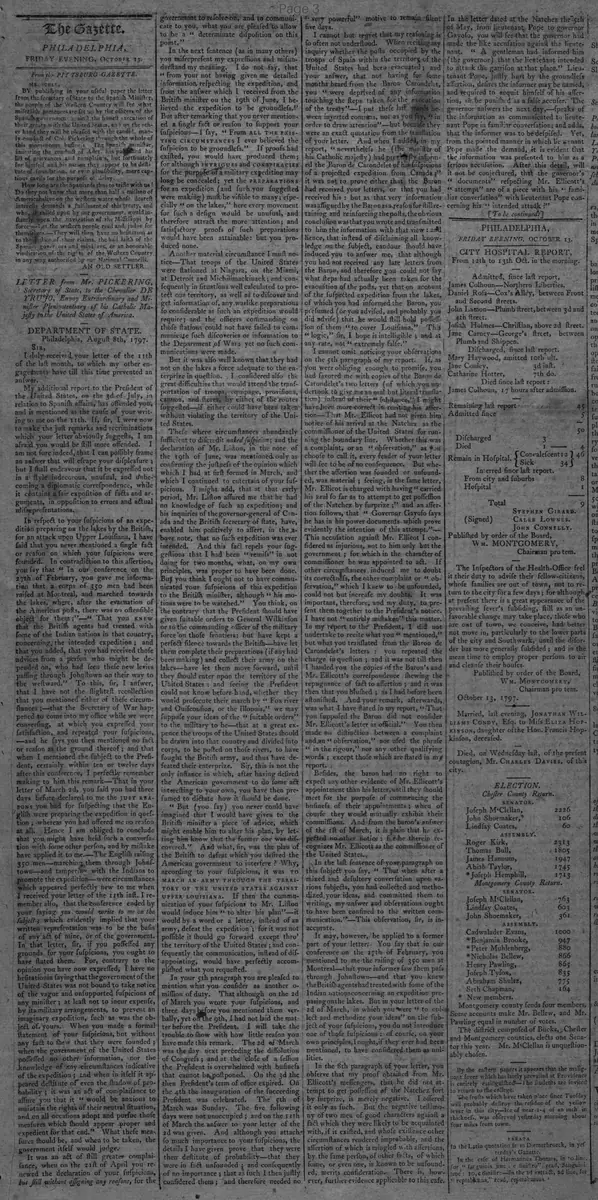
From the PITTSBURG GAZETTE:
MR. SCOUT:
By publishing in your useful paper the letter from the Secretary of State to the Spanish Minister, the people of the Western Country will see what miserable pretences are set up by the officers of the Spanish government against the honest execution of their treaty with the United States, and on the other hand they will be pleased with the candid, manly conduct of Col. Pickering through the whole of this momentous business. The Spanish minister, imitating the conduct of Adet, has published his list of grievances and complaints, but fortunately for himself and his nation they appear to be destitute of foundation, or even plausibility, mere captious cavils for the purpose of delay.
How long are the Spaniards thus to trifle with us! Do they not know that more than half a million of Americans live on the western waters whose dearest interests demands a fulfillment of this treaty, and who, if called upon by our government, would instantly open the navigation of the Mississippi by force—let the western people read and judge for themselves.—They will then have no hesitation as to the justice of their claims, the bad faith of the Spanish governors and ministers, or an honorable vindication of the rights of the Western Country in any way authorised by our National Councils.
AN OLD SETTLER.
LETTER from Mr. PICKERING, Secretary of State, to the Chevalier DE TRUGILL, Envoy Extraordinary and Minister Plenipotentiary of his Catholic Majesty to the United States of America.
DEPARTMENT OF STATE.
Philadelphia, August 8th, 1797.
SIR,
I duly received your letter of the 11th of the last month, to which my other engagements have till this time prevented an answer.
My additional report to the President of the United States, on the 3d of July, in relation to Spanish affairs, has offended you, and is mentioned as the cause of your writing to me on the 11th. If, sir, I were now to make the just remarks and recriminations which your letter obviously suggests, I am afraid you would be still more offended. I am not sure indeed, that I can possibly frame an answer that will escape your displeasure; but I shall endeavour that it be expressed not in a style indecorous, unusual, and unbecoming a diplomatic correspondence, while it contains a fair exposition of facts and arguments, in opposition to errors and actual misrepresentations.
In respect to your suspicions of an expedition preparing on the lakes by the British, for an attack upon Upper Louisiana, I have said that you never mentioned a single fact or reason on which your suspicions were founded. In contradiction to this assertion, you say that "In our conference on the 27th of February, you gave me information that a corps of 350 men had been raised at Montreal, and marched towards the lakes, where, after the evacuation of the American posts, there was no ostensible object for them:" That you knew that the British agents had treated with some of the Indian nations in that country, concerning the intended expedition; and that you added, that you had received those advices from a person who might be depended on, who had seen those new levies passing through Johnstown on their way to the westward." To this, sir, I answer, that I have not the slightest recollection that you mentioned either of these circumstances; that the Secretary of War happened to come into my office while we were conversing, at which you expressed your satisfaction, and repeated your suspicions,—and he says you then mentioned no fact or reason as the ground thereof; and that when I mentioned the subject to the President, certainly within ten or twelve days after this conference, I perfectly remember making to him this remark—That in your letter of March 2d, you said you had three days before declared to me the just reasons you had for suspecting that the English were preparing the expedition in question;—whereas you had offered me no reason at all. Hence I am obliged to conclude that you might have held such a conversation with some other person, and by mistake have applied it to me.—The English raising 350 men—marching them through Johnstown—and tampering with the Indians to promote the expedition—were circumstances which appeared perfectly new to me when I received your letter of the 11th inst. I remember also, that the conference ended by your saying you would write to me on the subject; which evidently implied that your written representation was to be the basis of any act of mine, or of the government.
In that letter, sir, if you possessed any grounds for your suspicions, you ought to have stated them. For, contrary to the opinion you have now expressed, I have no hesitation in saying that the government of the United States was not bound to take notice of the vague and unsupported suspicions of any minister; at least not to incur expense, by its military arrangements, to prevent an imaginary expedition, such as was the object of yours. When you made a formal statement of your suspicions, but without showing any fact that they were founded; when the government of the United States possessed no other information, nor the knowledge of any circumstances indicative of the expedition; and when in itself it appeared destitute of even the shadow of probability; it was an act of compliance to assure you that it "would be anxious to maintain the rights of their neutral situation, and on all occasions adopt and pursue those measures which should appear proper and expedient for that end." What those measures should be, and when to be taken, the government itself would judge.
It was an act of still greater compliance, when on the 21st of April you renewed the declaration of your suspicions, but still without assigning any reasons, for the government to resolve on, and to communicate to you, what you are pleased to allow to be a "determinate disposition on this point."
In the next sentence (as in many others) you misrepresent my expressions and misunderstand my meaning. I do not say, that "from your not having given me detailed information respecting the expedition, and from the answer which I received from the British minister on the 19th of June, I believed the expedition to be groundless." But after remarking that you never mentioned a single fact or reason to support your suspicions—I say, "From ALL THE EXISTING CIRCUMSTANCES I ever believed the suspicion to be groundless." If proofs had existed, you would have produced them; for although INTRIGUES and CONSPIRACIES for the purpose of a military expedition may long be concealed; yet the PREPARATIONS for an expedition (and such you suggested were making) must be visible to many; especially "on the lakes," where every movement for such a design would be unusual, and therefore attract the more attention; and satisfactory proofs of such preparations would have been attainable: but you produced none.
Another material circumstance I must notice—That troops of the United States were stationed at Niagara, on the Miami, at Detroit and Michilimackinac; and consequently in situations well calculated to protect our territory, as well as to discover and get information of, any warlike preparations so considerable as such an expedition would require; and the officers commanding on those stations could not have failed to communicate such discoveries or information to the Department of War: yet no such communications were made.
But it was also well known that they had not on the lakes a force adequate to the enterprize in question. I considered also the great difficulties that would attend the transportation of troops, equipage, provisions, cannon, and stores, by either of the routes suggested—if either could have been taken without violating the territory of the United States.
These various circumstances abundantly sufficient to discredit naked suspicion; and the declaration of Mr. Liston, in the note of the 19th of June, was mentioned only as confirming the justness of the opinion which I had at first formed in March, and which I continued to entertain of your suspicions. I might add, that at that early period, Mr. Liston assured me that he had no knowledge of such an expedition; and his inquiries of the governor-general of Canada and the British secretary of state, have, enabled him positively to assert, in the above note, that no such expedition was ever intended. And this fact repels your suggestions that I had been "remiss" in not doing for two months, what, on my own principles, was proper to have been done.
But you think I ought not to have communicated your suspicions of this expedition to the British minister, although "his motions were to be watched." You think, on the contrary that the President should have given suitable orders to General Wilkinson or to the commanding officer of the military force on those frontiers: but have kept a perfect silence towards the British—have let them complete their preparations (if any had been making) and collect their army on the lakes—have let them move forward, until they should enter upon the territory of the United States: and seeing the President could not know before-hand, whether they would prosecute their march by "Fox river and Ouiconcin, or the Illinois," we may suppose your ideas of the "suitable orders" to the military to be—that at a great expense the troops of the United States should be drawn into that country and divided into corps, to be posted on those rivers, to have fought the British army, and thus have defeated their enterprize. Sir, this is not the only instance in which, after having desired the American government to do some act interesting to your own, you have then presumed to dictate how it should be done.
"But (you say) you never could have imagined that I would have given to the British minister a piece of advice, which might enable him to alter his plan, by letting him know that the former one was discovered." And what, sir, was the plan of the British to defeat which you desired the American government to interfere? Why, according to your suspicions, it was To MARCH AN ARMY THROUGH THE TERRITORY OF THE UNITED STATES AGAINST UPPER LOUISIANA. If then the communication of your suspicions to Mr. Liston would induce him "to alter his plan"—it would by a word or a letter, instead of an army, defeat the expedition; for it was not possible it should go forward except thro' the territory of the United States; and consequently the communication, instead of disappointing, would have perfectly accomplished what you requested.
In your 5th paragraph you are pleased to mention what you consider as another omission of duty. That although on the 2d of March you wrote your suspicions, and three days before you mentioned them verbally, yet on the 9th, I had not laid the matter before the President. I will take the trouble to show with how little reason you have made this remark. The 2d of March was the day next preceding the dissolution of Congress; and at the close of a session the President is overwhelmed with business that cannot be postponed. On the 3d the then President's term of office expired. On the 4th the inauguration of the succeeding President was celebrated. The 5th of March was Sunday. The five following days were not unoccupied; and on the 11th of March the answer to your letter of the 2d was given. And although you attach so much importance to your suspicions, the details I have given prove that they were then destitute of probability—that they were in fact unfounded; and consequently of no importance; that as such I then justly considered them; and therefore needed no very powerful motive to remain silent five days.
I cannot but regret that my reasoning is so often not understood. When reciting my inquiry whether the posts occupied by the troops of Spain within the territory of the United States had been evacuated; and your answer, that not having for some months heard from the Baron Carondelet, you "were deprived of any information touching the steps taken for the execution of the treaty" I put these last words between inverted commas, not as you say, "in order to draw attention" -but because they were an exact quotation from the translation of your letter. And when I added, in my report, "nevertheless he (the minister of his Catholic majesty) had previously informed the Baron de Carondelet of his suspicions of a projected expedition from Canada;" it was not to prove either that the Baron had received your letters, or that you had received his: but as that very information was assigned by the Baron as a reason for still retaining and reinforcing the posts, the obvious conclusion was that you wrote and transmitted to him the information with that view: and hence, that instead of disclaiming all knowledge on the subject, candour should have induced you to answer me, that although you had not received any late letters from the Baron, and therefore you could not say what steps had actually been taken for the evacuation of the posts, yet that on account of the suspected expedition from the lakes, of which you had informed the Baron, you presumed (or you advised, and probably you did advise) that he would still hold possession of them "to cover Louisiana." This "logic," sir, I hope is intelligible; and at any rate, not "extremely false."
I cannot omit noticing your observations on the 5th paragraph of my report. If, as you were obliging enough to promise, you had favored me with copies of the Baron de Carondelet's two letters (of which you undertook to give me an oral but literal translation) instead of their "substance," I might have been more correct in reciting his assertion—That Mr. Ellicott had not given him notice of his arrival at the Natchez as the commissioner of the United States for running the boundary line. Whether this was a complaint, or an "observation," as you choose to call it, every reader of your letter will see to be of no consequence. But whether the assertion was founded or unfounded, was material; seeing, in the same letter, Mr. Ellicott is charged with having "carried his zeal so far as to attempt to get possession of the Natchez by surprise;" and an assertion follows, that "Governor Gayoso says he has in his power documents which prove evidently the intention of this attempt."
This accusation against Mr. Ellicott I considered as injurious, not to him only but the government; for which in the character of commissioner he was appointed to act. If other circumstances, induced me to doubt its correctness, the other complaint or "observation," which I knew to be unfounded, could not but increase my doubts. It was important, therefore, and my duty, to present them together to the President's notice.
I have not "entirely mistaken" this matter. In my report to the President, I did not undertake to recite what you "mentioned," but what you translated from the Baron de Carondelet's letters: you repeated the charge in question; and it was not till then I handed you the copies of the Baron's and Mr. Ellicott's correspondence showing the repugnance of fact to assertion; and it was then that you blushed; as I had before been astonished. And your remark, afterwards, was what I have stated in my report, "That you supposed the Baron did not consider Mr. Ellicott's letter as official." You then made no distinction between a complaint and an "observation," nor used the phrase "in the rigour," nor any other qualifying words; except those which are stated in my report.
Besides, the baron had no right to expect any other evidence of Mr. Ellicott's appointment than his letter, until they should meet for the purpose of commencing the business of their appointments; when of course they would mutually exhibit their commissions. And from the baron's answer of the 1st of March, it is plain that he expected no other notice: for he therein recognizes Mr. Ellicott as the commissioner of the United States.
In the last sentence of your paragraph on this subject you say, "That when after a mixed and desultory conversation upon various subjects, you had collected and methodized your ideas, and committed them to writing, my answer and observations ought to have been confined to the written communication." This observation, sir, is inaccurate.
It may, however, be applied to a former part of your letter. You say that in our conference on the 27th of February, you mentioned to me the raising of 350 men at Montreal—that your informer saw them pass through Johnstown—and that you knew the British agents had treated with some of the Indian nations concerning an expedition preparing on the lakes. But in your letter of the 2d of March, in which you were "to collect and methodize your ideas" on the subject of your suspicions, you do not introduce one of those suspicious: of course, on your own principles, I ought, if they ever had been mentioned, to have considered them as nullities.
In the 8th paragraph of your letter, you observe that my proof obtained from Mr. Ellicott's messengers, that he did not attempt to get possession of the Natchez fort by surprise, is merely negative. I offered it only as such. But the negative testimony of two men of good characters against a fact which they were likely to be acquainted with, if it existed, and whose existence other circumstances rendered improbable, and the assertion of which is mingled with assertions, by the same person, of other facts, of which some, or even one, is known to be unfounded, merits consideration. There is, however,
further evidence applicable to this case.
In the letter dated at the Natchez the 5th of May, from lieutenant Pope to governor Gayoso, you will see that the governor had made the like accusation against the lieutenant. "A gentleman had informed him (the governor) that the lieutenant intended to attack the garrison at that place." Lieutenant Pope, justly hurt by the groundless assertion, desires the informer may be named, and required to acquit himself of his assertion, or be punished as a false accuser. The governor answers the next day,—speaks of the information as communicated to lieutenant Pope in familiar conversation; and adds, that the informer was to be denied. Yet, from the pointed manner in which lieutenant Pope made the demand, it is evident that the information was presented to him as a serious accusation. After this detail, will it not be conjectured, that the governor's "documents" respecting Mr. Ellicott's "attempt" are of a piece with his "familiar conversation" with lieutenant Pope concerning his "intended attack?"
[To be continued]
What sub-type of article is it?
What keywords are associated?
What entities or persons were involved?
Where did it happen?
Foreign News Details
Primary Location
Upper Louisiana
Event Date
August 8th, 1797
Key Persons
Outcome
diplomatic defense of us positions; dismissal of spanish suspicions of british expedition as unfounded; refutation of accusations against us boundary commissioner; arguments for spanish treaty non-compliance in evacuating posts.
Event Details
Secretary of State Pickering's letter responds to Spanish Minister de Trugill's complaints about a US report on Spanish affairs. Pickering defends the US government's handling of Spanish suspicions of a British military expedition against Upper Louisiana, asserting no evidence was provided and suspicions were groundless. He addresses delays in evacuating Spanish posts per treaty, issues with boundary commissioner Ellicott at Natchez, and refutes Spanish accusations of US attempts to seize territory.