Thank you for visiting SNEWPapers!
Sign up free
The Ohio Daily Express
Dayton, Montgomery County, Ohio
What is this article about?
George Bernard Shaw denounces South Africa's 'ghetto legislation' as persecution and its white democracy as shallow, criticizing leaders like F.M. Smuts. He compares policies to U.S. segregation and highlights similar racial exclusion in Australia and New Zealand, amid Indo-South African UN disputes.
Clipping
OCR Quality
Full Text
By Lawrence C. Burr
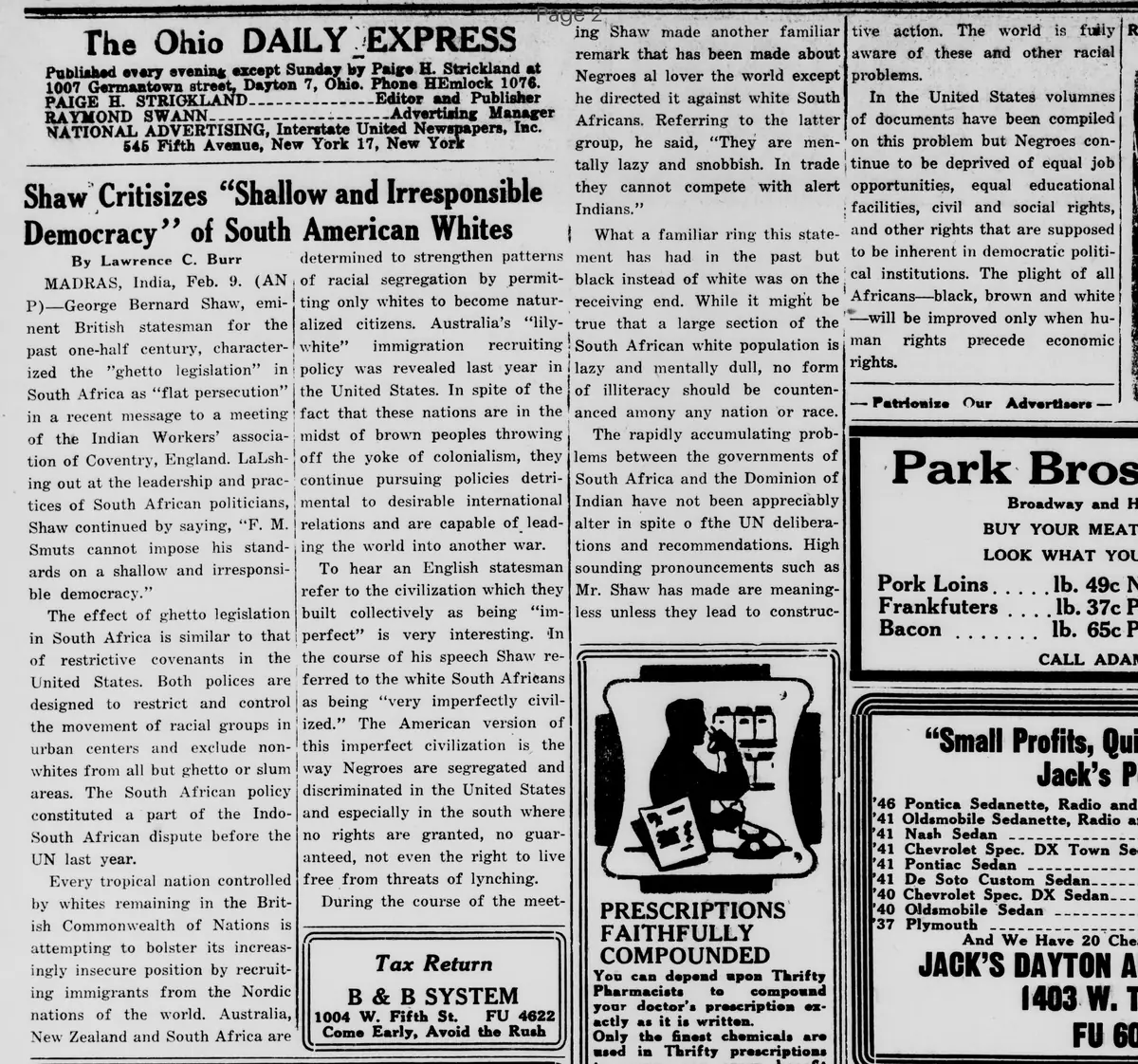
MADRAS, India, Feb. 9. (AP)--George Bernard Shaw, eminent British statesman for the past one-half century, characterized the "ghetto legislation" in South Africa as "flat persecution" in a recent message to a meeting of the Indian Workers' association of Coventry, England. Lashing out at the leadership and practices of South African politicians, Shaw continued by saying, "F. M. Smuts cannot impose his standards on a shallow and irresponsible democracy."
The effect of ghetto legislation in South Africa is similar to that of restrictive covenants in the United States. Both policies are designed to restrict and control the movement of racial groups in urban centers and exclude non-whites from all but ghetto or slum areas. The South African policy constituted a part of the Indo-South African dispute before the UN last year.
Every tropical nation controlled by whites remaining in the British Commonwealth of Nations is attempting to bolster its increasingly insecure position by recruiting immigrants from the Nordic nations of the world. Australia, New Zealand and South Africa are determined to strengthen patterns of racial segregation by permitting only whites to become naturalized citizens. Australia's "lily-white" immigration recruiting policy was revealed last year in the United States. In spite of the fact that these nations are in the midst of brown peoples throwing off the yoke of colonialism, they continue pursuing policies detrimental to desirable international relations and are capable of leading the world into another war.
To hear an English statesman refer to the civilization which they built collectively as being "imperfect" is very interesting. In the course of his speech Shaw referred to the white South Africans as being "very imperfectly civilized." The American version of this imperfect civilization is the way Negroes are segregated and discriminated in the United States and especially in the south where no rights are granted, no guaranteed, not even the right to live free from threats of lynching.
During the course of the meeting Shaw made another familiar remark that has been made about Negroes all over the world except he directed it against white South Africans. Referring to the latter group, he said, "They are mentally lazy and snobbish. In trade they cannot compete with alert Indians."
What a familiar ring this statement has had in the past but black instead of white was on the receiving end. While it might be true that a large section of the South African white population is lazy and mentally dull, no form of illiteracy should be countenanced among any nation or race.
The rapidly accumulating problems between the governments of South Africa and the Dominion of India have not been appreciably altered in spite of the UN deliberations and recommendations. High sounding pronouncements such as Mr. Shaw has made are meaningless unless they lead to constructive action. The world is fully aware of these and other racial problems.
In the United States volumes of documents have been compiled on this problem but Negroes continue to be deprived of equal job opportunities, equal educational facilities, civil and social rights, and other rights that are supposed to be inherent in democratic political institutions. The plight of all Africans--black, brown and white--will be improved only when human rights precede economic rights.
What sub-type of article is it?
What keywords are associated?
What entities or persons were involved?
Where did it happen?
Foreign News Details
Primary Location
South Africa
Event Date
Feb. 9
Key Persons
Outcome
ongoing racial problems between south africa and india unchanged despite un deliberations; policies continue to foster segregation and risk international conflict.
Event Details
George Bernard Shaw, in a message to the Indian Workers' association of Coventry, England, criticizes South African ghetto legislation as flat persecution, states F. M. Smuts cannot impose standards on a shallow democracy, calls white South Africans imperfectly civilized, mentally lazy, and snobbish, unable to compete with Indians in trade. Compares to U.S. restrictive covenants and segregation; notes similar white-only immigration policies in Australia, New Zealand, and South Africa to bolster segregation amid decolonization.