Thank you for visiting SNEWPapers!
Sign up free
Literary
November 6, 1828
The Virginian
Lynchburg, Virginia
What is this article about?
Extracts from Joseph L. Litchfield's address to the Rhode Island Society for the Encouragement of Domestic Industry advocate for long-term tillage plans, reinvestment in existing land over expansion, proper farm maintenance including enclosures and drainage, and managing soil moisture for fertility.
Clipping
OCR Quality
75%
Good
Full Text
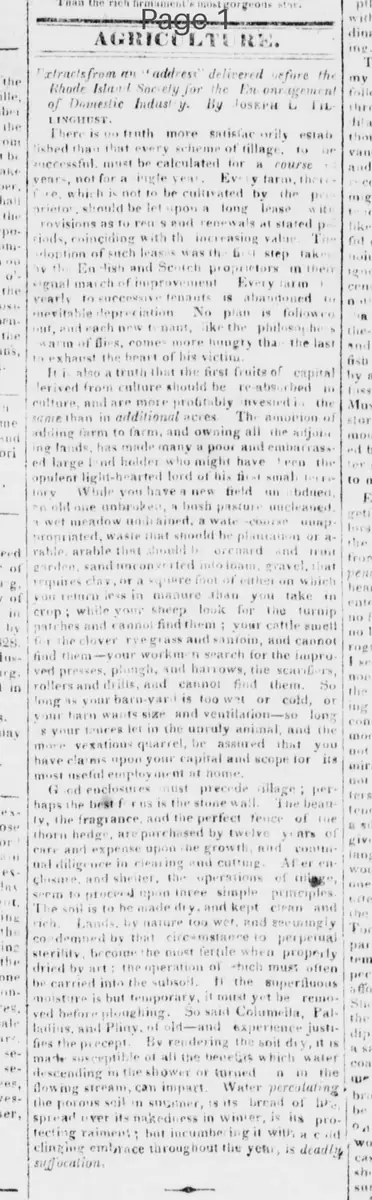
AGRICULTURE.
Extracts from an address delivered before the Rhode Island Society for the Encouragement of Domestic Industry. By Joseph L. Litchfield.
There is no truth more satisfactorily established than that every scheme of tillage, to be successful must be calculated for a course of years, not for a single year. Every farm, that is not to be cultivated by the proprietor, should be let upon a long lease with provisions as to rents and renewals at stated periods, coinciding with the increasing value. The adoption of such leases was the first step taken by English and Scotch projectors in their signal march of improvement. Every farm yearly to successive tenants is abandoned to inevitable depreciation. No plan is followed, but each new tenant takes the farm as he finds it, comes more hungry than the last to exhaust the heart of his victim.
It is also a truth that the first fruits of capital derived from culture should be reabsorbed in culture, and are more profitably invested in the one than in additional acres. The ambition of adding farm to farm, and owning all the adjacent trade has made many a poor and embarrassed large land holder who might have been the opulent light-hearted lord of his first small patrimony.
While you have a new field unbudded and an old one unbroken a bush pasture uncleaned a wet meadow undrained, a vale course unappropriated, waste that should be planted or arable that should be garden, and not garden, sand unconverted into marl, gravel, slate vegetables etc., or a spare foot of earth on which you spend more in manure than you take in crop; while your sheep look for the turnip gathers and cannot find them; your cattle smell for the red clover ryegrass and sainfoin, and cannot find them—your workmen search for the top-dressed presses, plough, and harrows, the scarifiers, rollers and drills, and cannot find them. So long as your barn yard is too wet or cold, or your barn wants size and ventilation—so long as your fences let in the unruly animal, and the more vexatious quarrels, be assured that you have claims upon your capital and scope for its most useful employment at home.
Good enclosures must precede tillage; perhaps the best fence is the stone wall. The beauty, the fragrance, and the perfect fence of the thorn hedge, are purchased by twelve years of care and expense upon the growth and continual diligence in cleaning and cutting. After enclosing, and shelter, the operations of tillage seem to proceed upon these simple principles. The soil is to be made dry, and kept clean and tillable. By nature too wet, and consequently condemned by that circumstance to perpetual sterility, become the most fertile when properly dried by art: the operation of which must often be carried into the subsoil. If the superfluous moisture is but temporary, it must yet be removed before ploughing. So said Columella, Palladius, and Pliny, of old—and experience justifies the precept. By rendering the soil dry, it is made susceptible of all the benefits which water descending in the shower or turned on in the flowing stream, can impart. Water percolating the porous soil in summer, is its bread of life; spread over its nakedness in winter, is its protecting raiment; but encumbering it with a cold and clinging embrace throughout the year, is deadly suffocation.
Extracts from an address delivered before the Rhode Island Society for the Encouragement of Domestic Industry. By Joseph L. Litchfield.
There is no truth more satisfactorily established than that every scheme of tillage, to be successful must be calculated for a course of years, not for a single year. Every farm, that is not to be cultivated by the proprietor, should be let upon a long lease with provisions as to rents and renewals at stated periods, coinciding with the increasing value. The adoption of such leases was the first step taken by English and Scotch projectors in their signal march of improvement. Every farm yearly to successive tenants is abandoned to inevitable depreciation. No plan is followed, but each new tenant takes the farm as he finds it, comes more hungry than the last to exhaust the heart of his victim.
It is also a truth that the first fruits of capital derived from culture should be reabsorbed in culture, and are more profitably invested in the one than in additional acres. The ambition of adding farm to farm, and owning all the adjacent trade has made many a poor and embarrassed large land holder who might have been the opulent light-hearted lord of his first small patrimony.
While you have a new field unbudded and an old one unbroken a bush pasture uncleaned a wet meadow undrained, a vale course unappropriated, waste that should be planted or arable that should be garden, and not garden, sand unconverted into marl, gravel, slate vegetables etc., or a spare foot of earth on which you spend more in manure than you take in crop; while your sheep look for the turnip gathers and cannot find them; your cattle smell for the red clover ryegrass and sainfoin, and cannot find them—your workmen search for the top-dressed presses, plough, and harrows, the scarifiers, rollers and drills, and cannot find them. So long as your barn yard is too wet or cold, or your barn wants size and ventilation—so long as your fences let in the unruly animal, and the more vexatious quarrels, be assured that you have claims upon your capital and scope for its most useful employment at home.
Good enclosures must precede tillage; perhaps the best fence is the stone wall. The beauty, the fragrance, and the perfect fence of the thorn hedge, are purchased by twelve years of care and expense upon the growth and continual diligence in cleaning and cutting. After enclosing, and shelter, the operations of tillage seem to proceed upon these simple principles. The soil is to be made dry, and kept clean and tillable. By nature too wet, and consequently condemned by that circumstance to perpetual sterility, become the most fertile when properly dried by art: the operation of which must often be carried into the subsoil. If the superfluous moisture is but temporary, it must yet be removed before ploughing. So said Columella, Palladius, and Pliny, of old—and experience justifies the precept. By rendering the soil dry, it is made susceptible of all the benefits which water descending in the shower or turned on in the flowing stream, can impart. Water percolating the porous soil in summer, is its bread of life; spread over its nakedness in winter, is its protecting raiment; but encumbering it with a cold and clinging embrace throughout the year, is deadly suffocation.
What sub-type of article is it?
Essay
What themes does it cover?
Agriculture Rural
What keywords are associated?
Agriculture
Tillage
Farming
Soil Drainage
Long Term Leases
Enclosures
Fences
What entities or persons were involved?
By Joseph L. Litchfield.
Literary Details
Title
Extracts From An Address Delivered Before The Rhode Island Society For The Encouragement Of Domestic Industry.
Author
By Joseph L. Litchfield.
Subject
On Agricultural Improvement And Tillage Practices
Key Lines
There Is No Truth More Satisfactorily Established Than That Every Scheme Of Tillage, To Be Successful Must Be Calculated For A Course Of Years, Not For A Single Year.
It Is Also A Truth That The First Fruits Of Capital Derived From Culture Should Be Reabsorbed In Culture, And Are More Profitably Invested In The One Than In Additional Acres.
Water Percolating The Porous Soil In Summer, Is Its Bread Of Life; Spread Over Its Nakedness In Winter, Is Its Protecting Raiment; But Encumbering It With A Cold And Clinging Embrace Throughout The Year, Is Deadly Suffocation.