Thank you for visiting SNEWPapers!
Sign up free
Letter to Editor
December 30, 1888
The Daily Bulletin
Honolulu, Honolulu County, Hawaii
What is this article about?
J. O. Carter writes to defend the American Sugar Refinery Company against accusations from the California Refinery regarding sugar imported from Java on the Westmeath. He details the contract, customs entry, additional duties paid under protest, and chemist examinations, asserting proper procedures were followed.
Clipping
OCR Quality
98%
Excellent
Full Text
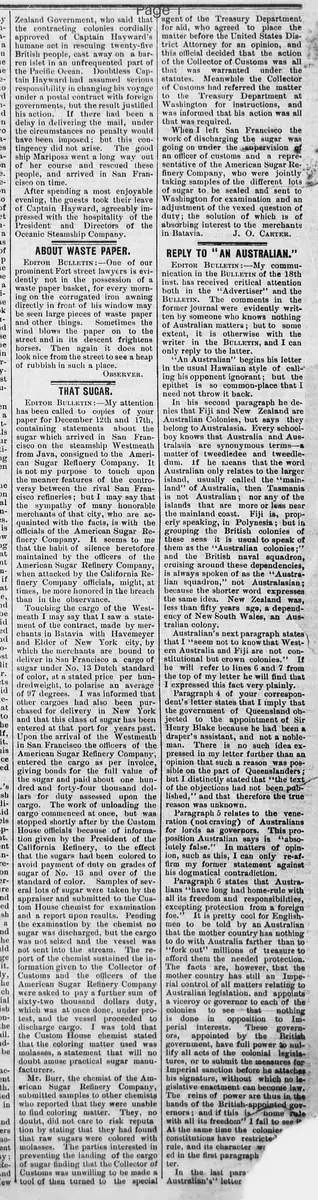
THAT SUGAR.
EDITOR Bulletin:- My attention has been called to copies of your paper for December 12th and 17th, containing statements about the sugar which arrived in San Francisco on the steamship Westmeath from Java, consigned to the American Sugar Refinery Company. It is not my purpose to touch upon the meaner features of the controversy between the rival San Francisco refineries; but I may say that the sympathy of many honorable merchants of that city, who are acquainted with the facts, is with the officials of the American Sugar Refinery Company. It seems to me that the habit of silence heretofore maintained by the officers of the American Sugar Refinery Company, when attacked by the California Refinery Company officials, might, at times, be more honored in the breach than in the observance.
Touching the cargo of the Westmeath I may say that I saw a statement of the contract, made by merchants in Batavia with Havemeyer and Elder of New York city, by which the merchants are bound to deliver in San Francisco a cargo of sugar under No. 13 Dutch standard of color, at a stated price per hundredweight, to polarize an average of 97 degrees. I was informed that other cargoes had also been purchased for delivery in New York and that this class of sugar has been entered at that port for years past.
Upon the arrival of the Westmeath in San Francisco the officers of the American Sugar Refinery Company, entered the cargo as per invoice, giving bonds for the full value of the sugar and paid about one hundred and forty-four thousand dollars for duty assessed upon the cargo. The work of unloading the cargo commenced at once, but was stopped shortly after by the Custom House officials because of information given by the President of the California Refinery, to the effect that the sugars had been colored to avoid payment of duty on grades of sugar of No. 13 and over of the standard of color. Samples of several lots of sugar were taken by the appraiser and submitted to the Custom House chemist for examination and a report upon results. Pending the examination by the chemist no sugar was discharged, but the cargo was not seized and the vessel was not sent into the stream. The report of the chemist sustained the information given to the Collector of Customs and the officers of the American Sugar Refinery Company were asked to pay a further sum of sixty-two thousand dollars duty, which was at once done, under protest, and the vessel proceeded to discharge cargo. I was told that the Custom House chemist stated that the coloring matter used was molasses, a statement that will no doubt amuse practical sugar manufacturers.
Mr. Burr, the chemist of the American Sugar Refinery Company, submitted samples to other chemists who reported that they were unable to find coloring matter. They, no doubt, did not care to risk reputation by stating that they had found that raw sugars were colored with molasses. The parties interested in preventing the landing of the cargo of sugar finding that the Collector of Customs was unwilling to be made a tool of then turned to the special agent of the Treasury Department for aid, who agreed to place the matter before the United States District Attorney for an opinion, and this official decided that the action of the Collector of Customs was all that was warranted under the statutes. Meanwhile the Collector of Customs had referred the matter to the Treasury Department at Washington for instructions, and was informed that his action was all that was required.
When I left San Francisco the work of discharging the sugar was going on under the supervision of an officer of customs and a representative of the American Sugar Refinery Company, who were jointly taking samples of the different lots of sugar to be sealed and sent to Washington for examination and an adjustment of the vexed question of duty; the solution of which is of absorbing interest to the merchants in Batavia.
J. O. CARTER.
EDITOR Bulletin:- My attention has been called to copies of your paper for December 12th and 17th, containing statements about the sugar which arrived in San Francisco on the steamship Westmeath from Java, consigned to the American Sugar Refinery Company. It is not my purpose to touch upon the meaner features of the controversy between the rival San Francisco refineries; but I may say that the sympathy of many honorable merchants of that city, who are acquainted with the facts, is with the officials of the American Sugar Refinery Company. It seems to me that the habit of silence heretofore maintained by the officers of the American Sugar Refinery Company, when attacked by the California Refinery Company officials, might, at times, be more honored in the breach than in the observance.
Touching the cargo of the Westmeath I may say that I saw a statement of the contract, made by merchants in Batavia with Havemeyer and Elder of New York city, by which the merchants are bound to deliver in San Francisco a cargo of sugar under No. 13 Dutch standard of color, at a stated price per hundredweight, to polarize an average of 97 degrees. I was informed that other cargoes had also been purchased for delivery in New York and that this class of sugar has been entered at that port for years past.
Upon the arrival of the Westmeath in San Francisco the officers of the American Sugar Refinery Company, entered the cargo as per invoice, giving bonds for the full value of the sugar and paid about one hundred and forty-four thousand dollars for duty assessed upon the cargo. The work of unloading the cargo commenced at once, but was stopped shortly after by the Custom House officials because of information given by the President of the California Refinery, to the effect that the sugars had been colored to avoid payment of duty on grades of sugar of No. 13 and over of the standard of color. Samples of several lots of sugar were taken by the appraiser and submitted to the Custom House chemist for examination and a report upon results. Pending the examination by the chemist no sugar was discharged, but the cargo was not seized and the vessel was not sent into the stream. The report of the chemist sustained the information given to the Collector of Customs and the officers of the American Sugar Refinery Company were asked to pay a further sum of sixty-two thousand dollars duty, which was at once done, under protest, and the vessel proceeded to discharge cargo. I was told that the Custom House chemist stated that the coloring matter used was molasses, a statement that will no doubt amuse practical sugar manufacturers.
Mr. Burr, the chemist of the American Sugar Refinery Company, submitted samples to other chemists who reported that they were unable to find coloring matter. They, no doubt, did not care to risk reputation by stating that they had found that raw sugars were colored with molasses. The parties interested in preventing the landing of the cargo of sugar finding that the Collector of Customs was unwilling to be made a tool of then turned to the special agent of the Treasury Department for aid, who agreed to place the matter before the United States District Attorney for an opinion, and this official decided that the action of the Collector of Customs was all that was warranted under the statutes. Meanwhile the Collector of Customs had referred the matter to the Treasury Department at Washington for instructions, and was informed that his action was all that was required.
When I left San Francisco the work of discharging the sugar was going on under the supervision of an officer of customs and a representative of the American Sugar Refinery Company, who were jointly taking samples of the different lots of sugar to be sealed and sent to Washington for examination and an adjustment of the vexed question of duty; the solution of which is of absorbing interest to the merchants in Batavia.
J. O. CARTER.
What sub-type of article is it?
Informative
Investigative
Persuasive
What themes does it cover?
Commerce Trade
Economic Policy
What keywords are associated?
Sugar Import
Customs Duty
San Francisco Refineries
Westmeath Cargo
Sugar Coloring
Batavia Contract
Treasury Department
What entities or persons were involved?
J. O. Carter
Editor Bulletin
Letter to Editor Details
Author
J. O. Carter
Recipient
Editor Bulletin
Main Argument
the american sugar refinery company properly entered and paid duties on the sugar cargo from the westmeath, despite accusations of coloring to evade higher duties by the california refinery; customs officials and higher authorities confirmed the procedures were correct.
Notable Details
Contract With Batavia Merchants For Sugar Under No. 13 Dutch Standard
Paid $144,000 Initial Duty, Additional $62,000 Under Protest
Custom House Chemist Claimed Molasses Coloring, But Company Chemists Found None
Samples Sent To Washington For Final Examination