Thank you for visiting SNEWPapers!
Sign up free
Editorial
October 12, 1822
Winchester Gazette
Winchester, Virginia
What is this article about?
Editorial reflects on the sudden suicide of Lord Londonderry after a lavish event, questions the coroner's inquest via National Gazette's views, and stresses the role of religious faith in enduring life's woes, quoting poetry and Hamlet.
Clipping
OCR Quality
95%
Excellent
Full Text
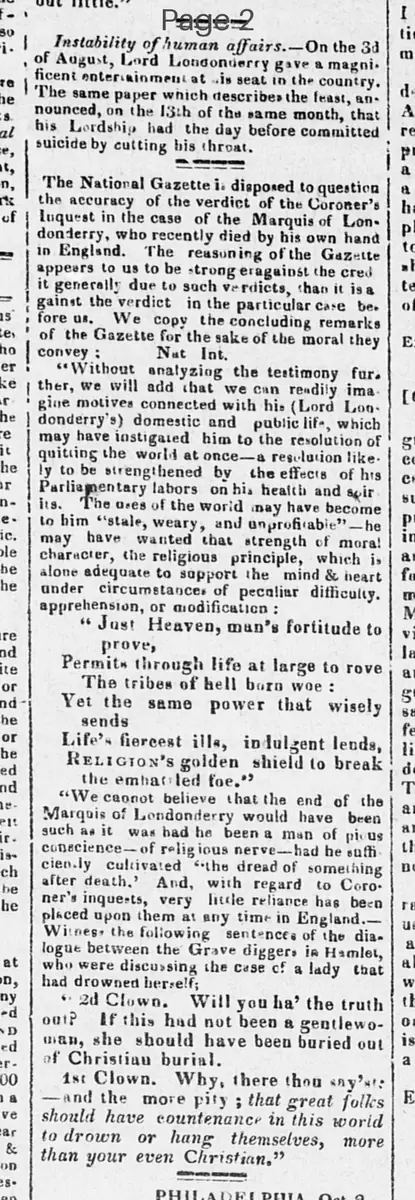
Instability of human affairs.--On the 3d of August, Lord Londonderry gave a magnificent entertainment at his seat in the country. The same paper which describes the feast, announced, on the 13th of the same month, that his Lordship had the day before committed suicide by cutting his throat.
The National Gazette is disposed to question the accuracy of the verdict of the Coroner's Inquest in the case of the Marquis of Londonderry, who recently died by his own hand in England. The reasoning of the Gazette appears to us to be stronger against the credit generally due to such verdicts, than it is against the verdict in the particular case before us. We copy the concluding remarks of the Gazette for the sake of the moral they convey:
Nat. Int.
"Without analyzing the testimony further, we will add that we can readily imagine motives connected with his (Lord Londonderry's) domestic and public life, which may have instigated him to the resolution of quitting the world at once--a resolution likely to be strengthened by the effects of his Parliamentary labors on his health and spirits. The dress of the world may have become to him "stale, weary, and unprofitable" he may have wanted that strength of moral character, the religious principle, which is alone adequate to support the mind & heart under circumstances of peculiar difficulty. apprehension, or modification:
"Just Heaven, man's fortitude to prove,
Permits through life at large to rove
The tribes of hellborn woe:
Yet the same power that wisely sends
Life's fiercest ills, indulgent lends,
Religion's golden shield to break the embattled foe."
We cannot believe that the end of the Marquis of Londonderry would have been such as it was had he been a man of pious conscience--of religious nerve--had he sufficiently cultivated "the dread of something after death.' And, with regard to Coroner's inquests, very little reliance has been placed upon them at any time in England.-- Witness, the following sentences of the dialogue between the Grave diggers in Hamlet, who were discussing the Case of a lady that had drowned herself
2d Clown. Will you ha' the truth of it? If this had not been a gentlewoman, she should have been buried out of Christian burial.
1st Clown. Why, there thou say'st: --and the more pity; that great folks should have countenance in this world to drown or hang themselves, more than your even Christian."
The National Gazette is disposed to question the accuracy of the verdict of the Coroner's Inquest in the case of the Marquis of Londonderry, who recently died by his own hand in England. The reasoning of the Gazette appears to us to be stronger against the credit generally due to such verdicts, than it is against the verdict in the particular case before us. We copy the concluding remarks of the Gazette for the sake of the moral they convey:
Nat. Int.
"Without analyzing the testimony further, we will add that we can readily imagine motives connected with his (Lord Londonderry's) domestic and public life, which may have instigated him to the resolution of quitting the world at once--a resolution likely to be strengthened by the effects of his Parliamentary labors on his health and spirits. The dress of the world may have become to him "stale, weary, and unprofitable" he may have wanted that strength of moral character, the religious principle, which is alone adequate to support the mind & heart under circumstances of peculiar difficulty. apprehension, or modification:
"Just Heaven, man's fortitude to prove,
Permits through life at large to rove
The tribes of hellborn woe:
Yet the same power that wisely sends
Life's fiercest ills, indulgent lends,
Religion's golden shield to break the embattled foe."
We cannot believe that the end of the Marquis of Londonderry would have been such as it was had he been a man of pious conscience--of religious nerve--had he sufficiently cultivated "the dread of something after death.' And, with regard to Coroner's inquests, very little reliance has been placed upon them at any time in England.-- Witness, the following sentences of the dialogue between the Grave diggers in Hamlet, who were discussing the Case of a lady that had drowned herself
2d Clown. Will you ha' the truth of it? If this had not been a gentlewoman, she should have been buried out of Christian burial.
1st Clown. Why, there thou say'st: --and the more pity; that great folks should have countenance in this world to drown or hang themselves, more than your even Christian."
What sub-type of article is it?
Moral Or Religious
What keywords are associated?
Lord Londonderry
Suicide
Coroner Inquest
Religious Principle
Moral Character
Human Instability
Hamlet Quote
What entities or persons were involved?
Lord Londonderry
Marquis Of Londonderry
National Gazette
Editorial Details
Primary Topic
Moral Reflections On Lord Londonderry's Suicide And The Need For Religious Fortitude
Stance / Tone
Reflective And Exhortative On Religion's Role In Human Endurance
Key Figures
Lord Londonderry
Marquis Of Londonderry
National Gazette
Key Arguments
- sudden shift from entertainment to suicide illustrates human affairs' instability
- coroner's inquests in england warrant little reliance
- possible motives from domestic, public life, and parliamentary stress led to suicide
- lack of religious principle contributed to his despair
- religious faith provides shield against life's woes
- great persons receive undue leniency in suicide cases, as per hamlet quote