Thank you for visiting SNEWPapers!
Sign up free
Story
January 24, 1825
Palladium Of Virginia And The Pacific Monitor
Lewisburg, Greenbrier County, West Virginia
What is this article about?
A drunken stranger seeks a law license at court but fails a humorous examination by lawyers who quiz him on absurd legal scenarios. They then trick him into defending a chained bear mistaken for a prisoner, leading to his mortification.
Clipping
OCR Quality
95%
Excellent
Full Text
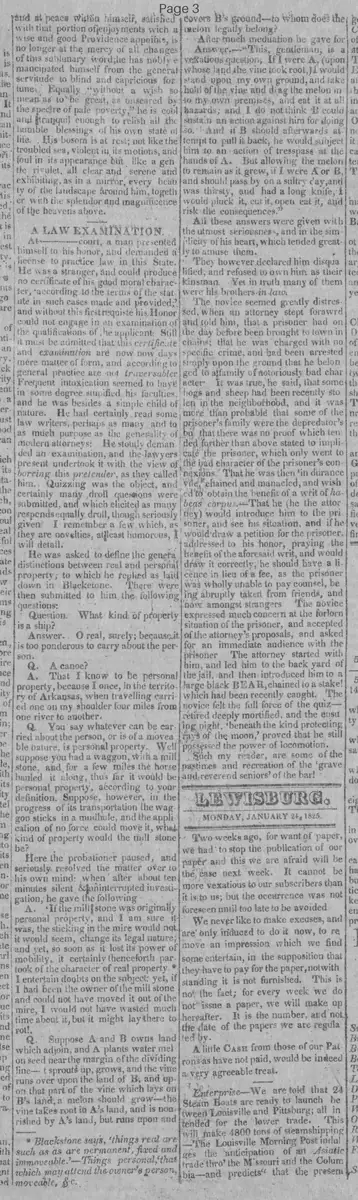
A LAW EXAMINATION.
At court, a man presented himself to his honor, and demanded a license to practice law in this State. He was a stranger, and could produce no certificate of his good moral character, 'according to the terms of the statute in such cases made and provided;' and without this first requisite his Honor could not engage in an examination of the qualifications of the applicant. Still it must be admitted that this certificate and examination are now-a-days mere matter of form, and according to general practice are not traversable.
Frequent intoxication seemed to have in some degree stupified his faculties, and he was besides a simple child of nature. He had certainly read some law writers, perhaps as many and to as much purpose as the generality of modern attorneys. He stoutly demanded an examination, and the lawyers present undertook it with the view of boring this pretender, as they called him. Quizzing was the object, and certainly many droll questions were submitted, and which elicited as many responses equally droll, though seriously given. I remember a few which, as they are novelties, at least humorous, I will detail.
He was asked to define the general distinctions between real and personal property; to which he replied as laid down in Blackstone. There were then submitted to him the following questions:
Question. What kind of property is a ship?
Answer. O real, surely; because it is too ponderous to carry about the person.
Q. A canoe?
A. That I know to be personal property, because I once, in the territory of Arkansas, when travelling, carried one on my shoulder four miles from one river to another.
Q. You say whatever can be carried about the person, or is of a moveable nature, is personal property. Well, suppose you had a waggon, with a mill stone, and for a few miles the horse hauled it along, thus far it would be personal property, according to your definition. Suppose, however, in the progress of its transportation the waggon sticks in a mudhole, and the application of no force could move it, what kind of property would the mill stone be?
Here the probationer paused, and seriously revolved the matter over to his own mind: when after about ten minutes silent and uninterrupted investigation, he gave the following
A. If the mill stone was originally personal property, and I am sure it was, the sticking in the mire would not, it would seem, change its legal nature; and yet, so soon as it lost its power of mobility, it certainly thenceforth partook of the character of real property.* I entertain doubts on the subject: yet, if I had been the owner of the mill stone and could not have moved it out of the mire, I would not have wasted much time about it, but it might lay there to rot!
Q. Suppose A and B own land which adjoin, and A plants water melon seed near the margin of the dividing line—it sprouts up, grows, and the vine runs over upon the land of B, and on that part of the vine which lays on B's land, a melon should grow—the vine takes root in A's land, and is nourished by A's land, but runs upon and covers B's ground—to whom does the melon legally belong?
After much meditation he gave for
Answer.—"This, gentlemen, is a vexations question; If I were A, (upon whose land the vine took root,) I would stand upon my own ground, and take hold of the vine and dig the melon in do my own premises, and eat it at all hazards: and I do not think B could sustain an action against him for doing so. And if B should afterwards attempt to pull it back, he would subject himself to an action of trespass at the hands of A. But allowing the melon to remain as it grew, if I were A or B, and should pass by on a sultry day, and was thirsty, and had a long knife, I would pluck it, cut it open, eat it, and risk the consequences."
All these answers were given with the utmost seriousness, and in the simplicity of his heart, which tended greatly to amuse them.
They however declared him disqualified, and refused to own him as their kinsman. Yet in truth many of them were his brothers in law.
The novice seemed greatly distressed, when an attorney stepped forward and told him, that a prisoner had on the day before been brought to town in chains; that he was charged with no specific crime, and had been arrested simply upon the ground that he belonged to a family of notoriously bad character. It was true, he said, that some hogs and sheep had been recently stolen in the neighborhood, and it was more than probable that some of the prisoner's family were the depredators; but that there was no proof which tended further than above stated to implicate the prisoner, which only went to the bad character of the prisoner's connexions. That he was then in durance vile, chained and manacled, and wished to obtain the benefit of a writ of habeas corpus. That he (the attorney) would introduce him to the prisoner, and see his situation, and if he would draw a petition for the prisoner, addressed to his honor, praying the benefit of the aforesaid writ, and would draw it correctly, he should have a license in lieu of a fee, as the prisoner was wholly unable to pay counsel, being abruptly taken from friends, and now amongst strangers. The novice expressed much concern at the forlorn situation of the prisoner, and accepted of the attorney's proposals, and asked for an immediate audience with the prisoner. The attorney started with him, and led him to the back yard of the jail, and then introduced him to a large black BEAR, chained to a stake! which had been recently caught. The novice felt the full force of the quiz—retired deeply mortified, and the ensuing night, 'beneath the kind protecting rays of the moon,' proved that he still possessed the power of locomotion.
Such, my reader, are some of the pastimes and recreation of the 'grave and reverend seniors' of the bar!
At court, a man presented himself to his honor, and demanded a license to practice law in this State. He was a stranger, and could produce no certificate of his good moral character, 'according to the terms of the statute in such cases made and provided;' and without this first requisite his Honor could not engage in an examination of the qualifications of the applicant. Still it must be admitted that this certificate and examination are now-a-days mere matter of form, and according to general practice are not traversable.
Frequent intoxication seemed to have in some degree stupified his faculties, and he was besides a simple child of nature. He had certainly read some law writers, perhaps as many and to as much purpose as the generality of modern attorneys. He stoutly demanded an examination, and the lawyers present undertook it with the view of boring this pretender, as they called him. Quizzing was the object, and certainly many droll questions were submitted, and which elicited as many responses equally droll, though seriously given. I remember a few which, as they are novelties, at least humorous, I will detail.
He was asked to define the general distinctions between real and personal property; to which he replied as laid down in Blackstone. There were then submitted to him the following questions:
Question. What kind of property is a ship?
Answer. O real, surely; because it is too ponderous to carry about the person.
Q. A canoe?
A. That I know to be personal property, because I once, in the territory of Arkansas, when travelling, carried one on my shoulder four miles from one river to another.
Q. You say whatever can be carried about the person, or is of a moveable nature, is personal property. Well, suppose you had a waggon, with a mill stone, and for a few miles the horse hauled it along, thus far it would be personal property, according to your definition. Suppose, however, in the progress of its transportation the waggon sticks in a mudhole, and the application of no force could move it, what kind of property would the mill stone be?
Here the probationer paused, and seriously revolved the matter over to his own mind: when after about ten minutes silent and uninterrupted investigation, he gave the following
A. If the mill stone was originally personal property, and I am sure it was, the sticking in the mire would not, it would seem, change its legal nature; and yet, so soon as it lost its power of mobility, it certainly thenceforth partook of the character of real property.* I entertain doubts on the subject: yet, if I had been the owner of the mill stone and could not have moved it out of the mire, I would not have wasted much time about it, but it might lay there to rot!
Q. Suppose A and B own land which adjoin, and A plants water melon seed near the margin of the dividing line—it sprouts up, grows, and the vine runs over upon the land of B, and on that part of the vine which lays on B's land, a melon should grow—the vine takes root in A's land, and is nourished by A's land, but runs upon and covers B's ground—to whom does the melon legally belong?
After much meditation he gave for
Answer.—"This, gentlemen, is a vexations question; If I were A, (upon whose land the vine took root,) I would stand upon my own ground, and take hold of the vine and dig the melon in do my own premises, and eat it at all hazards: and I do not think B could sustain an action against him for doing so. And if B should afterwards attempt to pull it back, he would subject himself to an action of trespass at the hands of A. But allowing the melon to remain as it grew, if I were A or B, and should pass by on a sultry day, and was thirsty, and had a long knife, I would pluck it, cut it open, eat it, and risk the consequences."
All these answers were given with the utmost seriousness, and in the simplicity of his heart, which tended greatly to amuse them.
They however declared him disqualified, and refused to own him as their kinsman. Yet in truth many of them were his brothers in law.
The novice seemed greatly distressed, when an attorney stepped forward and told him, that a prisoner had on the day before been brought to town in chains; that he was charged with no specific crime, and had been arrested simply upon the ground that he belonged to a family of notoriously bad character. It was true, he said, that some hogs and sheep had been recently stolen in the neighborhood, and it was more than probable that some of the prisoner's family were the depredators; but that there was no proof which tended further than above stated to implicate the prisoner, which only went to the bad character of the prisoner's connexions. That he was then in durance vile, chained and manacled, and wished to obtain the benefit of a writ of habeas corpus. That he (the attorney) would introduce him to the prisoner, and see his situation, and if he would draw a petition for the prisoner, addressed to his honor, praying the benefit of the aforesaid writ, and would draw it correctly, he should have a license in lieu of a fee, as the prisoner was wholly unable to pay counsel, being abruptly taken from friends, and now amongst strangers. The novice expressed much concern at the forlorn situation of the prisoner, and accepted of the attorney's proposals, and asked for an immediate audience with the prisoner. The attorney started with him, and led him to the back yard of the jail, and then introduced him to a large black BEAR, chained to a stake! which had been recently caught. The novice felt the full force of the quiz—retired deeply mortified, and the ensuing night, 'beneath the kind protecting rays of the moon,' proved that he still possessed the power of locomotion.
Such, my reader, are some of the pastimes and recreation of the 'grave and reverend seniors' of the bar!
What sub-type of article is it?
Curiosity
Deception Fraud
What themes does it cover?
Deception
Social Manners
What keywords are associated?
Law Examination
Humorous Answers
Property Law Quiz
Bear Trick
Legal Deception
License Denial
What entities or persons were involved?
The Stranger
His Honor
The Lawyers
The Attorney
The Bear
Where did it happen?
At Court In This State
Story Details
Key Persons
The Stranger
His Honor
The Lawyers
The Attorney
The Bear
Location
At Court In This State
Story Details
An intoxicated stranger demands a law license and provides humorous, simplistic answers to absurd property law questions during examination. Denied, he is tricked by lawyers into drafting a habeas corpus petition for a chained bear mistaken for a prisoner, leading to his embarrassment and flight.