Thank you for visiting SNEWPapers!
Sign up free
Domestic News
February 27, 1926
Arizona State Miner
Wickenburg, Maricopa County, Arizona
What is this article about?
United States Department of Agriculture advises housewives to test fabric samples for color fastness to light, washing, and other conditions before purchasing to avoid fading or bleaching. Household methods like salt or alum do not permanently set dyes.
Clipping
OCR Quality
98%
Excellent
Full Text
EXPOSE SAMPLES BEFORE BUYING
Fabrics Should Be Tested for Fastness to Light.
(Prepared by the United States Department of Agriculture.)
"Is the color fast?" is one of the questions the housewife usually asks when purchasing washable and other fabrics. As a rule, the salesperson can give but little authoritative information on this point. The only way for the customer to protect herself from the chance of having the material bleach out when washed or fade if exposed to sunlight, is to take a sample of the fabric home and submit it to the conditions under which it is to be used.
No dye yet discovered is fast under all conditions. Some dyes are fast to light, others to perspiration, others to washing and ironing. So far as the usefulness of a fabric goes, it may not be necessary that the dye should hold under all circumstances. Curtain material, for example, must be affected as little as possible by light, but it is unlikely to be touched by perspiration. Dresses for small children need frequent washing, and material for this purpose should be tested with repeated laundering in mind. Prints, ginghams and other cotton fabrics for wash dresses must not only withstand soap and water but exposure to sunlight when being dried and also when being worn. The heat of the iron may affect some dyes more than others. By trying all these treatments on the sample, the chances of purchasing unsatisfactory material are lessened.
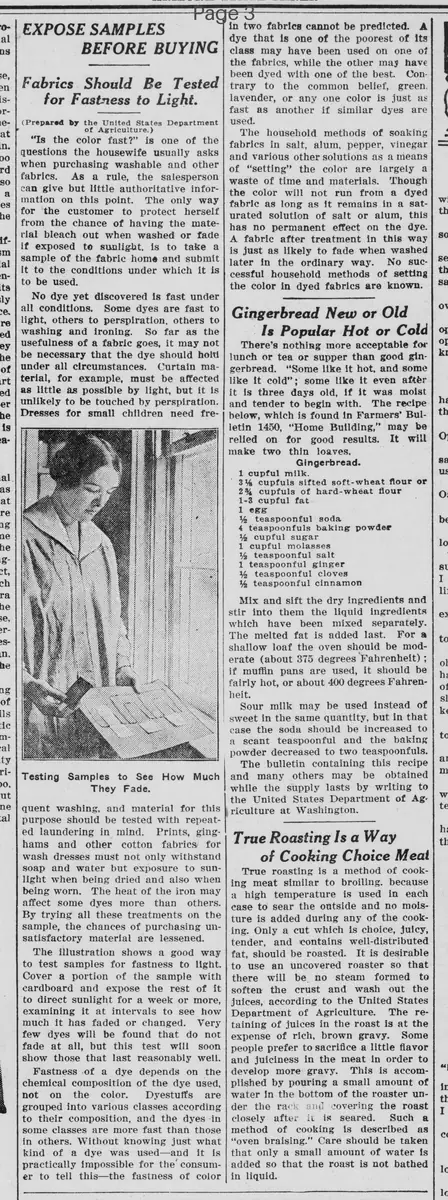
The illustration shows a good way to test samples for fastness to light. Cover a portion of the sample with cardboard and expose the rest of it to direct sunlight for a week or more, examining it at intervals to see how much it has faded or changed. Very few dyes will be found that do not fade at all, but this test will soon show those that last reasonably well.
Fastness of a dye depends on the chemical composition of the dye used, not on the color. Dyestuffs are grouped into various classes according to their composition, and the dyes in some classes are more fast than those in others. Without knowing just what kind of a dye was used - and it is practically impossible for the consumer to tell this - the fastness of color in two fabrics cannot be predicted. A dye that is one of the poorest of its class may have been used on one of the fabrics, while the other may have been dyed with one of the best. Contrary to the common belief, green, lavender, or any one color is just as fast as another if similar dyes are used.
The household methods of soaking fabrics in salt, alum, pepper, vinegar and various other solutions as a means of "setting" the color are largely a waste of time and materials. Though the color will not run from a dyed fabric as long as it remains in a saturated solution of salt or alum, this has no permanent effect on the dye. A fabric after treatment in this way is just as likely to fade when washed later in the ordinary way. No successful household methods of setting the color in dyed fabrics are known.
Testing Samples to See How Much They Fade.
Fabrics Should Be Tested for Fastness to Light.
(Prepared by the United States Department of Agriculture.)
"Is the color fast?" is one of the questions the housewife usually asks when purchasing washable and other fabrics. As a rule, the salesperson can give but little authoritative information on this point. The only way for the customer to protect herself from the chance of having the material bleach out when washed or fade if exposed to sunlight, is to take a sample of the fabric home and submit it to the conditions under which it is to be used.
No dye yet discovered is fast under all conditions. Some dyes are fast to light, others to perspiration, others to washing and ironing. So far as the usefulness of a fabric goes, it may not be necessary that the dye should hold under all circumstances. Curtain material, for example, must be affected as little as possible by light, but it is unlikely to be touched by perspiration. Dresses for small children need frequent washing, and material for this purpose should be tested with repeated laundering in mind. Prints, ginghams and other cotton fabrics for wash dresses must not only withstand soap and water but exposure to sunlight when being dried and also when being worn. The heat of the iron may affect some dyes more than others. By trying all these treatments on the sample, the chances of purchasing unsatisfactory material are lessened.
The illustration shows a good way to test samples for fastness to light. Cover a portion of the sample with cardboard and expose the rest of it to direct sunlight for a week or more, examining it at intervals to see how much it has faded or changed. Very few dyes will be found that do not fade at all, but this test will soon show those that last reasonably well.
Fastness of a dye depends on the chemical composition of the dye used, not on the color. Dyestuffs are grouped into various classes according to their composition, and the dyes in some classes are more fast than those in others. Without knowing just what kind of a dye was used - and it is practically impossible for the consumer to tell this - the fastness of color in two fabrics cannot be predicted. A dye that is one of the poorest of its class may have been used on one of the fabrics, while the other may have been dyed with one of the best. Contrary to the common belief, green, lavender, or any one color is just as fast as another if similar dyes are used.
The household methods of soaking fabrics in salt, alum, pepper, vinegar and various other solutions as a means of "setting" the color are largely a waste of time and materials. Though the color will not run from a dyed fabric as long as it remains in a saturated solution of salt or alum, this has no permanent effect on the dye. A fabric after treatment in this way is just as likely to fade when washed later in the ordinary way. No successful household methods of setting the color in dyed fabrics are known.
Testing Samples to See How Much They Fade.
What sub-type of article is it?
Consumer Advice
Fabric Testing
What keywords are associated?
Dye Fastness
Fabric Testing
Sunlight Exposure
Washing Fabrics
Household Dyes
Domestic News Details
Event Details
Advice on testing fabric samples for dye fastness to light, washing, perspiration, and ironing before purchase. No dye is fast under all conditions; test by exposing to sunlight with part covered. Household setting methods like salt or alum are ineffective.