Thank you for visiting SNEWPapers!
Sign up free
Green Mountain Freeman
Montpelier, Washington County, Vermont
What is this article about?
Account of the closing session of the 32nd Congress on August 31, 1852, in Washington. Senate debates resolutions on clerk classification, fraud investigations, and appropriation bills before adjourning sine die under Vice President King. Chaotic House proceedings concur in conference reports and adjourn amid confusion.
Merged-components note: Continuation of report on closing scenes in Congress; merged sequential components on same topic, relabeled from story to domestic_news.
Clipping
OCR Quality
Full Text
SECOND SESSION.
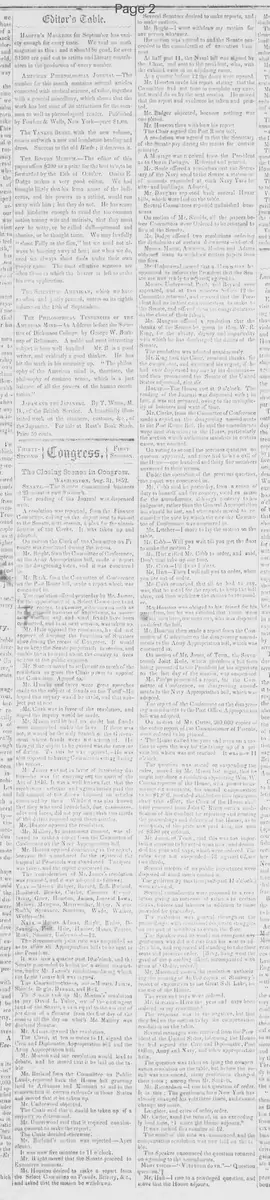
The Closing Scenes in Congress.
Washington, Aug. 31, 1852.
SENATE.—The Senate commenced business at 25 minutes past 9 o'clock.
The reading of the Journal was dispensed with.
A resolution was reported, from the Finance Committee, calling on the department to submit to the Senate, next session, a plan for the classification of the Clerks. It was taken up and adopted.
On motion the Clerk of the Committee on Finance was continued during the recess.
Mr. Bright, from the Committee of Conference, on the Army Appropriation bill, made a report on the disagreeing votes, and it was concurred in.
Mr. Rusk, from the Committee of Conference on the Post Route bill, made a report which was concurred in.
The resolution offered yesterday by Mr. James, for the appointment of a Select Committee to sit during recess to examine, with as much width as to the general business of importance, to ascertain whether any and what frauds have been committed, and to act next session, was taken up.
Mr. Hale opposed the resolution, he did not approve of keeping the functions of Senators alive during the recess of Congress. It would be to keep the Senate perpetually in session, and enable them to travel about the country in fives or tens at the public expense.
Mr. Soule on moved to strike out so much of the resolution as gives the Chair power to appoint the Committee. Agreed to.
Mr. Sumner said there were great speeches made on the subject of frauds on the Tariff—he hoped this inquiry would be made, and that subject put at rest.
Mr. Clarke was in favor of the resolution, and hoped the inquiry would be made.
Mr. Mason said he had no doubt but frauds were committed under the laws. If there was not, it would be the only branch of the Government where frauds were not attempted. He thought the object to be gained was the increase of duties. To this he was opposed.—He was also opposed to having Committees sitting during the recess.
Mr. James was not in favor of increasing duties—he was for carrying out the spirit of the Act of 1846. It was a well known fact that the mechanics artisans and agriculturists paid the full amount of the duties imposed on articles consumed by them. While it was also known that they who used broadcloth, fine cassimeres, silks and laces, did not pay more than two thirds of the duties imposed upon those articles.
Mr. Hunter opposed the resolution.
Mr. Mallory, by unanimous consent, was allowed to make a report from the Committee of Conference on the Navy Appropriation bill.
Mr. Morton opposed concurring in the report, because the amendment for the repairs of the hospital at Pensacola was abandoned. The question was taken, and the report concurred in.
The consideration of Mr. James's resolution was resumed, and it was adopted as follows:
YEAS.—Messrs. Badger, Bayard, Bell, Borland, Bright, Brodhead, Brooke, Clarke, Clemens, Cooper, Davis, Geyer, Houston, James, Johnson of Iowa, Mallory, Mangum, Merrimether, Miller, Norris, Pearce, Rusk, Sebastian, Smith, Spruance, Stockton, Sumner, Wade, Walker, Welter—26.
NAYS.—Messrs. Adams, Bright, Butler, Douglass, Foot, Hale, Hunter, Mason, Pearce, Rusk, Sumner, Underwood—12.
The Seventeenth joint rule was suspended so as to allow all Appropriation bills to be sent to the President.
It was now a quarter past 10 o'clock, and the Senate proceeded to ballot for a select committee, under Mr. James's resolution—during which the Light House bill was signed.
The Committee chosen, are—Messrs. James, Shields, Bright, Dawson, and Bell.
The Senate took up Mr. Morton's resolution to pay David L. Yulee, out of the contingent fund of the Senate, a sum equal to the amount of per diem of a Senator from the first day of the session till the day on which Mr. Mallory was declared Senator.
Mr. Adams opposed the resolution.
The Chair, at ten minutes to 11, signed the Civil and Diplomatic Appropriation bill and the Army Appropriation bill.
Mr. Morton said the resolution would lead to debate, and he moved that it be laid on the table.
Mr. Borland from the Committee on Public Lands, reported back the House bill granting land to Arkansas and Missouri to aid in the construction of certain railroads in those States and moved that it be taken up.
Mr. Underwood objected.
The Chair said that it could be taken up if a majority so determined.
Mr. Underwood said that it required unanimous consent to make the report.
The Chair decided otherwise.
Mr. Borland's motion was rejected—Ayes eleven.
It was now five minutes to 11 o'clock.
Mr. Bright moved that the Senate proceed to Executive business.
Mr. Houston desired to make a report from the Select Committee on Frauds, Bribery, &c., and asked that the motion be withdrawn.
Several Senators desired to make reports, and to make motions.
Mr. Bright—I won't withdraw my motion for any person whatever.
His motion was agreed to and the Senate proceeded to the consideration of executive business.
At half past 11, the Naval bill was signed by the Chair, and sent to the president, who, with the cabinet were in an adjoining room.
At a quarter before 12 the doors were opened.
Mr. Houston made his report stating that the Committee had not time to complete any case, but would do so by the next session. He moved that the report and evidence be taken and printed.
Mr. Badger objected, because nothing was completed.
Mr. Houston then withdrew his report.
The Chair signed the Post Route bill.
A resolution was agreed to that the Secretary of the Senate pay during the recess for certain printing.
A Message was received from the President as to Ocean Postage. Referred and printed.
Mr. Soule offered a resolution that the Secretary of the Navy send to the Senate a statement of amounts expended at each Navy Yard for sites and buildings. Adopted.
Mr. Douglas reported back several House bills, which were laid on the table.
Several Committees reported unfinished business.
On motion of Mr. Shields, all the papers before Committees were ordered to be returned to files of the Senate.
Mr. Dodge offered two resolutions ordering the distribution of certain documents—adopted.
Messrs. Mason, Atchison, Morton and Adams obtained leave to withdraw certain Papers from the files.
Mr. Underwood moved that a Committee be appointed to inform the President that the Senate is now ready to adjourn. Agreed to.
Messrs. Underwood, Pearce, and Bayard were appointed, and at two minutes before 12, the Committee returned, and reported that the President had no further communication to make to the Senate, and offered his Congratulations on the close of their labors.
Mr. Mangum offered a resolution that the thanks of the Senate be given to Hon. W. R. King, for the ability, dignity and impartiality with which he has discharged the duties of the Senate.
The resolution was adopted unanimously.
Mr. King took the Chair, returned thanks for the compliment, and expressed his regret, if he had ever displeased any one by his decisions—and then pronounced the Senate of the United States adjourned, sine die.
HOUSE.—The House met at 9 o'clock. The reading of the Journal was dispensed with; in fact, it was not prepared, owing to the multiplicity of business and want of time.
Mr. Clarke, from the Committee of Conference made a report on the disagreeing amendments to the Post Route Bill. He said the amendments were most obnoxious to the House, particularly the section which authorizes marshals in certain cases, was omitted.
On voting to second the previous question no quorum appeared, and there had to be a call of the House—one hundred and thirty five members answered to their names.
Under the operation of the previous question, the report was concurred in.
Mr. Cobb said he yesterday, from a sense of duty to himself and the country, voted en masse for the amendments, although contrary to his judgment, rather than the General Appropriation bill should be lost, and afterwards moved to reconsider the vote by which the vote he Committee of Conference was concurred in.
Mr. Letcher—I move to lay the motion on the table.
Mr. Cobb—Will you wait till you get the floor to make the motion?
Mr. Hart called Mr. Cobb to order, and said Don't thus take up our time.
Mr. Cobb—[Holds] as [does].
Mr. Hart—Then I will call you to order, when you are out of order.
Mr. Cobb remarked that all he had to say, was, that he voted for the report, to keep the bill alive, and then withdrew the motion to reconsider.
Mr. Houston was obliged to his friend for his explanation, but he was satisfied that there were not six members, nor even one, who was disposed to defeat the bill.
Mr. Houston then made a report from the Committee of Conference on the disagreeing amendments to the Army Appropriation bill, which was concurred in.
On motion of Mr. Jones, of Tenn., the Seventeenth Joint Rule, which prohibits a bill from being presented to the President for his signature on the last day of the session, was suspended.
Mr. Phelps presented a report, for the Committee of Conference, on disagreeing amendments to the Navy Appropriation bill, which was adopted.
The report of the Conference on the disagreeing amendments to the Post Office Appropriation bill was adopted.
On motion of Mr. Carter, 20,000 copies of the entire report of the Commissioner of Patents, were ordered to be printed.
The House called the yeas and nays on a motion to open the way for the taking up of a private bill which was not reached. It was now 11 o'clock.
The question was stated on suspending the rules, moved by Mr. Mason last night, that he might introduce a resolution appointing Wm. W. Curran reporter of the House, with power to associate six assistants, his annual compensation to be $1800, provided that before this resolution shall take effect, the Clerk of the House shall have procured from John C. Rives such a modification of his contract for reporting and printing the proceedings and debates of the House, as to reduce, of the price now paid him, the sum of $350 per column.
Mr. Jones, of Tenn., said this was too important a matter to be acted on now and demanded the yeas and nays, which were ordered. The rules were not suspended—78 against 112, no quorum.
Several matters of no public importance were disposed of amid much confusion.
The galleries by this time (half-past 11 o'clock) were crowded.
Several amendments were proposed to a resolution giving an increase of salary to certain clerks, folders and laborers in addition to those provided for yesterday.
The confusion was general throughout the proceedings with desperate struggles on the part of members to gain the floor.
The Speaker at last recognized a gentleman who did not rise from his seat to address him, and requested all standing to take their seats and preserve order. [Bang, bang went the gavel of the presiding officer, accompanied with cries of Order, order.]
Mr. Marsham moved the resolution authorizing the printing of 10,000 copies of Stanbury's report of exploration to the Great Salt Lake, for the use of the House.
The yeas and nays were ordered.
Mr. Giddings—Have the yeas and nays been ordered on my resolution?
The response was in the negative, but that they had on the motion to lay the compensation resolution on the table.
Several messages were received from the President of the United States, informing the House he had signed the Civil and Diplomatic, Post Office, Army and Navy, and other appropriation bills.
The question was taken on laying the compensation resolution on the table, but before the result was announced, many gentlemen changed their votes; among them Mr. Sackett,
Mr. Richardson—I rise to a question of order. It is this: The gentleman from New York has already changed his vote three times, and cannot change any more.
Laughter, and cries of order, order.
Mr. Carter, near the door, in an exceedingly loud tone, "I move the House adjourn."
It now lacked five minutes of 12.
The result of the vote was announced and the compensation resolution was now laid on the table.
The Speaker announced the question recurred on agreeing to the amendments.
Many voices—"Vote them down."—"Question, question."
Mr. Hill—I rise to a privileged question, and move that the House adjourn.
Mr. Moon, in nearly the same breath, made a similar motion,
The Speaker banged and rapped, calling gentlemen to order. They were standing and talking loudly, all over the Hall.
Mr. Stanton, of Tenn., rose to a question of order, viz: the House has already determined at what time it would adjourn.
Mr. Carter—I move the House adjourn.
"Agreed," agreed, "Adjourn," "adjourn,"
The Speaker—Gentlemen will resume their seats [Bang, bang]
Mr. Carter—I withdraw the motion.
Mr. Polk—I will appeal to the House to re- cede from their amendment to the bill for the relief of Mrs. Margaret Worth.
"Agreed." "agreed."
The Speaker—It can only be done by the unanimous consent of the House.
"Object," object," broke from all parts of the Hall.
Mr. Carter—I renew my motion to adjourn.
The Speaker, after knocking to order, and requesting gentlemen to resume their seats, said the Chair would state the proposition before the House.
Mr. Harris, of Tenn.—I hope he will.
The Speaker cried order; gentlemen invited to take their seats.
Voices—"All right"—"Go ahead."
Then followed tremendous thumps with his gavel. He then said the hour fixed for the adjournment of the present session having arrived,
The Chair accordingly announces this House stands adjourned sine die.
Voices—"Enough said," "Good," "good,"
and with high glee and confusedly, the members rushed from the hall.
What sub-type of article is it?
What keywords are associated?
What entities or persons were involved?
Where did it happen?
Domestic News Details
Primary Location
Washington
Event Date
Aug. 31, 1852
Key Persons
Outcome
senate and house adjourned sine die after concurring on appropriation bills, adopting resolutions including one for a select committee on frauds, and amid chaotic final proceedings in the house.
Event Details
The Senate began at 9:25 AM, dispensed with journal reading, adopted resolutions on clerk classification and fraud investigations, concurred in conference reports on Army, Post Route, and Navy bills, selected a committee on frauds, signed bills, and adjourned at noon under President pro tempore King after thanks resolution. The House met at 9 AM, concurred in conference reports on Post Route, Army, Navy, and Post Office bills, suspended joint rules, ordered printing, faced quorum issues and confusion over private bills and salaries, and adjourned sine die at noon amid disorder.