Thank you for visiting SNEWPapers!
Sign up free
Red Lodge Daily News Combined With Carbon County News
Red Lodge, Carbon County, Montana
What is this article about?
Scholar John B. Alexander translates 4,000-year-old Babylonian tablets revealing peculiar customs: first wives gifting second wives, slave-for-slave justice, pleading letters from women, temple office sales, and a king's retaliatory death decree. From Yale's collection.
Clipping
OCR Quality
Full Text
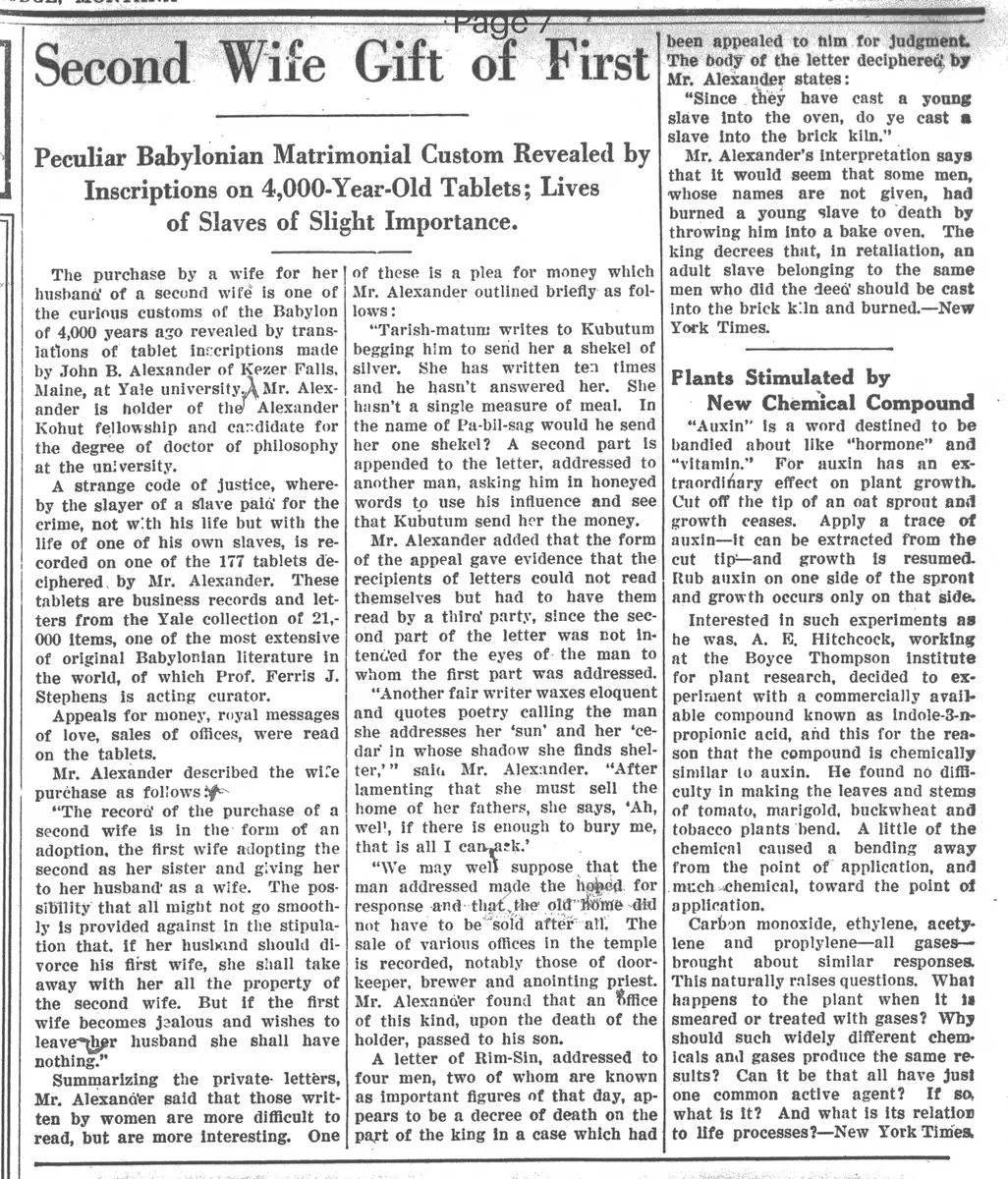
Peculiar Babylonian Matrimonial Custom Revealed by Inscriptions on 4,000-Year-Old Tablets; Lives of Slaves of Slight Importance.
The purchase by a wife for her husband of a second wife is one of the curious customs of the Babylon of 4,000 years ago revealed by translations of tablet inscriptions made by John B. Alexander of Kezer Falls, Maine, at Yale university. Mr. Alexander is holder of the Alexander Kohut fellowship and candidate for the degree of doctor of philosophy at the university.
A strange code of justice, whereby the slayer of a slave paid for the crime, not with his life but with the life of one of his own slaves, is recorded on one of the 177 tablets deciphered by Mr. Alexander. These tablets are business records and letters from the Yale collection of 21,000 items, one of the most extensive of original Babylonian literature in the world, of which Prof. Ferris J. Stephens is acting curator.
Appeals for money, royal messages of love, sales of offices, were read on the tablets.
Mr. Alexander described the wife purchase as follows:
"The record of the purchase of a second wife is in the form of an adoption, the first wife adopting the second as her sister and giving her to her husband as a wife. The possibility that all might not go smoothly is provided against in the stipulation that if her husband should divorce his first wife, she shall take away with her all the property of the second wife. But if the first wife becomes jealous and wishes to leave her husband she shall have nothing."
Summarizing the private letters, Mr. Alexander said that those written by women are more difficult to read, but are more interesting. One of these is a plea for money which Mr. Alexander outlined briefly as follows:
"Tarish-matun writes to Kubutum begging him to send her a shekel of silver. She has written ten times and he hasn't answered her. She hasn't a single measure of meal. In the name of Pa-bil-sag would he send her one shekel? A second part is appended to the letter, addressed to another man, asking him in honeyed words to use his influence and see that Kubutum send her the money."
Mr. Alexander added that the form of the appeal gave evidence that the recipients of letters could not read themselves but had to have them read by a third party, since the second part of the letter was not intended for the eyes of the man to whom the first part was addressed.
"Another fair writer waxes eloquent and quotes poetry calling the man she addresses her 'sun' and her 'cedar' in whose shadow she finds shelter," said Mr. Alexander. "After lamenting that she must sell the home of her fathers, she says, 'Ah, well', if there is enough to bury me, that is all I can ask.'"
"We may well suppose that the man addressed made the hoped-for response and that the old home did not have to be sold after all. The sale of various offices in the temple is recorded, notably those of door-keeper, brewer and anointing priest. Mr. Alexander found that an office of this kind, upon the death of the holder, passed to his son.
A letter of Rim-Sin, addressed to four men, two of whom are known as important figures of that day, appears to be a decree of death on the part of the king in a case which had been appealed to him for judgment.
The body of the letter deciphered by Mr. Alexander states:
"Since they have cast a young slave into the oven, do ye cast a slave into the brick kiln."
Mr. Alexander's interpretation says that it would seem that some men, whose names are not given, had burned a young slave to death by throwing him into a bake oven. The king decrees that, in retaliation, an adult slave belonging to the same men who did the deed should be cast into the brick kiln and burned. -New York Times.
What sub-type of article is it?
What themes does it cover?
What keywords are associated?
What entities or persons were involved?
Where did it happen?
Story Details
Key Persons
Location
Babylon
Event Date
4,000 Years Ago
Story Details
Translations of Babylonian tablets reveal customs including a first wife adopting and gifting a second wife to her husband, with stipulations for divorce or jealousy; justice where slayers of slaves must sacrifice their own slave; women's letters pleading for money or lamenting home sales; sales of temple offices; and a king's decree for retaliatory slave execution.