Thank you for visiting SNEWPapers!
Sign up free
Letter to Editor
March 10, 1804
Jenks' Portland Gazette
Portland, Cumberland County, Maine
What is this article about?
A Federalist correspondent to the Portland Gazette critiques Thomas Jefferson's 1801 inaugural address, accusing him of hypocrisy for promoting unity and impartiality while pursuing partisan persecutions, removals from office, and the debt-increasing Louisiana Purchase.
Clipping
OCR Quality
92%
Excellent
Full Text
FOR THE PORTLAND GAZETTE
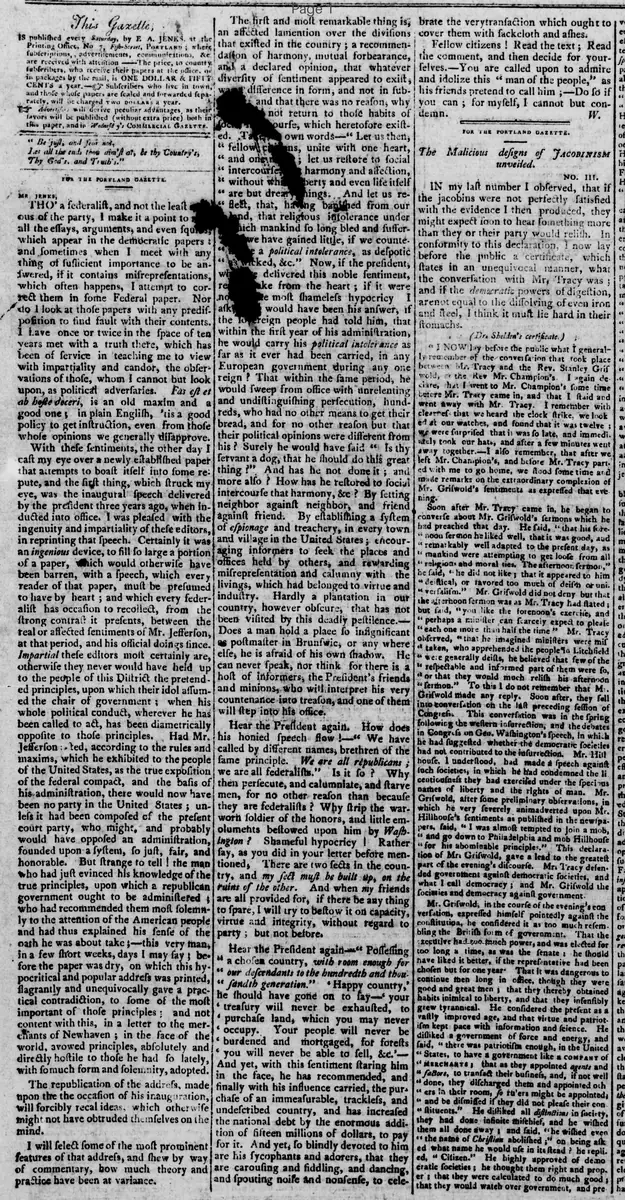
MR. JENKS,
THO' a federalist, and not the least zealous of the party, I make it a point to read all the essays, arguments, and even squibs which appear in the democratic papers: and sometimes when I meet with any thing of sufficient importance to be answered, if it contains misrepresentations, which often happens, I attempt to correct them in some Federal paper. Nor do I look at those papers with any predisposition to find fault with their contents. I have once or twice in the space of ten years met with a truth there, which has been of service in teaching me to view with impartiality and candor, the observations of those, whom I cannot but look upon, as political adversaries. Far et et ab hoste doceri, is an old maxim and a good one: in plain English, 'tis a good policy to get instruction, even from those whose opinions we generally disapprove.
With these sentiments, the other day I cast my eye over a newly established paper that attempts to blast itself into some repute, and the first thing, which struck my eye, was the inaugural speech delivered by the president three years ago, when inducted into office. I was pleased with the ingenuity and impartiality of these editors, in reprinting that speech. Certainly it was an ingenious device, to fill so large a portion of a paper, which would otherwise have been barren, with a speech, which every reader of that paper, must be presumed to have by heart; and which every federalist has occasion to recollect, from the strong contrast it presents, between the real or affected sentiments of Mr. Jefferson, at that period, and his official doings since. Impartial these editors most certainly are, otherwise they never would have held up to the people of this District the pretended principles, upon which their idol assumed the chair of government; when his whole political conduct, wherever he has been called to act, has been diametrically opposite to those principles. . . Had Mr. Jefferson acted, according to the rules and maxims, which he exhibited to the people of the United States, as the true exposition of the federal compact, and the basis of his administration, there would now have been no party in the United States; unless it had been composed of the present court party, who might, and probably would have opposed an administration, founded upon a system, so just, fair, and honorable. 'But strange to tell! the man who had just evinced his knowledge of the true principles, upon which a republican government ought to be administered; who had recommended them most solemnly to the attention of the American people and had thus explained his sense of the oath he was about to take;—this very man; in a few short weeks, days I may say; before the paper was dry, on which this hypocritical and popular address was printed, flagrantly and unequivocally gave a practical contradiction, to some of the most important of those principles; and not content with this, in a letter to the merchants of Newhaven; in the face of the world, avowed principles, absolutely and directly hostile to those he had so lately, with so much form and solemnity, adopted. The republication of the address, made upon the occasion of his inauguration, will forcibly recal ideas, which otherwise might not have obtruded themselves on the mind.
I will select some of the most prominent features of that address, and shew by way of commentary, how much theory and practice have been at variance.
The first and most remarkable thing is, an affected lamentation over the divisions that existed in this country; a recommendation of harmony, mutual forbearance, and a declared opinion, that whatever diversity of sentiment appeared to exist, it was in form; and not in substance, and that there was no reason, why not return to those habits of social intercourse, which heretofore existed: In his own words—"Let us then, fellow-citizens, unite with one heart and one mind. Let us restore to social intercourse harmony and affection, without which liberty and even life itself are but dreary things: .. And let us restore, that having banished from our land, that religious intolerance under which mankind so long bled and suffered we have gained little, if we countenance a political intolerance, as despotic, unchecked, &c." Now, if the president delivered this noble sentiment from the heart: if it were no mere harmless hypocrisy I ask would have been his answer, if the Tory reigning people had told him, that within the first year of his administration, he would carry his political intolerance as far as it ever had been carried, in any European government during any one reign? That within the same period, he would sweep from office with unrelenting and undistinguishing persecution, hundreds, who had no other means to get their bread, and for no other reason but that their political opinions were different from his? Surely he would have said "Is thy servant a dog, that he should do this great thing?". And has he not done it; and more also? How has he restored to social intercourse that harmony, &c? By setting neighbor against neighbor, and friend against friend: By establishing a system of espionage and treachery, in every town and village in the United States; encouraging informers to seek the places and offices held by others, and rewarding misrepresentation and calumny with the livings; which had belonged to virtue and industry. Hardly a plantation in our country, however obscure, that has not been visited by this deadly pestilence.— Does a man hold a place so insignificant as postmaster in Brunswick, or any where else, he is afraid of his own shadow. He can never speak, nor think for there is a host of informers, the President's friends and minions, who will interpret his very countenance into treason, and one of them will step into his office.
Hear the President again. How does his honied speech flow! "We have called by different names; brethren of the same principle. We are all republicans; we are all federalists." Is it so? Why then persecute, and calumniate, and starve men, for no other reason than because they are federalists? Why strip the war-worn soldier of the honors, and little emoluments bestowed upon him by Washington? Shameful hypocrisy! Rather say, as you did in your letter before mentioned, There are two sects in the country, and my sect must be built up, on the ruins of the other. And when my friends are all provided for, if there be any thing to spare, I will try to bestow it on capacity, virtue and integrity, without regard to party; but not before.
Hear the President again—once Possessing "a chosen country, with room enough for our descendants to the hundredth and thousandth generation." 'Happy country,' he should have gone on to say' your 'treasury will never be exhausted, to 'purchase land, which you may never 'occupy.. Your people. will never be 'burdened and mortgaged, for forests 'you will never be able to sell, &c.' And yet, with this sentiment staring him in the face, he has recommended, and finally with his influence carried, the purchase of an immeasurable, trackless, and undescribed country, and has increased the national debt by the enormous addition of fifteen millions of dollars, to pay for it. And yet; so blindly devoted to him are his sycophants and adorers, that they are carousing and fiddling, and dancing, and shouting noise and nonsense, to celebrate the very transaction which ought to cover them with sackcloth and ashes.
Fellow citizens! Read the text: Read the comment, and then decide for yourselves.—You are called upon to admire and idolize this "man of the people," as his friends pretend to call him: Do so if you can: for myself, I cannot but condemn.
W.
MR. JENKS,
THO' a federalist, and not the least zealous of the party, I make it a point to read all the essays, arguments, and even squibs which appear in the democratic papers: and sometimes when I meet with any thing of sufficient importance to be answered, if it contains misrepresentations, which often happens, I attempt to correct them in some Federal paper. Nor do I look at those papers with any predisposition to find fault with their contents. I have once or twice in the space of ten years met with a truth there, which has been of service in teaching me to view with impartiality and candor, the observations of those, whom I cannot but look upon, as political adversaries. Far et et ab hoste doceri, is an old maxim and a good one: in plain English, 'tis a good policy to get instruction, even from those whose opinions we generally disapprove.
With these sentiments, the other day I cast my eye over a newly established paper that attempts to blast itself into some repute, and the first thing, which struck my eye, was the inaugural speech delivered by the president three years ago, when inducted into office. I was pleased with the ingenuity and impartiality of these editors, in reprinting that speech. Certainly it was an ingenious device, to fill so large a portion of a paper, which would otherwise have been barren, with a speech, which every reader of that paper, must be presumed to have by heart; and which every federalist has occasion to recollect, from the strong contrast it presents, between the real or affected sentiments of Mr. Jefferson, at that period, and his official doings since. Impartial these editors most certainly are, otherwise they never would have held up to the people of this District the pretended principles, upon which their idol assumed the chair of government; when his whole political conduct, wherever he has been called to act, has been diametrically opposite to those principles. . . Had Mr. Jefferson acted, according to the rules and maxims, which he exhibited to the people of the United States, as the true exposition of the federal compact, and the basis of his administration, there would now have been no party in the United States; unless it had been composed of the present court party, who might, and probably would have opposed an administration, founded upon a system, so just, fair, and honorable. 'But strange to tell! the man who had just evinced his knowledge of the true principles, upon which a republican government ought to be administered; who had recommended them most solemnly to the attention of the American people and had thus explained his sense of the oath he was about to take;—this very man; in a few short weeks, days I may say; before the paper was dry, on which this hypocritical and popular address was printed, flagrantly and unequivocally gave a practical contradiction, to some of the most important of those principles; and not content with this, in a letter to the merchants of Newhaven; in the face of the world, avowed principles, absolutely and directly hostile to those he had so lately, with so much form and solemnity, adopted. The republication of the address, made upon the occasion of his inauguration, will forcibly recal ideas, which otherwise might not have obtruded themselves on the mind.
I will select some of the most prominent features of that address, and shew by way of commentary, how much theory and practice have been at variance.
The first and most remarkable thing is, an affected lamentation over the divisions that existed in this country; a recommendation of harmony, mutual forbearance, and a declared opinion, that whatever diversity of sentiment appeared to exist, it was in form; and not in substance, and that there was no reason, why not return to those habits of social intercourse, which heretofore existed: In his own words—"Let us then, fellow-citizens, unite with one heart and one mind. Let us restore to social intercourse harmony and affection, without which liberty and even life itself are but dreary things: .. And let us restore, that having banished from our land, that religious intolerance under which mankind so long bled and suffered we have gained little, if we countenance a political intolerance, as despotic, unchecked, &c." Now, if the president delivered this noble sentiment from the heart: if it were no mere harmless hypocrisy I ask would have been his answer, if the Tory reigning people had told him, that within the first year of his administration, he would carry his political intolerance as far as it ever had been carried, in any European government during any one reign? That within the same period, he would sweep from office with unrelenting and undistinguishing persecution, hundreds, who had no other means to get their bread, and for no other reason but that their political opinions were different from his? Surely he would have said "Is thy servant a dog, that he should do this great thing?". And has he not done it; and more also? How has he restored to social intercourse that harmony, &c? By setting neighbor against neighbor, and friend against friend: By establishing a system of espionage and treachery, in every town and village in the United States; encouraging informers to seek the places and offices held by others, and rewarding misrepresentation and calumny with the livings; which had belonged to virtue and industry. Hardly a plantation in our country, however obscure, that has not been visited by this deadly pestilence.— Does a man hold a place so insignificant as postmaster in Brunswick, or any where else, he is afraid of his own shadow. He can never speak, nor think for there is a host of informers, the President's friends and minions, who will interpret his very countenance into treason, and one of them will step into his office.
Hear the President again. How does his honied speech flow! "We have called by different names; brethren of the same principle. We are all republicans; we are all federalists." Is it so? Why then persecute, and calumniate, and starve men, for no other reason than because they are federalists? Why strip the war-worn soldier of the honors, and little emoluments bestowed upon him by Washington? Shameful hypocrisy! Rather say, as you did in your letter before mentioned, There are two sects in the country, and my sect must be built up, on the ruins of the other. And when my friends are all provided for, if there be any thing to spare, I will try to bestow it on capacity, virtue and integrity, without regard to party; but not before.
Hear the President again—once Possessing "a chosen country, with room enough for our descendants to the hundredth and thousandth generation." 'Happy country,' he should have gone on to say' your 'treasury will never be exhausted, to 'purchase land, which you may never 'occupy.. Your people. will never be 'burdened and mortgaged, for forests 'you will never be able to sell, &c.' And yet, with this sentiment staring him in the face, he has recommended, and finally with his influence carried, the purchase of an immeasurable, trackless, and undescribed country, and has increased the national debt by the enormous addition of fifteen millions of dollars, to pay for it. And yet; so blindly devoted to him are his sycophants and adorers, that they are carousing and fiddling, and dancing, and shouting noise and nonsense, to celebrate the very transaction which ought to cover them with sackcloth and ashes.
Fellow citizens! Read the text: Read the comment, and then decide for yourselves.—You are called upon to admire and idolize this "man of the people," as his friends pretend to call him: Do so if you can: for myself, I cannot but condemn.
W.
What sub-type of article is it?
Persuasive
Political
Provocative
What themes does it cover?
Politics
Morality
What keywords are associated?
Jefferson Hypocrisy
Inaugural Address
Louisiana Purchase
Federalist Criticism
Political Persecution
National Debt
Partisan Appointments
What entities or persons were involved?
W.
Mr. Jenks
Letter to Editor Details
Author
W.
Recipient
Mr. Jenks
Main Argument
thomas jefferson's inaugural address hypocritically professed unity, impartiality, and fiscal restraint, yet his administration pursued partisan persecutions, office removals, and the debt-laden louisiana purchase, contradicting those principles.
Notable Details
Quotes Jefferson's Inaugural Address On Unity And Harmony
References Jefferson's Letter To New Haven Merchants
Criticizes Louisiana Purchase As Increasing National Debt By Fifteen Millions
Accuses Administration Of Political Intolerance And Rewarding Informers