Thank you for visiting SNEWPapers!
Sign up free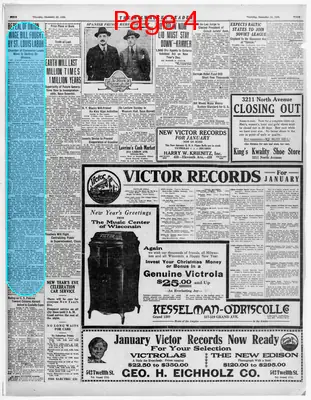
Story
December 30, 1920
The Milwaukee Leader
Milwaukee, Milwaukee County, Wisconsin
What is this article about?
St. Louis public hearing debates repeal of ordinance mandating union wages and eight-hour day for public works; contractors, led by Atty. Rodgers and Chamber of Commerce, oppose it for violating charter and stopping projects, while labor leaders like Cassidy defend it amid bitter exchanges.
Clipping

OCR Quality
98%
Excellent
Full Text
REPEAL OF UNION WAGE BILL FOUGHT BY ST. LOUIS LABOR
Chamber of Commerce Leads Move to Destroy Ordinance.
ST. LOUIS—Arguments for and against the repeal of the city ordinance which regulates the letting of contracts for public work, making special provisions for payment of the union scale of wages and the eight-hour day, were presented to the committee on legislation of the board of aldermen at a public hearing in the city hall. About 75 persons, representing both supporters and opponents of the ordinance, were in attendance.
The fight for the repeal of the ordinance was led by Atty. Hickman P. Rodgers, representing the local contractors, whose statements were seconded by many representatives of the Chamber of Commerce and other business organizations. Those in favor of maintaining the ordinance, rallied under labor leaders, including Maurice J. Cassidy of the Building Trades council and representatives of the Central Trades and Labor union.
The discussions, which centered about the question as to whether the provisions of the ordinance would invalidate the city's special tax bills and would indefinitely stop the carrying out of public work, were frequently marked by bitter attacks by labor leaders upon the activities of the Chamber of Commerce.
Chamber Bitterly Attacked
The arguments reached a climax when W. R. Hamilton, who introduced himself as "a taxpayer," called the Chamber of Commerce an "incubator of Bolshevism" and demanded to know "whether the city was being governed by the Chamber of Commerce or the board of aldermen?"
Rodgers, who opened the discussion for the contractors, said that during the long years of his experience with special tax-bill litigations he had found that many tax-payers would resist payment of special tax bills upon the slightest technicality. For this reason, he said, the city would have to be doubly careful not to pass legislation that would jeopardize the legality of these tax bills.
"The charter provides," Rodgers continued, "that there shall be fullest and freest competition between contractors bidding on public work. The ordinance which we have under discussion tonight is a direct violation of this provision, because by requiring that citizens of St. Louis shall be given the preference and by fixing the wages to be paid, it absolutely eliminates all competition."
"With an ordinance providing that the prevailing rate of wage must be paid these employes, the contractors have but little choice as to the men they want to hire. They cannot bargain with the men as to the wages, and then there are other clauses in the ordinance, affecting the working hours and the work on holidays."
Banks Refuse Loans.
"All lawyers, who have investigated this bill, have declared that its provisions so clearly conflict with the charter that the special tax bills, which are issued by the city in payment for public work, are void and the payment of them could easily be resisted by those against whom they are issued. Consequently the bankers have announced that they will not lend money upon these bills, so that all public work has come to a standstill."
Maurice J. Cassidy, secretary of the Building Trades council, who led the opposition to the repeal bill, said that the contract ordinance had been pending before the board of aldermen for 18 months and that City Counselor Daues had rendered an opinion declaring the bill constitutional and not in violation to any charter provision.
Cassidy blamed what he called the "municipal contractors' trust" for the opposition to the measure and said that if the union labor men had assumed the same attitude now displayed by the contractors they would long ago have been jailed.
Predicts Costly Work.
"If this ordinance is repealed," Cassidy said, "you will find that the bids for public work will be much higher than ever before. It is too bad that the city has not material and money to do its own work. We would be glad to do what we could to help do this work."
C. E. Ehlenbeck of the Central Trades and Labor union charged that the opposition to the contract ordinance was part of the general movement for the so-called "American Plan" and that the city, instead of repealing the bill, should go to work and promulgate enough money to do its own work.
Patrick Price of the Hoisting Engineers' union bitterly attacked the contractors and invited the Chamber of Commerce and any other business organization to investigate the conditions under which quarry laborers and similar workmen are now being employed by the contractors.
Chamber of Commerce Leads Move to Destroy Ordinance.
ST. LOUIS—Arguments for and against the repeal of the city ordinance which regulates the letting of contracts for public work, making special provisions for payment of the union scale of wages and the eight-hour day, were presented to the committee on legislation of the board of aldermen at a public hearing in the city hall. About 75 persons, representing both supporters and opponents of the ordinance, were in attendance.
The fight for the repeal of the ordinance was led by Atty. Hickman P. Rodgers, representing the local contractors, whose statements were seconded by many representatives of the Chamber of Commerce and other business organizations. Those in favor of maintaining the ordinance, rallied under labor leaders, including Maurice J. Cassidy of the Building Trades council and representatives of the Central Trades and Labor union.
The discussions, which centered about the question as to whether the provisions of the ordinance would invalidate the city's special tax bills and would indefinitely stop the carrying out of public work, were frequently marked by bitter attacks by labor leaders upon the activities of the Chamber of Commerce.
Chamber Bitterly Attacked
The arguments reached a climax when W. R. Hamilton, who introduced himself as "a taxpayer," called the Chamber of Commerce an "incubator of Bolshevism" and demanded to know "whether the city was being governed by the Chamber of Commerce or the board of aldermen?"
Rodgers, who opened the discussion for the contractors, said that during the long years of his experience with special tax-bill litigations he had found that many tax-payers would resist payment of special tax bills upon the slightest technicality. For this reason, he said, the city would have to be doubly careful not to pass legislation that would jeopardize the legality of these tax bills.
"The charter provides," Rodgers continued, "that there shall be fullest and freest competition between contractors bidding on public work. The ordinance which we have under discussion tonight is a direct violation of this provision, because by requiring that citizens of St. Louis shall be given the preference and by fixing the wages to be paid, it absolutely eliminates all competition."
"With an ordinance providing that the prevailing rate of wage must be paid these employes, the contractors have but little choice as to the men they want to hire. They cannot bargain with the men as to the wages, and then there are other clauses in the ordinance, affecting the working hours and the work on holidays."
Banks Refuse Loans.
"All lawyers, who have investigated this bill, have declared that its provisions so clearly conflict with the charter that the special tax bills, which are issued by the city in payment for public work, are void and the payment of them could easily be resisted by those against whom they are issued. Consequently the bankers have announced that they will not lend money upon these bills, so that all public work has come to a standstill."
Maurice J. Cassidy, secretary of the Building Trades council, who led the opposition to the repeal bill, said that the contract ordinance had been pending before the board of aldermen for 18 months and that City Counselor Daues had rendered an opinion declaring the bill constitutional and not in violation to any charter provision.
Cassidy blamed what he called the "municipal contractors' trust" for the opposition to the measure and said that if the union labor men had assumed the same attitude now displayed by the contractors they would long ago have been jailed.
Predicts Costly Work.
"If this ordinance is repealed," Cassidy said, "you will find that the bids for public work will be much higher than ever before. It is too bad that the city has not material and money to do its own work. We would be glad to do what we could to help do this work."
C. E. Ehlenbeck of the Central Trades and Labor union charged that the opposition to the contract ordinance was part of the general movement for the so-called "American Plan" and that the city, instead of repealing the bill, should go to work and promulgate enough money to do its own work.
Patrick Price of the Hoisting Engineers' union bitterly attacked the contractors and invited the Chamber of Commerce and any other business organization to investigate the conditions under which quarry laborers and similar workmen are now being employed by the contractors.
What sub-type of article is it?
Historical Event
What themes does it cover?
Justice
Social Manners
What keywords are associated?
Union Wage Bill
St Louis Labor
Chamber Of Commerce
Public Hearing
Contract Ordinance
Eight Hour Day
What entities or persons were involved?
Hickman P. Rodgers
Maurice J. Cassidy
W. R. Hamilton
C. E. Ehlenbeck
Patrick Price
Where did it happen?
St. Louis
Story Details
Key Persons
Hickman P. Rodgers
Maurice J. Cassidy
W. R. Hamilton
C. E. Ehlenbeck
Patrick Price
Location
St. Louis
Story Details
Public hearing in St. Louis city hall on repealing ordinance requiring union wages and eight-hour day for public works contracts; contractors and Chamber of Commerce argue it violates charter and halts work, labor leaders defend it as constitutional and accuse opponents of anti-union bias.