Thank you for visiting SNEWPapers!
Sign up free
Story
July 26, 1958
Jackson Advocate
Jackson, Hinds County, Mississippi
What is this article about?
The National Foundation for Infantile Paralysis, led by Basil O'Connor, announces in New York on July 22 an expansion beyond polio to target arthritis and birth defects through research, patient care, and education, funded by March of Dimes.
Clipping
OCR Quality
98%
Excellent
Full Text
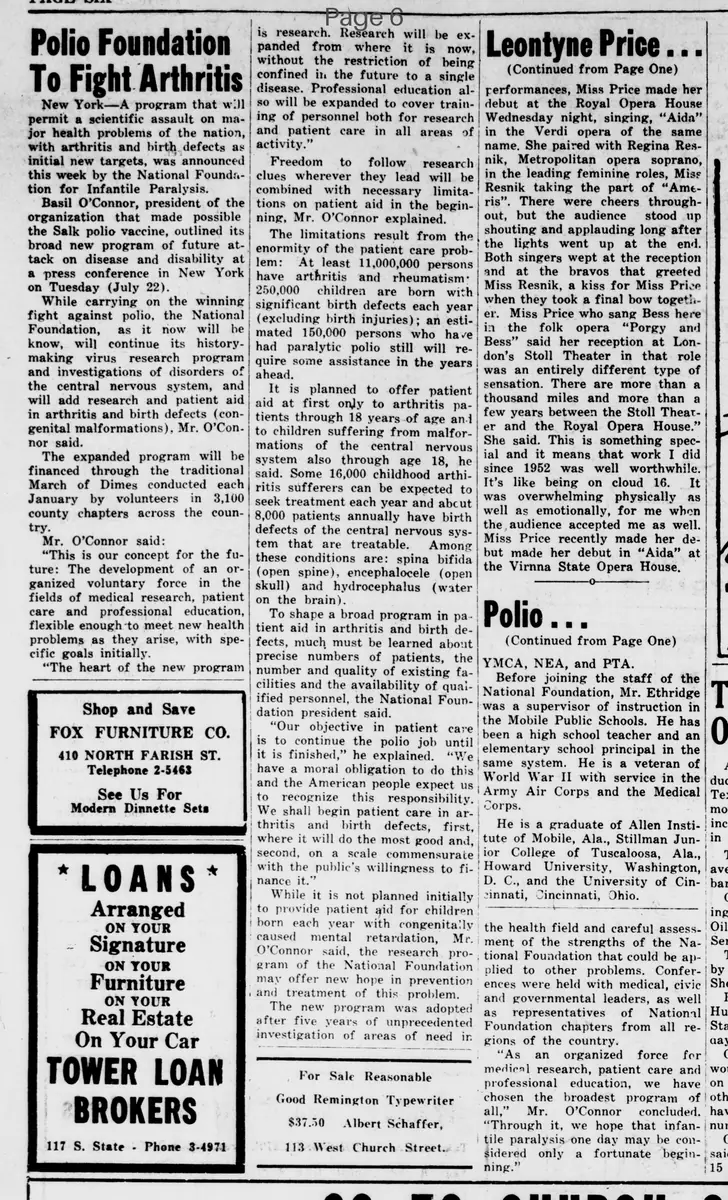
Polio Foundation
To Fight Arthritis
New York—A program that will permit a scientific assault on major health problems of the nation, with arthritis and birth defects as initial new targets, was announced this week by the National Foundation for Infantile Paralysis.
Basil O'Connor, president of the organization that made possible the Salk polio vaccine, outlined its broad new program of future attack on disease and disability at a press conference in New York on Tuesday (July 22).
While carrying on the winning fight against polio, the National Foundation, as it now will be known, will continue its history-making virus research program and investigations of disorders of the central nervous system, and will add research and patient aid in arthritis and birth defects (congenital malformations). Mr. O'Connor said.
The expanded program will be financed through the traditional March of Dimes conducted each January by volunteers in 3,100 county chapters across the country.
Mr. O'Connor said:
"This is our concept for the future: The development of an organized voluntary force in the fields of medical research, patient care and professional education, flexible enough to meet new health problems as they arise, with specific goals initially.
"The heart of the new program is research. Research will be expanded from where it is now, without the restriction of being confined in the future to a single disease. Professional education also will be expanded to cover training of personnel both for research and patient care in all areas of activity."
Freedom to follow research clues wherever they lead will be combined with necessary limitations on patient aid in the beginning, Mr. O'Connor explained.
The limitations result from the enormity of the patient care problem:
At least 11,000,000 persons have arthritis and rheumatism;
250,000 children are born with significant birth defects each year (excluding birth injuries); an estimated 150,000 persons who have had paralytic polio still will require some assistance in the years ahead.
It is planned to offer patient aid at first only to arthritis patients through 18 years of age and to children suffering from malformations of the central nervous system also through age 18, he said. Some 16,000 childhood arthritis sufferers can be expected to seek treatment each year and about 8,000 patients annually have birth defects of the central nervous system that are treatable. Among these conditions are: spina bifida (open spine), encephalocele (open skull) and hydrocephalus (water on the brain).
To shape a broad program in patient aid in arthritis and birth defects, much must be learned about precise numbers of patients, the number and quality of existing facilities and the availability of qualified personnel, the National Foundation president said.
"Our objective in patient care is to continue the polio job until it is finished," he explained. "We have a moral obligation to do this and the American people expect us to recognize this responsibility.
We shall begin patient care in arthritis and birth defects, first, where it will do the most good and, second, on a scale commensurate with the public's willingness to finance it."
While it is not planned initially to provide patient aid for children born each year with congenitally caused mental retardation, Mr. O'Connor said, the research program of the National Foundation may offer new hope in prevention and treatment of this problem.
The new program was adopted after five years of unprecedented investigation of areas of need in the health field and careful assessment of the strengths of the National Foundation that could be applied to other problems. Conferences were held with medical, civic and governmental leaders, as well as representatives of National Foundation chapters from all regions of the country.
"As an organized force for medical research, patient care and professional education, we have chosen the broadest program of all," Mr. O'Connor concluded.
"Through it, we hope that infantile paralysis one day may be considered only a fortunate beginning."
To Fight Arthritis
New York—A program that will permit a scientific assault on major health problems of the nation, with arthritis and birth defects as initial new targets, was announced this week by the National Foundation for Infantile Paralysis.
Basil O'Connor, president of the organization that made possible the Salk polio vaccine, outlined its broad new program of future attack on disease and disability at a press conference in New York on Tuesday (July 22).
While carrying on the winning fight against polio, the National Foundation, as it now will be known, will continue its history-making virus research program and investigations of disorders of the central nervous system, and will add research and patient aid in arthritis and birth defects (congenital malformations). Mr. O'Connor said.
The expanded program will be financed through the traditional March of Dimes conducted each January by volunteers in 3,100 county chapters across the country.
Mr. O'Connor said:
"This is our concept for the future: The development of an organized voluntary force in the fields of medical research, patient care and professional education, flexible enough to meet new health problems as they arise, with specific goals initially.
"The heart of the new program is research. Research will be expanded from where it is now, without the restriction of being confined in the future to a single disease. Professional education also will be expanded to cover training of personnel both for research and patient care in all areas of activity."
Freedom to follow research clues wherever they lead will be combined with necessary limitations on patient aid in the beginning, Mr. O'Connor explained.
The limitations result from the enormity of the patient care problem:
At least 11,000,000 persons have arthritis and rheumatism;
250,000 children are born with significant birth defects each year (excluding birth injuries); an estimated 150,000 persons who have had paralytic polio still will require some assistance in the years ahead.
It is planned to offer patient aid at first only to arthritis patients through 18 years of age and to children suffering from malformations of the central nervous system also through age 18, he said. Some 16,000 childhood arthritis sufferers can be expected to seek treatment each year and about 8,000 patients annually have birth defects of the central nervous system that are treatable. Among these conditions are: spina bifida (open spine), encephalocele (open skull) and hydrocephalus (water on the brain).
To shape a broad program in patient aid in arthritis and birth defects, much must be learned about precise numbers of patients, the number and quality of existing facilities and the availability of qualified personnel, the National Foundation president said.
"Our objective in patient care is to continue the polio job until it is finished," he explained. "We have a moral obligation to do this and the American people expect us to recognize this responsibility.
We shall begin patient care in arthritis and birth defects, first, where it will do the most good and, second, on a scale commensurate with the public's willingness to finance it."
While it is not planned initially to provide patient aid for children born each year with congenitally caused mental retardation, Mr. O'Connor said, the research program of the National Foundation may offer new hope in prevention and treatment of this problem.
The new program was adopted after five years of unprecedented investigation of areas of need in the health field and careful assessment of the strengths of the National Foundation that could be applied to other problems. Conferences were held with medical, civic and governmental leaders, as well as representatives of National Foundation chapters from all regions of the country.
"As an organized force for medical research, patient care and professional education, we have chosen the broadest program of all," Mr. O'Connor concluded.
"Through it, we hope that infantile paralysis one day may be considered only a fortunate beginning."
What sub-type of article is it?
Historical Event
What themes does it cover?
Recovery
Triumph
Moral Virtue
What keywords are associated?
Polio Foundation
Arthritis
Birth Defects
March Of Dimes
Basil Oconnor
Medical Research
Patient Aid
What entities or persons were involved?
Basil O'connor
Where did it happen?
New York
Story Details
Key Persons
Basil O'connor
Location
New York
Event Date
Tuesday (July 22)
Story Details
The National Foundation for Infantile Paralysis announces an expanded program to include research and patient aid for arthritis and birth defects, while continuing polio efforts, financed by March of Dimes.