Thank you for visiting SNEWPapers!
Sign up free
Story
July 20, 1914
Atlanta Georgian
Atlanta, Fulton County, Georgia
What is this article about?
Garrett P. Serviss argues for adopting the metric system over the cumbersome British system, highlighting its simplicity, decimal base, and international scientific acceptance, while criticizing resistance rooted in tradition and anti-French prejudice.
Clipping
OCR Quality
95%
Excellent
Full Text
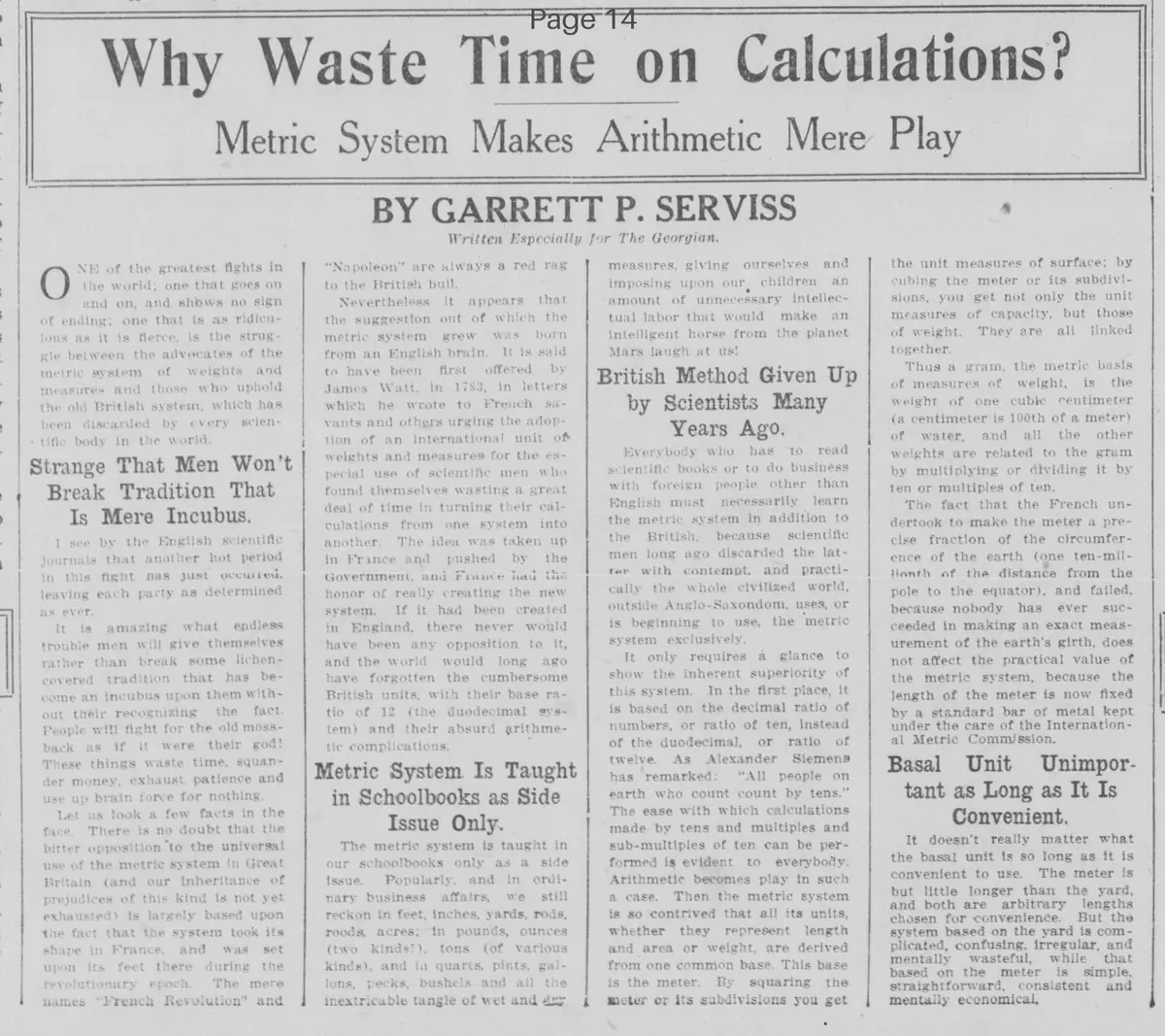
Why
Waste
Time on
Calculations?
Metric
System
Makes
Arithmetic
Mere Play
BY GARRETT P. SERVISS
Written Especially for The Georgian.
One of the greatest fights in the world; one that goes on and on, and shows no sign of ending, one that is as ridiculous as it is fierce, is the struggle between the advocates of the metric system of weights and measures and those who uphold the old British system, which has been discarded by every scientific body in the world.
Strange That Men Won't
Break Tradition That
Is Mere Incubus.
I see by the English scientific Journals that another hot period in this fight has just occurred, leaving each party as determined as ever.
It is amazing what endless trouble men will give themselves rather than break some lichen-covered tradition that has become an incubus upon them without their recognizing the fact.
People will fight for the old moss-back as if it were their god!
These things waste time, squander money, exhaust patience and use up brain force for nothing.
Let us look a few facts in the face. There is no doubt that the bitter opposition to the universal use of the metric system in Great Britain (and our inheritance of prejudices of this kind is not yet exhausted) is largely based upon the fact that the system took its shape in France and was set upon its feet there during the revolutionary epoch.
The mere names "French Revolution" and "Napoleon" are always a red rag to the British bull.
Nevertheless it appears that the suggestion out of which the metric system grew was born from an English brain. It is said to have been first offered by James Watt in 1783, in letters which he wrote to French scientists and others urging the adoption of an international unit of weights and measures for the especial use of scientific men who found themselves wasting a great deal of time in turning their calculations from one system into another. The idea was taken up in France and pushed by the Government and France laid the honor of really creating the new system. If it had been created in England, there never would have been any opposition to it, and the world would long ago have forgotten the cumbersome British units, with their base ratio of 12 (the duodecimal system) and their absurd arithmetic complications.
Metric System Is Taught
in Schoolbooks as Side
Issue Only.
The metric system is taught in our schoolbooks only as a side issue. Popularly, and in ordinary business affairs, we still reckon in feet, inches, yards, rods, roods, acres, in pounds, ounces (two kinds), tons (of various kinds), and in quarts, pints, gallons, pecks, bushels and all the inextricable tangle of wet and dry measures, giving ourselves and imposing upon our children an amount of unnecessary intellectual labor that would make an intelligent horse from the planet Mars laugh at us.
British Method Given Up
by
Scientists
Many
Years Ago.
Everybody who has to read scientific books or to do business with foreign people other than English must necessarily learn the metric system in addition to the British, because scientific men long ago discarded the latter with contempt, and practically the whole civilized world, outside Anglo-Saxondom, uses, or is beginning to use, the metric system exclusively.
It only requires a glance to show the inherent superiority of this system. In the first place, it is based on the decimal ratio of numbers, or ratio of ten, instead of the duodecimal, or ratio of twelve. As Alexander Siemens has remarked: "All people on earth who count count by tens."
The ease with which calculations made by tens and multiples and sub-multiples of ten can be performed is evident to everybody.
Arithmetic becomes play in such a case. Then the metric system is so contrived that all its units, whether they represent length and area or weight, are derived from one common base. This base is the meter. By squaring the meter or its subdivisions you get the unit measures of surface; by cubing the meter or its subdivisions, you get not only the unit measures of capacity, but those of weight. They are all linked together.
Thus a gram, the metric basis of measures of weight, is the weight of one cubic centimeter (a centimeter is 1-100th of a meter) of water, and all the other weights are related to the gram by multiplying or dividing it by ten or multiples of ten.
The fact that the French undertook to make the meter a precise fraction of the circumference of the earth (one ten-millionth of the distance from the pole to the equator), and failed, because nobody has ever succeeded in making an exact measurement of the earth's girth, does not affect the practical value of the metric system, because the length of the meter is now fixed by a standard bar of metal kept under the care of the International Metric Commission.
Basal
Unit
Unimportant as Long as It Is
Convenient.
It doesn't really matter what the basal unit is so long as it is convenient to use. The meter is but little longer than the yard, and both are arbitrary lengths chosen for convenience. But the system based on the yard is complicated, confusing, irregular, and mentally wasteful, while that based on the meter is simple, straightforward, consistent and mentally economical.
Waste
Time on
Calculations?
Metric
System
Makes
Arithmetic
Mere Play
BY GARRETT P. SERVISS
Written Especially for The Georgian.
One of the greatest fights in the world; one that goes on and on, and shows no sign of ending, one that is as ridiculous as it is fierce, is the struggle between the advocates of the metric system of weights and measures and those who uphold the old British system, which has been discarded by every scientific body in the world.
Strange That Men Won't
Break Tradition That
Is Mere Incubus.
I see by the English scientific Journals that another hot period in this fight has just occurred, leaving each party as determined as ever.
It is amazing what endless trouble men will give themselves rather than break some lichen-covered tradition that has become an incubus upon them without their recognizing the fact.
People will fight for the old moss-back as if it were their god!
These things waste time, squander money, exhaust patience and use up brain force for nothing.
Let us look a few facts in the face. There is no doubt that the bitter opposition to the universal use of the metric system in Great Britain (and our inheritance of prejudices of this kind is not yet exhausted) is largely based upon the fact that the system took its shape in France and was set upon its feet there during the revolutionary epoch.
The mere names "French Revolution" and "Napoleon" are always a red rag to the British bull.
Nevertheless it appears that the suggestion out of which the metric system grew was born from an English brain. It is said to have been first offered by James Watt in 1783, in letters which he wrote to French scientists and others urging the adoption of an international unit of weights and measures for the especial use of scientific men who found themselves wasting a great deal of time in turning their calculations from one system into another. The idea was taken up in France and pushed by the Government and France laid the honor of really creating the new system. If it had been created in England, there never would have been any opposition to it, and the world would long ago have forgotten the cumbersome British units, with their base ratio of 12 (the duodecimal system) and their absurd arithmetic complications.
Metric System Is Taught
in Schoolbooks as Side
Issue Only.
The metric system is taught in our schoolbooks only as a side issue. Popularly, and in ordinary business affairs, we still reckon in feet, inches, yards, rods, roods, acres, in pounds, ounces (two kinds), tons (of various kinds), and in quarts, pints, gallons, pecks, bushels and all the inextricable tangle of wet and dry measures, giving ourselves and imposing upon our children an amount of unnecessary intellectual labor that would make an intelligent horse from the planet Mars laugh at us.
British Method Given Up
by
Scientists
Many
Years Ago.
Everybody who has to read scientific books or to do business with foreign people other than English must necessarily learn the metric system in addition to the British, because scientific men long ago discarded the latter with contempt, and practically the whole civilized world, outside Anglo-Saxondom, uses, or is beginning to use, the metric system exclusively.
It only requires a glance to show the inherent superiority of this system. In the first place, it is based on the decimal ratio of numbers, or ratio of ten, instead of the duodecimal, or ratio of twelve. As Alexander Siemens has remarked: "All people on earth who count count by tens."
The ease with which calculations made by tens and multiples and sub-multiples of ten can be performed is evident to everybody.
Arithmetic becomes play in such a case. Then the metric system is so contrived that all its units, whether they represent length and area or weight, are derived from one common base. This base is the meter. By squaring the meter or its subdivisions you get the unit measures of surface; by cubing the meter or its subdivisions, you get not only the unit measures of capacity, but those of weight. They are all linked together.
Thus a gram, the metric basis of measures of weight, is the weight of one cubic centimeter (a centimeter is 1-100th of a meter) of water, and all the other weights are related to the gram by multiplying or dividing it by ten or multiples of ten.
The fact that the French undertook to make the meter a precise fraction of the circumference of the earth (one ten-millionth of the distance from the pole to the equator), and failed, because nobody has ever succeeded in making an exact measurement of the earth's girth, does not affect the practical value of the metric system, because the length of the meter is now fixed by a standard bar of metal kept under the care of the International Metric Commission.
Basal
Unit
Unimportant as Long as It Is
Convenient.
It doesn't really matter what the basal unit is so long as it is convenient to use. The meter is but little longer than the yard, and both are arbitrary lengths chosen for convenience. But the system based on the yard is complicated, confusing, irregular, and mentally wasteful, while that based on the meter is simple, straightforward, consistent and mentally economical.
What sub-type of article is it?
Advocacy Article
Opinion Essay
What keywords are associated?
Metric System
British System
Weights Measures
Decimal Ratio
Scientific Adoption
Arithmetic Simplicity
Historical Opposition
What entities or persons were involved?
Garrett P. Serviss
James Watt
Alexander Siemens
Napoleon
Where did it happen?
Great Britain, France
Story Details
Key Persons
Garrett P. Serviss
James Watt
Alexander Siemens
Napoleon
Location
Great Britain, France
Event Date
1783
Story Details
Serviss advocates for the metric system, noting its origins from James Watt's 1783 idea, French development, decimal simplicity, and superiority over the British system's complexities, criticizing tradition-bound resistance.