Thank you for visiting SNEWPapers!
Sign up free
The National Intelligencer And Washington Advertiser
Washington, District Of Columbia
What is this article about?
Detailed account of the 1801 court martial trial of U.S. Navy Captain George Little, accused of pillage from French prisoners captured from the ship Berceau. Includes defense speech emphasizing his humanity and integrity, unanimous honorable acquittal by the court, and approving letter from Navy Secretary Robert Smith.
Clipping
OCR Quality
Full Text
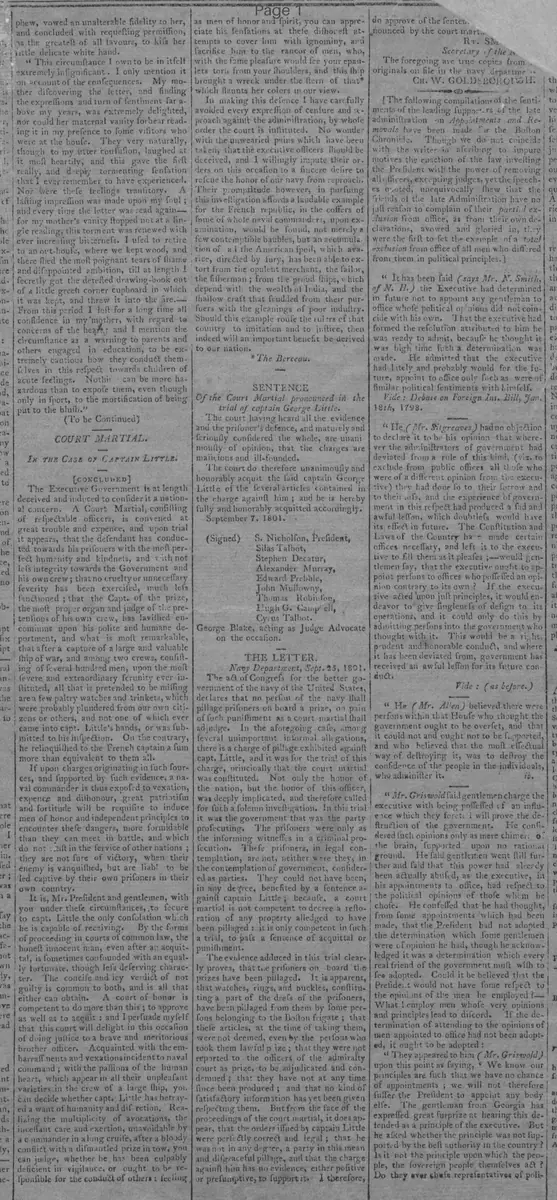
IN THE CASE OF CAPTAIN LITTLE.
[CONCLUDED]
The Executive Government is at length deceived and induced to consider it a national concern. A Court Martial, consisting of respectable officers, is convened at great trouble and expense, and upon trial it appears, that the defendant has conducted towards his prisoners with the most perfect humanity and kindness, and with no less integrity towards the Government and his own crew; that no cruelty or unnecessary severity has been exercised, much less sanctioned; that the Capt. of the prize, the most proper organ and judge of the pretensions of his own crew, has lavished encomiums upon his polite and humane deportment, and what is most remarkable, that after a capture of a large and valuable ship of war, and among two crews, consisting of several hundred men, upon the most severe and extraordinary scrutiny ever instituted, all that is pretended to be missing are a few paltry watches and trinkets, which were probably plundered from our own citizens or others, and not one of which ever came into Capt. Little's hands, or was submitted to his inspection. On the contrary, he relinquished to the French captain a sum more than equivalent to them all.
If upon charges originating in such sources, and supported by such evidence, a naval commander is thus exposed to vexation, expense and dishonor, great patriotism and fortitude will be requisite to induce men of honor and independent principles to encounter these dangers, more formidable than they can meet in battle, and which do not exist in the service of other nations: they are not sure of victory, when their enemy is vanquished, but are liable to be led captive by their own prisoners in their own country.
It is, Mr. President and gentlemen, with you under these circumstances, to secure to Capt. Little the only consolation which he is capable of receiving. By the forms of proceeding in courts of common law, the honest innocent man, even after an acquittal, is sometimes confounded with an equally fortunate, though less deserving character. The concise and icy verdict of not guilty is common to both, and is all that either can obtain. A court of honor is competent to do more than this; to approve as well as to acquit: and I persuade myself that this court will delight in this occasion of doing justice to a brave and meritorious brother officer. Acquainted with the embarrassments and vexations incident to naval command; with the passions of the human heart, which appear in all their unpleasant varieties in the crew of a large ship, you can decide whether Capt. Little has betrayed a want of humanity and discretion. Realizing the multiplicity of avocations, the incessant care and exertion, unavoidable by a commander in a long cruise, after a bloody conflict with a dismantled prize in tow, you can judge, whether he has been culpably deficient in vigilance, or ought to be responsible for the conduct of others: feeling as men of honor and spirit, you can appreciate his sensations at these dishonorable attempts to cover him with ignominy, and sacrifice him to the rancor of men, who, with the same pleasure would see your epaulets torn from your shoulders, and this ship brought a wreck under the stern of that which flaunts her colors in our view.
In making this defense I have carefully avoided every expression of censure and reproach against the administration, by whose order the court is instituted. No wonder with the unwearied pains which have been taken, that the executive officers should be deceived, and I willingly impute their orders on this occasion to a sincere desire to rescue the honor of our navy from reproach. Their promptitude however, in pursuing this investigation affords a laudable example for the French republic, in the coffers of some of whose naval commanders, upon examination, would be found, not merely a few contemptible baubles, but an accumulation of all the American spoil, which avarice, directed by fury, has been able to extort from the opulent merchant, the sailor, the fisherman; from the proud ships, which depart with the wealth of India, and the shallow craft that scudded from their pursuers with the gleanings of poor industry.
Should this example rouse the rulers of that country to imitation and to justice, then indeed will an important benefit be derived to our nation.
* The Berceau.
SENTENCE
Of the Court Martial pronounced in the trial of captain George Little.
The court having heard all the evidence and the prisoner's defense, and maturely and seriously considered the whole, are unanimously of opinion, that the charges are malicious and ill-founded.
The court do therefore unanimously and honorably acquit the said captain George Little of the several articles contained in the charge against him; and he is hereby fully and honorably acquitted accordingly.
September 7, 1801.
(Signed)
S. Nicholson, President,
Silas Talbot,
Stephen Decatur,
Alexander Murray,
Edward Preble,
John Mullowny,
Thomas Robinson,
Hugh G. Campbell,
Cyrus Talbot.
George Blake, acting as Judge Advocate on the occasion.
THE LETTER.
Navy Department, Sept. 25, 1801.
The act of Congress for the better government of the navy of the United States, declares that no person of the navy shall pillage prisoners on board a prize, on pain of such punishment as a court martial shall adjudge. In the aforegoing case, among several unimportant informal allegations, there is a charge of pillage exhibited against Capt. Little, and it was for the trial of this charge, principally that the court martial was constituted. Not only the honor of the nation, but the honor of this officer, was deeply implicated, and therefore called for such a solemn investigation. In this trial it was the government that was the party prosecuting. The prisoners were only as the informing witnesses in a criminal prosecution. These prisoners, in legal contemplation, are not, neither were they, in the contemplation of government, considered as parties. They could not have been, in any degree, benefited by a sentence against captain Little; because, a court martial is not competent to decree a restoration of any property alleged to have been pillaged: it is only competent in such a trial, to pass a sentence of acquittal or punishment.
The evidence adduced in this trial clearly proves, that the prisoners on board the prizes have been pillaged. It is apparent, that watches, rings, and buckles, constituting a part of the dress of the prisoners, have been pillaged from them by some persons belonging to the Boston frigate; that these articles, at the time of taking them, were not deemed, even by the persons who took them lawful prize; that they were not reported to the officers of the admiralty court as prize, to be adjudicated and condemned; that they have not at any time since been produced; and that no kind of satisfactory information has yet been given respecting them. But from the face of the proceedings of the court martial, it does appear, that the orders issued by captain Little were perfectly correct and legal: that he was not in any degree, a party in this mean and disgraceful pillage, and that the charge against him has no evidence, either positive or presumptive, to support it. I therefore, do approve of the sentence pronounced by the court martial.
(Signed) RT: SM.
Secretary of the Navy.
The foregoing are true copies from originals on file in the navy department.
CH. W. GOLDSBOROUGH.
What sub-type of article is it?
What themes does it cover?
What keywords are associated?
What entities or persons were involved?
Where did it happen?
Story Details
Key Persons
Location
Boston Frigate
Event Date
September 7, 1801
Story Details
Captain George Little is tried by court martial on charges of pillage from French prisoners captured from the Berceau. Defense highlights his humane treatment and lack of involvement in thefts. Court unanimously acquits him honorably, deeming charges malicious. Navy Secretary approves the sentence, noting pillage by others but not Little.