Thank you for visiting SNEWPapers!
Sign up free
Alexandria Gazette & Advertiser
Alexandria, Virginia
What is this article about?
Report on U.S. Congress proceedings, 18th Congress Second Session, December 20, 1824: Senate handles qualifications, pension reports, memorials, bills for La Fayette and others; House addresses petitions, resolutions on piracies, Virginia claims, naval defenses, duties, public lands, and Oregon settlement.
Merged-components note: These components form a continuous report on congressional proceedings from the National Intelligencer, including Senate and House activities, resolutions, and debates on Virginia claims and other matters.
Clippings
1 of 2
OCR Quality
Full Text
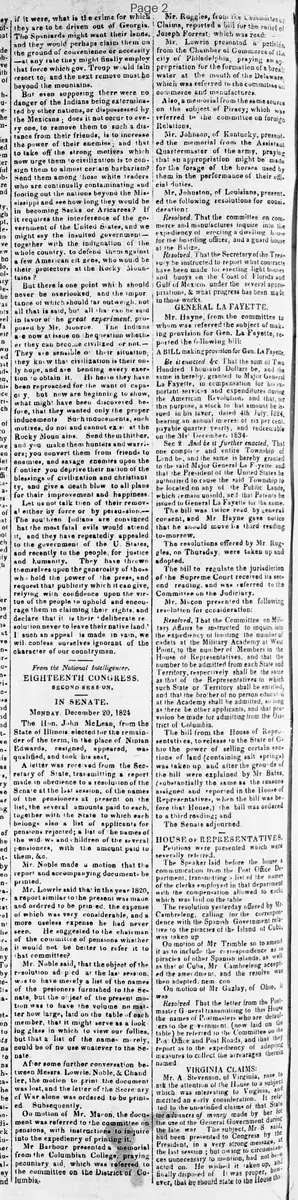
EIGHTEENTH CONGRESS.
SECOND SESSION.
IN SENATE.
Monday, December 20, 1824.
The Hon. John McLean, from the State of Illinois, elected for the remainder of the term, in the place of Ninian Edwards, resigned, appeared, qualified, and took his seat.
A letter was received from the Secretary of State, transmitting a report made in obedience to a resolution of the Senate at the last session, of the names of the pensioners at present on the list, the several amounts paid to each, together with the State to which each belongs; also a list of applicants for pensions rejected; a list of the names of the widows and children of the several pensioners, with the amount paid to them, &c.
Mr. Noble made a motion that the report and accompanying documents be printed.
Mr. Lowrie said that in the year 1820, a report similar to the present was made and ordered to be printed, the expense of which was very considerable, and a more useless expense he had never seen. He suggested to the chairman of the committee of pensions whether it would not be better to refer it to that committee?
Mr. Noble said, that the object of the resolution adopted at the last session, was to have merely a list of the names of the pensioners furnished to the Senate: but the object of the present motion was to have the volume no matter how large, laid on the table of each member, that it might serve as a looking glass in which to view our follies, but that a list of the names merely, could be of no use whatever to the Senate.
After some further conversation between Messrs. Lowrie, Noble, & Chandler, the motion to print the document was lost, and the letter of the Secretary of War alone was ordered to be printed. Subsequently,
On motion of Mr. Macon, the document was referred to the committee on pensions, with instructions to inquire into the expediency of printing it.
Mr. Barbour presented a memorial from the Columbian College, praying pecuniary aid; which was referred to the committee on the District of Columbia.
Mr. Ruggles, from the Committee of Claims, reported a bill for the relief of Joseph Forrest, which was read.
Mr. Lowrie presented a petition from the Chamber of Commerce of the city of Philadelphia, praying an appropriation for the formation of a breakwater at the mouth of the Delaware, which was referred to the committee on commerce and manufactures.
Also a memorial from the same source on the subject of Piracy; which was referred to the committee on foreign Relations.
Mr. Johnson, of Kentucky, presented the memorial from the Assistant Quarter Master of the army, praying that an appropriation might be made for the forage of the horses used by them in the performance of their official duties.
Mr. Johnston, of Louisiana, presented the following resolutions for consideration:
Resolved, That the committee on commerce and manufactures inquire into the expediency of erecting a dwelling house for the boarding officer, and a guard house at the Balize.
Resolved, That the Secretary of the Treasury be instructed to report what contracts have been made for erecting light houses and buoys on the coast of Florida and Gulf of Mexico, under the several appropriations, & what progress has been made in those works.
GENERAL LA FAYETTE.
Mr. Hayne, from the committee to whom was referred the subject of making provision for Gen. La Fayette, reported the following bill:
A BILL making provision for Gen. La Fayette.
Be it enacted &c. That the sum of Two Hundred Thousand Dollars be, and the same is hereby, granted to Major General La Fayette, in compensation for his important services and expenditures during the American Revolution, and that, for this purpose, a stock to that amount be issued in his favor, dated 4th July, 1824, bearing an annual interest of six per cent. payable quarter yearly, and redeemable on the 31st December, 1834.
Sec 2 And be it further enacted, That one complete and entire Township of Land be, and the same is hereby granted to the said Major General La Fayette and that the President of the United States be authorized to cause the said Township to be located on any of the Public Lands, which remain unsold, and that Patents be issued to General La Fayette for the same.
The bill was twice read by general consent, and Mr. Hayne gave notice that he should move its third reading to-morrow.
The resolutions offered by Mr Ruggles, on Thursday, were taken up and adopted.
The bill to regulate the jurisdiction of the Supreme Court received its second reading, and was referred to the Committee on the Judiciary.
Mr. Macon presented the following resolution for consideration:
Resolved, That the Committee on Military Affairs be instructed to inquire into the expediency of limiting the number of cadets at the Military Academy at West Point, to the number of Members in the House of Representatives, and that the number to be admitted from each State and Territory, respectively shall be the same as that of the Representatives to which such State or Territory shall be entitled, and that the brother of no person educated at the Academy shall be admitted, so long as there be other applicants, and that provision be made for admitting from the District of Columbia.
The bill from the House of Representatives, to release to the State of Ohio the power of selling certain sections of land (containing salt springs) was taken up and after the grounds of the bill were explained by Mr Bates, (substantially the same as the reasons assigned and reported in the House of Representatives, when the bill was before that House,) the bill was ordered to a third reading; and
The Senate adjourned.
HOUSE OF REPRESENTATIVES.
Petitions were presented which were severally referred.
The Speaker laid before the house a communication from the Post Office Department, transmitting a list of the names of the clerks employed in that department with the compensation allowed to each; which was laid on the table.
The resolution yesterday offered by Mr Cambreleng, calling for the correspondence with the Spanish Government relative to the piracies of the Island of Cuba, was taken up.
On motion of Mr Trimble so to amend it as to include the correspondence as to piracies of other Spanish islands, as well as that of Cuba, Mr Cambreleng accepted the amendment, and the resolve was then adopted. nem con.
On motion of Mr Gazlay, of Ohio,
Resolved That the letter from the Postmaster General transmitting to this House the names of Postmasters who are defaulters to the government. (now laid on the table) be referred to the Committee on the Post Office and Post Roads, and that they report as to the expediency of adopting measures to collect the arrearages therein named.
VIRGINIA CLAIMS:
Mr. A Stevenson, of Virginia, rose to ask the attention of the House to a subject which was so interesting to Virginia, and merited an early consideration. It related to the unsatisfied claims of that State for advances of money made by her for the use of the General Government during the late war.
The subject, Mr S said, in very strong terms unnecessary to mention, had not been acted on at the last session; but owing to circumstances, had not been finally disposed of. It was proper, however, that he should state to the House that the President in his message...
Virginia would press the payment only of that part of the claim which related to borrowed for the use of the General Government—paid by her upon moneys disbursed service claim, and the principles which it involved character not now speak. At a proper time, he would said the claim asserted by Virginia was founded shew the House authority ought to be paid. This, however, he would say in the Union might have been during the the conduct other states late war, there was not one who had been pervices than Virginia, or more loyal in more steadfast and disinterested in her the devotion of her resources to the general defence. fair and just principles This was due as claims should be speedily adjusted upon She now only asked that her right to this government as to Virginia, and with that view he begged leave to submit the following resolution: Resolved, That the Committee on Military Affairs be instructed to inquire into the propriety of providing by law for the reimbursement of the amount of interest. the money negotiated by her for the use of the paid by the state of Virginia upon loans of general government, during the late war between Great Britain and the U. States. Mr. Hamilton, (chairman of the committee on Military Affairs) suggested, that as this was a purely legal question, its proper direction was rather to the committee on the Judiciary, than to that on Military Affairs. Mr Stevenson observed that he felt no great solicitude as to what direction the resolution should take; but he thought his friend from South Carolina was mistaken in supposing that the resolution embraced was a question which arose entirely out of a question of a purely legal character. It was a question which arose entirely out of military transactions. In sending it to the Military Committee, he had been guided by the suggestion of some of the eldest members of this House, whose opinion he had consulted, and also by the reference of a similar question in the other house of congress. Mr. Hamilton adhered to his amendment, being persuaded that the resolution could in no case pertain to the military committee. If it did not properly belong to the committee on the Judiciary, it ought to go to the Committee on Claims. Mr. P.P. Barbour thought that, from the nature of the functions of the committee on the Judiciary, (which had cognizance of courts and of laws) this subject could not belong to them. The principle of the gentleman from South Carolina would send every question in which law was concerned to that committee— This was a question concerning disbursements for military service, and as such, properly pertained, he should suppose, to the committee on Military Affairs. The question was then taken on Mr. Hamilton's amendment, and lost. When Mr. Sharpe of New-York moved to amend the resolution so as to refer the subject to the Committee of Claims, which was carried, ayes 94. noes 63 Thus amended, the resolution was agreed to. Mr. Mallary of Vermont, then offered the following resolution: Resolved, That the Committee on Naval Affairs be instructed to inquire into the expediency of making an appropriation for collecting materials and preparing for the building of a steam vessel of war for the defence of Lake Champlain. Mr. Mallary observed, that it was well known to the House that the government had some time since erected fortifications on an extensive scale with a view to the defence of Lake Champlain—but that. owing to a dispute or error with respect to the boundary line which separates that part of the United States from Canada, those works had been abandoned. The lake was, in consequence, now left destitute of any defence whatever. as the navy which for a time floated on its waters, was now dismantled and fast going to decay. If the general principle of defence on which the country was acting in relation to our Atlantic seaboard, was a just and wise principle it surely applied with additional strength to a case where the country of the enemy was not on the other side of the Atlantic, but in immediate adjacency to our territory. The resolution was adopted. On motion of Mr. Allen, it was Resolved, That the committee of ways and means be instructed to inquire into the expediency of reducing the duty on the importation of brown sugar. Mr. Wickliffe moved to amend the resolution by adding the words 'and molasses, which motion was lost. [Mr. W. understood, when he made this motion, that the resolve to increase the duty on brown sugar, instead of proposing to reduce it ] The question was then put upon agreeing to the resolution, and it passed in the negative. On motion of Mr. McKimm, it was Resolved, That the committee on commerce be instructed to inquire into the expediency of reducing the amount of monthly pay now allowed by law to seamen of the United States, when discharged in foreign ports, from the sale of vessels, or other causes. On motion of Mr. Moore, of Kentucky, the committee of the whole was discharged from the further consideration of the bill for the benefit of the Deaf and Dumb Asylum of Kentucky, and it was committed to a select committee Mr Whipple of N. H. laid on the table the following: Resolved, That the President of the United States be requested to communicate to this House any information which he may possess, and which, in his opinion, it may not be improper to make public, relative to the intentions of the allied powers of Europe to aid Spain in the subjugation and recovery of her former Colonies in America. On motion of Mr. McDuffie it was Resolved, That a select committee be appointed, with instructions to inquire into the expediency and practicability of limiting and regulating the sales of the public lands in such manner that the quantity brought into market may not exceed the effective demand at a fair and natural price: and with further instructions to inquire into any abuses which may exist from the combination of capitalists for the purpose of defrauding the government, or from the defective organization of the land office system; and, if any such abuses are found to exist, to devise and report some plan by which they may be corrected. Mr. Livingston gave notice, that when Mr. McDuffie should call up the consideration of the joint resolution moved by him, proposing an amendment to the constitution in regard to the election of President and Vice President of the United States, he should again offer the amendment he had formerly proposed to that resolution. SETTLEMENT OF THE OREGON. Mr. Floyd of Virginia, moved that the House go into committee of the whole on the state of the Union, with a view to take up the bill "for the occupation of the mouth of the Columbia (or Oregon) River;" which was agreed to, and the House went into committee accordingly, Mr. A. Stevenson in the chair. The bill was read by sections, and the several blanks were filled. Adjourned.
What sub-type of article is it?
What keywords are associated?
What entities or persons were involved?
Where did it happen?
Domestic News Details
Primary Location
Washington
Event Date
Monday, December 20, 1824
Key Persons
Event Details
The Senate convened with John McLean qualifying and taking his seat. A report on pensioners was received and debated, ultimately referred to the pensions committee without printing. Memorials and petitions on education, commerce, piracy, military forage were presented and referred. Resolutions on commerce, lighthouses, military academy limits introduced. Bill granting $200,000 and land to Gen. La Fayette reported. Other bills and resolutions handled, including Ohio land release. In the House, petitions referred, post office reports laid on table. Resolutions on Spanish piracies, postmaster defaulters, Virginia war claims (referred to Claims Committee), Lake Champlain defense, sugar duties (failed), seamen pay, Deaf and Dumb Asylum bill, European intentions toward Spanish colonies, public land sales regulation, and Oregon River occupation bill taken up.