Thank you for visiting SNEWPapers!
Sign up free
South Carolina Temperance Advocate
Columbia, Richland County, South Carolina
What is this article about?
Historical account from Philadelphia National Gazette on the anniversary of independence: Richard Henry Lee's June 7, 1776, motion in Congress for separation from Britain, committee drafting by Jefferson et al., adoption on July 4, signing details, and Jefferson's lodging house location. (248 characters)
Clipping
OCR Quality
Full Text
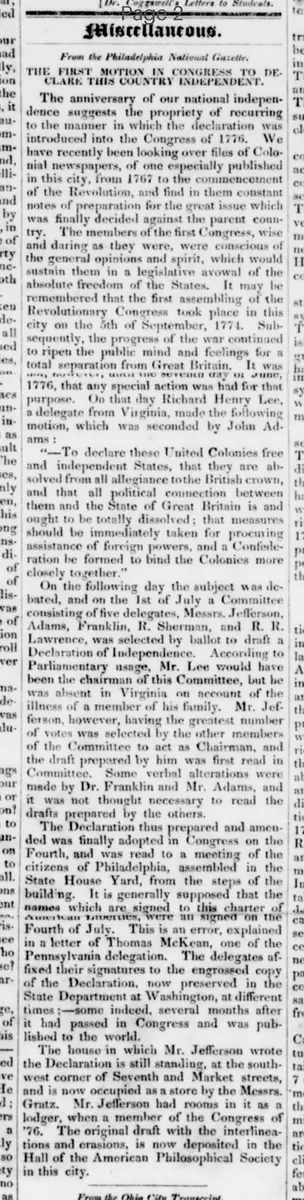
From the Philadelphia National Gazette.
THE FIRST MOTION IN CONGRESS TO DECLARE THIS COUNTRY INDEPENDENT.
The anniversary of our national independence suggests the propriety of recurring to the manner in which the declaration was introduced into the Congress of 1776. We have recently been looking over files of Colonial newspapers, of one especially published in this city, from 1767 to the commencement of the Revolution, and find in them constant notes of preparation for the great issue which was finally decided against the parent country. The members of the first Congress, wise and daring as they were, were conscious of the general opinions and spirit, which would sustain them in a legislative avowal of the absolute freedom of the States. It may be remembered that the first assembling of the Revolutionary Congress took place in this city on the 5th of September, 1774. Subsequently, the progress of the war continued to ripen the public mind and feelings for a total separation from Great Britain. It was towards the seventh day of June, 1776, that any special action was had for that purpose. On that day Richard Henry Lee, a delegate from Virginia, made the following motion, which was seconded by John Adams:
"That these United Colonies free and independent States, that they are absolved from all allegiance to the British crown, and that all political connection between them and the State of Great Britain is and ought to be totally dissolved: that measures should be immediately taken for procuring assistance of foreign powers, and a Confederation be formed to bind the Colonies more closely together."
On the following day the subject was debated, and on the 1st of July a Committee consisting of five delegates, Messrs. Jefferson, Adams, Franklin, R. Sherman, and R. R. Lawrence, was selected by ballot to draft a Declaration of Independence. According to Parliamentary usage, Mr. Lee would have been the chairman of this Committee, but he was absent in Virginia on account of the illness of a member of his family. Mr. Jefferson, however, having the greatest number of votes was selected by the other members of the Committee to act as Chairman, and the draft prepared by him was first read in Committee. Some verbal alterations were made by Dr. Franklin and Mr. Adams, and it was not thought necessary to read the drafts prepared by the others.
The Declaration thus prepared and amended was finally adopted in Congress on the Fourth, and was read to a meeting of the citizens of Philadelphia, assembled in the State House Yard, from the steps of the building. It is generally supposed that the names which are signed to this charter of American liberties, were all signed on the Fourth of July. This is an error, explained in a letter of Thomas McKean, one of the Pennsylvania delegation. The delegates affixed their signatures to the engrossed copy of the Declaration, now preserved in the State Department at Washington, at different times;—some indeed, several months after it had passed in Congress and was published to the world.
The house in which Mr. Jefferson wrote the Declaration is still standing, at the south-west corner of Seventh and Market streets, and is now occupied as a store by the Messrs. Gratz. Mr. Jefferson had rooms in it as a lodger, when a member of the Congress of '76. The original draft with the interlineations and erasures, is now deposited in the Hall of the American Philosophical Society in this city.
What sub-type of article is it?
What keywords are associated?
What entities or persons were involved?
Where did it happen?
Domestic News Details
Primary Location
Philadelphia
Event Date
Towards The Seventh Day Of June, 1776
Key Persons
Outcome
the declaration was adopted in congress on the fourth [of july], read to citizens in philadelphia, signatures affixed at different times, some months later.
Event Details
Richard Henry Lee made a motion on the seventh day of June, 1776, seconded by John Adams, to declare the United Colonies free and independent States, absolved from allegiance to the British crown, dissolve political connection with Great Britain, procure foreign assistance, and form a Confederation. Debated the next day. On July 1, a Committee of Jefferson, Adams, Franklin, R. Sherman, and R. R. Lawrence drafted the Declaration. Jefferson chaired due to Lee's absence and prepared the draft, amended by Franklin and Adams. House where Jefferson wrote it at south-west corner of Seventh and Market streets, now a store by Messrs. Gratz. Original draft in American Philosophical Society.