Thank you for visiting SNEWPapers!
Sign up free
Norfolk Gazette And Publick Ledger
Norfolk, Virginia
What is this article about?
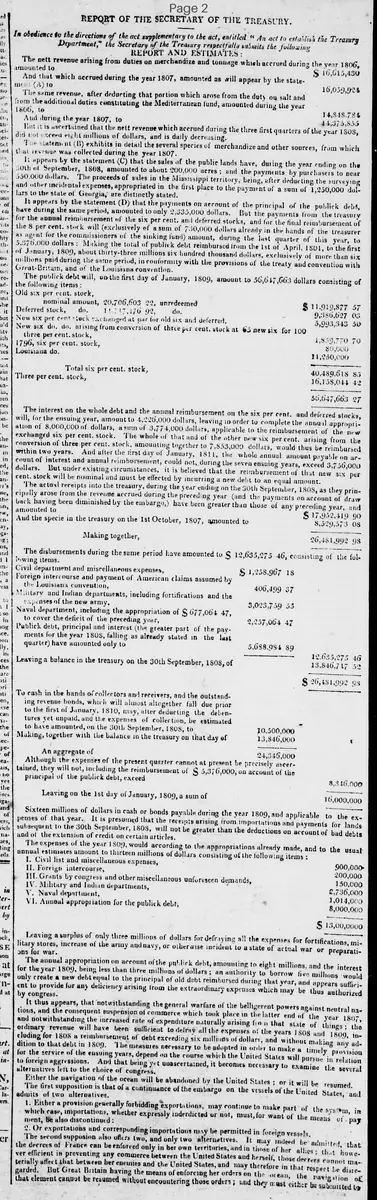
Secretary of the Treasury Albert Gallatin's report to Congress on December 10, 1808, details U.S. revenue from duties for 1806-1808, public land sales, debt reimbursements, treasury balances, projected expenses for 1809, and policy recommendations on embargo, non-importation, duties, and preparations for potential war with belligerents.
Merged-components note: Continuation of the Report of the Secretary of the Treasury across pages 2 and 3; relabeled from story to domestic_news as it is an official government financial report.
Clippings
1 of 2
OCR Quality
Full Text
In obedience to the directions of the act supplementary to the act, entitled "An act to establish the Treasury Department," the Secretary of the Treasury respectfully submits the following
REPORT AND ESTIMATES:
The nett revenue arising from duties on merchandize and tonnage which accrued during the year 1806, amounted to
$ 16,615,430
And that which accrued during the year 1807, amounted as will appear by the statement (A) to
16,059,924
The same revenue, after deducting that portion which arose from the duty on salt and from the additional duties constituting the Mediterranean fund, amounted during the year 1806, to
14,548,784
And during the year 1807, to
14,375,855
But it is ascertained that the nett revenue which accrued during the three first quarters of the year 1808, did not exceed eight millions of dollars, and is daily decreasing.
The statement (B) exhibits in detail the several species of merchandize and other sources, from which that revenue was collected during the year 1807.
It appears by the statement (C) that the sales of the public lands have, during the year ending on the 30th of September, 1808, amounted to about 200,000 acres; and the payments by purchasers to near $500,000 dollars. The proceeds of sales in the Mississippi territory, being, after deducting the surveying and other incidental expenses, appropriated in the first place to the payment of a sum of 1,250,000 dollars to the state of Georgia, are distinctly stated.
It appears by the statement (D) that the payments on account of the principal of the publick debts, have during the same period, amounted to only 2,335,000 dollars. But the payments from the treasury for the annual reimbursement of the six per cent. and deferred stocks, and for the final reimbursement of the 8 per cent. stock will (exclusively of a sum of 730,000 dollars already in the hands of the treasurer as agent for the commissioners of the sinking fund) amount, during the last quarter of this year, to 5,376,000 dollars: Making the total of publick debt reimbursed from the 1st of April, 1808, to the first of January, 1809, about thirty-three millions six hundred thousand dollars, exclusively of more than six millions paid during the same period, in conformity with the provisions of the treaty and convention with Great-Britain, and of the Louisiana convention.
The publick debt will, on the first day of January, 1809, amount to 56,647,663 dollars consisting of the following items:
Old six per cent. stock,
nominal amount, 20,706,603 22, unredeemed
$ 11,919,877 57
Deferred stock, do.
11,717,176 92,
do.
9,386,627 03
New six per cent stock exchanged at par for old six and deferred.
5,993,343 50
New six do. do. arising from conversion of three per cent. stock at 65 new six for 100 three per cent. stock,
1,796, six per cent. stock,
1,859,770 70
Louisiana do.
11,250,000
Total six per cent. stock,
40,489,618 85
Three per cent. stock,
16,158,044 42
56,647,663 27
The interest on the whole debt and the annual reimbursement on the six per cent. and deferred stocks, will, for the ensuing year, amount to 4,226,000 dollars, leaving in order to complete the annual appropriation of 8,000,000 of dollars, a sum of 3,774,000 dollars, applicable to the reimbursement of the new exchanged six per cent. stock. The whole of that and of the other new six per cent. arising from the conversion of three per cent. stock, amounting together to 7,853,000 dollars, would thus be reimbursed within two years. And after the first day of January, 1811, the whole annual amount payable on account of interest and annual reimbursement, could not, during the seven ensuing years, exceed 3,756,000 dollars. But under existing circumstances, it is believed that the reimbursement of that new six per cent. stock will be nominal and must be effected by incurring a new debt to an equal amount.
The actual receipts into the treasury, during the year ending on the 30th September, 1808, as they principally arose from the revenue accrued during the preceding year (and the payments on account of drawback having been diminished by the embargo,) have been greater than those of any preceding year, and amounted to
$ 17,952,419 90
And the specie in the treasury on the 1st October, 1807, amounted to
8,529,573 08
Making together,
26,481,992 98
The disbursements during the same period have amounted to $ 12,635,275 46, consisting of the following items.
Civil department and miscellaneous expenses,
$ 1,258,967 18
Foreign intercourse and payment of American claims assumed by the Louisiana convention,
406,499 37
Military and Indian departments, including fortifications and the expenses of the new army,
3,023,759 55
Naval department, including the appropriation of $ 677,064 47, to cover the deficit of the preceding year,
2,257,064 47
Publick debt, principal and interest (the greater part of the payments for the year 1808, falling as already stated in the last quarter) have amounted only to
5,688,984 89
12,635,275 46
Leaving a balance in the treasury on the 30th September, 1808, of
13,846,717 52
$ 26,481,992 98
To cash in the hands of collectors and receivers, and the outstanding revenue bonds, which will almost altogether fall due prior to the first of January, 1810, may, after deducting the debentures yet unpaid, and the expenses of collection, be estimated to have amounted, on the 30th September, 1808, to
10,500,000
Making, together with the balance in the treasury on that day of
13,846,000
An aggregate of
24,346,000
Although the expenses of the present quarter cannot at present be precisely ascertained, they will not, including the reimbursement of $ 5,376,000, on account of the principal of the publick debt, exceed
8,316,000
Leaving on the 1st day of January, 1809, a sum of
16,000,000
Sixteen millions of dollars in cash or bonds payable during the year 1809, and applicable to the expenses of that year. It is presumed that the receipts arising from importations and payments for lands subsequent to the 30th September, 1808, will not be greater than the deductions on account of bad debts and of the extension of credit on certain articles.
The expenses of the year 1809, would according to the appropriations already made, and to the usual annual estimates amount to thirteen millions of dollars consisting of the following items:
I. Civil list and miscellaneous expenses,
II. Foreign intercourse,
900,000
200,000
III. Grants by congress and other miscellaneous unforeseen demands,
IV. Military and Indian departments,
150,000
V. Naval department,
2,736,000
1,014,000
VI. Annual appropriation for the publick debt,
8,000,000
$ 13,000,000
Leaving a surplus of only three millions of dollars for defraying all the expenses for fortifications, military stores, increase of the army and navy, or otherwise incident to a state of actual war or preparations for war.
The annual appropriation on account of the publick debt, amounting to eight millions, and the interest for the year 1809, being less than three millions of dollars; an authority to borrow five millions would only create a new debt equal to the principal of old debt reimbursed during that year, and appears sufficient to provide for any deficiency arising from the extraordinary expenses which may be thus authorized by congress.
It thus appears, that notwithstanding the general warfare of the belligerent powers against neutral nations, and the consequent suspension of commerce which took place in the latter end of the year 1807, and notwithstanding the increased rate of expenditure naturally arising from that state of things; the ordinary revenue will have been sufficient to defray all the expenses of the years 1808 and 1809, including for 1808 a reimbursement of debt exceeding six millions of dollars, and without making any addition to that debt in 1809. The measures necessary to be adopted in order to make a timely provision for the service of the ensuing years, depend on the course which the United States will pursue in relation to foreign aggressions. And that being yet unascertained, it becomes necessary to examine the several alternatives left to the choice of congress.
Either the navigation of the ocean will be abandoned by the United States; or it will be resumed.
The first supposition is that of a continuance of the embargo on the vessels of the United States, and admits of two alternatives.
1. Either a provision generally forbidding exportations, may continue to make part of the system, in which case, importations, whether expressly interdicted or not, must, for want of the means of payment, be also discontinued:
2. Or exportations and corresponding importations may be permitted in foreign vessels.
The second supposition also offers two, and only two alternatives. It may indeed be admitted, that the decrees of France can be enforced only in her own territories, and in those of her allies; that however efficient in preventing any commerce between the United States and herself, those decrees cannot materially affect that between her enemies and the United States, and may therefore in that respect be disregarded. But Great Britain having the means of enforcing her orders on the ocean, the navigation of that element cannot be resumed without encountering those orders; and they must either be submitted to or resisted. There can be no middle way between those two courses. Either America must accept the portion of commerce allotted to her by the British edicts, and abandon all that is forbidden, (and it is not material whether this be done by legal provisions limiting the commerce of the United States to the permitted places,) or, by acquiescing in the capture of vessels stepping beyond the prescribed bounds. Or the nation must oppose force to the execution of the orders of England; and this, however done, and by whatever name called, will be war. Of those four alternatives, the second and third differ neither in principle, nor in their effect on the revenue. As both plans consist in permitting partial exportations and importations, it must be acknowledged, that objectionable as that course may be in other respects, if considered merely in relation to the fiscal concerns of the union, it will for the moment be attended with less difficulty than either the present system or war. For however narrow the limits to which, on that plan, the exportations and importations of the United States may be reduced, yet there will be some commerce, and some revenue arising from commerce. And as, in pursuing that humble path, means of defence will become unnecessary, as there will be no occasion for either an army or a navy, it is believed that there would be no difficulty in reducing the public expenditure to a rate corresponding with the fragments of impost which might still be collected. If that course be adopted, no other provision seems necessary, than an immediate reduction of expenses. The system now in force, and war, however dissimilar in some respects, are both considered as resistance. Nor is it believed that their effect on national wealth and public revenue would be materially different. In either case, a portion, and a portion only, of the national industry and capital, heretofore employed in the production, transportation, and exchange of agricultural products, or in the foreign carrying trade, can immediately be diverted to other objects. In case of a continuance of the embargo and non-exportation, either a less quantity of commodities must be produced, or a portion will accumulate until the freedom of commerce shall be restored. In case of war, that surplus will be exported: and although a part must be lost by capture, a portion of the returns will be received. If the embargo and suspension of commerce shall be continued, the revenue arising from commerce will, in a short time entirely disappear. In case of war, some part of that revenue will remain; but it will be absorbed by the increase of public expenditure. In either case, new resources to an amount yet unascertained, must be resorted to. But the assertion, that that amount will be nearly the same in either of the two alternatives of embargo or war, is correct only on the supposition, that the embargo and non-exportation are, after a certain time, to be superseded by war, unless foreign aggressions shall cease; and that rendering, therefore, preparations for war necessary, they require a rate of expenditure far beyond that of a peace establishment. If, however, the embargo and non-intercourse are to have equal continuance with the belligerent edicts, indefinite as that is; if it be determined to rely exclusively on that measure, and at all events not to risk a war on account of those aggressions, preparations for war will become useless, and the extraordinary expenses need not be incurred. In that case, the expenditure for the year 1809 ought not to exceed the sum of thirteen millions of dollars, which, as has been stated, is requisite for the support of the present establishment. And this would leave for the service of the year 1810, the above-mentioned surplus of 3 millions, and the proposed loan of five millions, which, together, would be sufficient to defray the peace establishment, and to pay the interest on the public debt during that year. Thus two years more would be provided for, without either increasing the public debt, or laying any new taxes. It is certainly only with a view to war, either immediate or contemplated that it will become necessary to resort, at least to any considerable extent, to extraordinary sources of supply. Legitimate resources can be derived only from loans or taxes: and the reasons which induce a belief, that loans should be principally relied on, in case of war, were stated in the annual report of the last year. That opinion has been corroborated by every subsequent view which has been taken of the subject, as well as by the present situation of the country. The embargo has brought into, and kept in the United States, almost all the floating property of the nation. And whilst the depreciated value of domestic products increases the difficulty of raising a considerable revenue by internal taxes, at no former time has there been so much specie, so much redundant, unemployed capital, in the country. The high price of public stocks, and indeed of all species of stocks, the reduction of the public debt, the unimpaired credit of the general government, and the large amount of existing bank stock in the United States, leave no doubt of the practicability of obtaining the necessary loans on reasonable terms. The geographical situation of the United States, their history since the revolution, and, above all present events, remove every apprehension of frequent wars. It may therefore be confidently expected, that a revenue derived solely from duties on importations, though necessarily impaired by war, will always be amply sufficient, during long intervals of peace, not only to defray current expenses, but also to reimburse the debt contracted during the few periods of war. No internal taxes, either direct or indirect, are therefore contemplated, even in the case of hostilities carried against the two great belligerent powers. Exclusively of the authority which must, from time to time, be given to borrow the same required (always providing for the reimbursement of such loans within limited periods) and of a due economy in the several branches of expenditure, nothing more appears necessary than such modifications, and increase of the duties on importations, as are naturally suggested by existing circumstances. 1. Although importations have already considerably diminished, and many under the system now in force, will shortly be altogether discontinued, no reasonable objection is perceived against an increase of duties on such as may still take place. Had the duties been doubled on the 1st January, 1809, as was then suggested in case of war, the receipts in the treasury during that and the ensuing year, would have been increased nine or ten millions of dollars. Those articles of most universal consumption, on which an increase of duty would be inconvenient, are generally either free of duty or abundant. It is therefore proposed that not only the Mediterranean duties, which will expire on the 1st day of January next, should be continued, but that all the existing duties should be doubled on importations subsequent to that day.
2. The present system of drawbacks also appears susceptible of modifications. The propriety of continuing generally that provision of the embargo laws which allows a drawback on articles exported more than one year after they have been imported, doubtful. A modification might check speculations and monopolies. The diminution of importations has afforded sufficient profits on most of the articles which had been imported: and a provision which would have a tendency to bring into market, and to lessen the price of those articles would be generally beneficial. 3. The causes which induced the adoption of a partial non-importation act, have ceased to exist. The object then in view has merged into a far more important one. The selection of interdicted articles was founded on the possibility of obtaining them in other countries than England, and does not agree with existing circumstances. The act producing now no other effect than to increase the temptations, and to produce habits of smuggling, impairs and injures the revenue. A general non-intercourse with that country would supersede that partial measure, and might be executed with greater facility.--And it is believed that, under every event, its repeal will be beneficial, and that a permanent increase of duties on articles selected with a view to those which may be manufactured in the United States, would be preferable. 4. It is believed that the present system of accountability of the military & naval establishments may be rendered more prompt and direct, and is susceptible of improvements which, without embarrassing the public service will have a tendency more effectually to check any abuses by subordinate agents. Provisions to that effect are rendered more necessary by the probable increase of expense in those departments. All which is respectfully submitted. ALBERT GALLATIN, Secretary of the Treasury. TREASURY DEPARTMENT, December 10, 1808.
What sub-type of article is it?
What keywords are associated?
What entities or persons were involved?
Where did it happen?
Domestic News Details
Primary Location
United States
Event Date
December 10, 1808
Key Persons
Outcome
public debt projected at $56,647,663 on january 1, 1809; treasury balance estimated at $16,000,000 for 1809 expenses; recommendations for doubling duties, modifying drawbacks, repealing partial non-importation, and relying on loans rather than taxes for potential war funding.
Event Details
Albert Gallatin's report details revenue from duties and tonnage for 1806-1808, public land sales, debt reimbursements, treasury receipts and disbursements through September 1808, projected 1809 expenses totaling $13,000,000, and analyzes fiscal impacts of embargo continuance, partial trade resumption, or war, proposing policy adjustments including duty increases and loan authority.