Thank you for visiting SNEWPapers!
Sign up free
Literary
February 16, 1848
The Abbeville Banner
Abbeville, Abbeville County, South Carolina
What is this article about?
Biographical account of historian William Hickling Prescott overcoming near-blindness through ear-dictation and adaptive methods to complete his 'History of Ferdinand and Isabella' after nearly ten years, published in 1838 to acclaim despite initial doubts.
Clipping
OCR Quality
78%
Good
Full Text
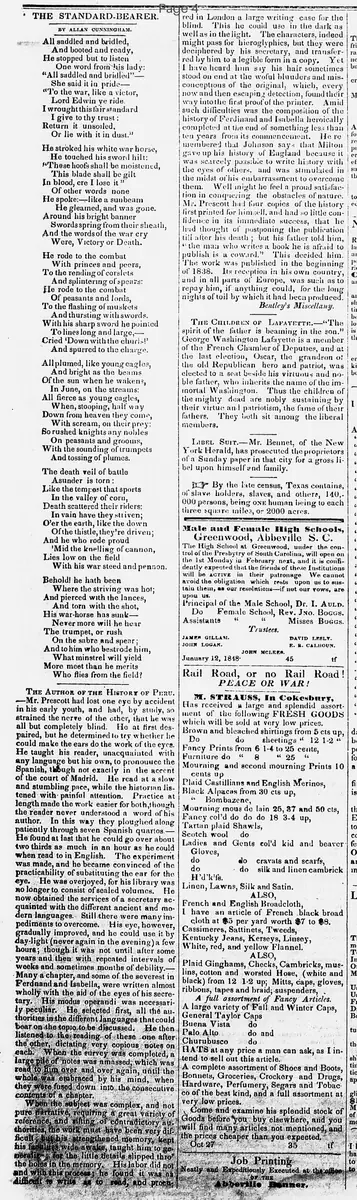
Mr. Prescott had lost one eye by accident in his early youth, and had, by study, so strained the nerve of the other, that he was all but completely blind. He at first despaired, but he determined to try whether he could make the ears do the work of the eyes. He taught his reader, unacquainted with any language but his own, to pronounce the Spanish, though not exactly in the accent of the court of Madrid. He read at a slow and stumbling pace, while the historian listened with painful attention. Practice at length made the work easier for both, though the reader never understood a word of his author. In this way they ploughed along patiently through seven Spanish quartos. He found at last that he could go over about two thirds as much in an hour as he could when read to in English. The experiment was made, and he became convinced of the practicability of substituting the ear for the eye. He was overjoyed, for his library was no longer to consist of sealed volumes. He now obtained the services of a secretary acquainted with the different ancient and modern languages. Still there were many impediments to overcome. His eye, however, gradually improved, and he could use it by daylight (never again in the evening) a few hours though it was not until after some years and then with repeated intervals of weeks and sometimes months of debility. Many a chapter, and some of the severest in Ferdinand and Isabella, were written almost wholly with the aid of the eyes of his secretary. His modus operandi was necessarily peculiar. He selected first, all the authorities in the different languages that could bear on the topic to be discussed. He then listened to the reading of these one after the other, dictating very copious notes on each. When the survey was completed, a large pile of notes was amassed, which was read to him over and over again, until the whole was embraced by his mind. When they were fused down into the consecutive contents of a chapter. When the subject was complex, and not pure narrative requiring, a great variety of reference and sifting of contradictory authorities, the work must have been very difficult. His strengthened memory kept his soul as wide awake, taught him to note nor glance for the little details slipped thro the holes in the memory. His labor did not end with this process he found it was as difficult to write as to read, and procured in London a large writing case for the blind. This he could use in the dark as well as in the light. The characters indeed might pass for hieroglyphics, but they were deciphered by his secretary, and transferred by him to a legible form in a copy. Yet I have heard him say his hair sometimes stood on end at the woeful blunders and misconceptions of the original; which, every now and then escaping detection, found their way into the first proof of the printer. Amid such difficulties was the composition of the history of Ferdinand and Isabella heroically completed at the end of something less than ten years from its commencement. He remembered that Johnson says that Milton gave up his history of England because it was scarcely possible to write history with the eyes of others. and was stimulated in the midst of his embarrassment to overcome them. Well might he feel a proud satisfaction in conquering the obstacles of nature. Mr. Prescott had four copies of the history first printed for himself. and had so little confidence in its immediate success. that he had thought of postponing the publication until after his death; but his father told him, "the man who writes a book he is afraid to publish is a coward." This decided him. The work was published in the beginning of 1838. Its reception in his own country, and in all parts of Europe, was such as to repay him, if anything could, for the long nights of toil by which it had been produced.
What sub-type of article is it?
Essay
What themes does it cover?
Moral Virtue
What keywords are associated?
Prescott
Blindness
History Writing
Ferdinand Isabella
Perseverance
Dictation
Overcoming Adversity
Literary Details
Form / Style
Biographical Narrative
Key Lines
He Remembered That Johnson Says That Milton Gave Up His History Of England Because It Was Scarcely Possible To Write History With The Eyes Of Others.
His Father Told Him, "The Man Who Writes A Book He Is Afraid To Publish Is A Coward."