Thank you for visiting SNEWPapers!
Sign up free
Literary
November 17, 1790
Gazette Of The United States
New York, New York County, New York
What is this article about?
Continuation of historical discourse on French regency under young Charles IX, detailing political maneuvers by Constable Montmorency, Guises, Colignys, and Prince of Conde. Intrigues involve religious tensions, a consecration ceremony dispute, and a financial assembly proposal to reclaim royal benefits, swaying the Constable toward Catholic alliance with Guises and Diana of Poitiers.
Clipping
OCR Quality
95%
Excellent
Full Text
Discourses on Davila.
NO. XXIII.-CONTINUED.
Utrumque regem, sua multitudo conclamaverat.
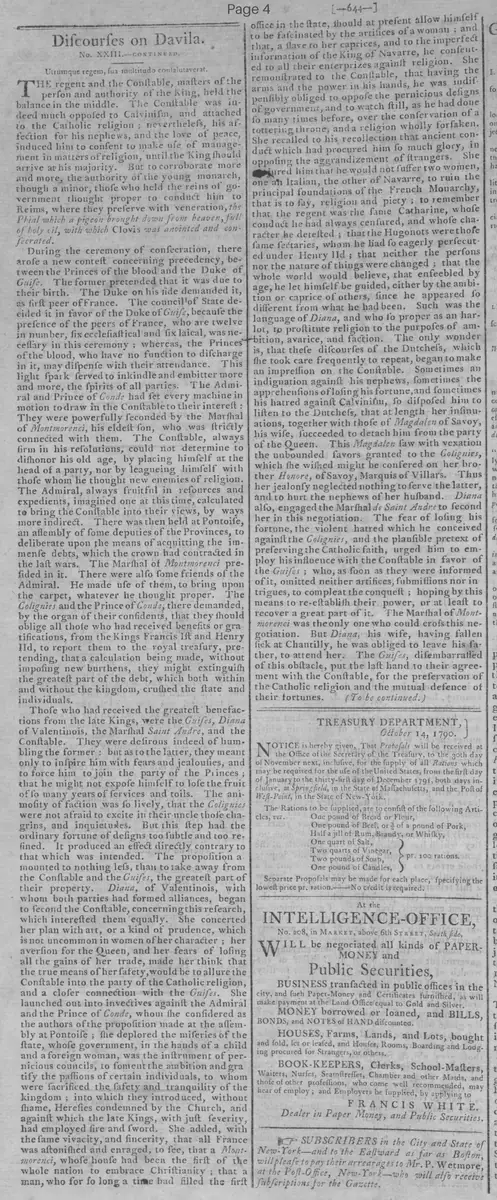
THE regent and the Constable, master of the balance in the middle. The Constable was indeed much opposed to Calvinism, and attached to the Catholic religion; nevertheless, his affection for his nephews, and the love of peace, induced him to consent to make use of management in matters of religion, until the King should arrive at his majority. But to corroborate more and more, the authority of the young monarch, though a minor, those who held the reins of government thought proper to conduct him to Reims, where they preserve with veneration, the Phial which a pigeon brought down from heaven, full of holy oil, with which Clovis was anointed and consecrated.
During the ceremony of consecration, there arose a new contest concerning precedency, between the Princes of the blood and the Duke of Guise. The former pretended that it was due to their birth. The Duke on his side demanded it, as first peer of France. The council of State decided it in favor of the Duke of Guise, because the presence of the peers of France, who are twelve in number, six ecclesiastical and six laical, was necessary in this ceremony; whereas, the Princes of the blood, who have no function to discharge in it, may dispense with their attendance. This slight spark served to enkindle and embitter more and more, the spirits of all parties. The Admiral and Prince of Conde had set every machine in motion to draw in the Constable to their interest: They were powerfully seconded by the Marshal of Montmorency, his eldest son, who was strictly connected with them. The Constable, always firm in his resolutions, could not determine to dishonor his old age, by placing himself at the head of a party, nor by leaguing himself with those whom he thought new enemies of religion.
The Admiral, always fruitful in resources and expedients, imagined one at this time, calculated to bring the Constable into their views, by ways more indirect. There was then held at Pontoise, an assembly of some deputies of the Provinces, to deliberate upon the means of acquitting the immense debts, which the crown had contracted in the last wars. The Marshal of Montmorency presided in it. There were also some friends of the Admiral. He made use of them, to bring upon the carpet, whatever he thought proper. The Colignies and the Prince of Conde, there demanded, by the organ of their confidants, that they should oblige all those who had received benefits or gratifications, from the Kings Francis IId and Henry IId, to report them to the royal treasury, pretending, that a calculation being made, without imposing new burthens, they might extinguish the greatest part of the debt, which both within and without the kingdom, crushed the state and individuals.
Those who had received the greatest benefactions from the late Kings, were the Guises, Diana of Valentinois, the Marshal Saint Andre, and the Constable. They were desirous indeed of humbling the former: but as to the latter, they meant only to inspire him with fears and jealousies, and to force him to join the party of the Princes; that he might not expose himself to lose the fruits of so many years of services and toils. The animosity of faction was so lively, that the Colignies were not afraid to excite in their uncle those chagrin, and inquietudes. But this step had the ordinary fortune of designs too subtle and too refined. It produced an effect directly contrary to that which was intended. The proposition amounted to nothing less, than to take away from the Constable and the Guises, the greatest part of their property. Diana, of Valentinois, with whom both parties had formed alliances, began to second the Constable, concerning this research, which interested them equally. She concerted her plan with art, or a kind of prudence, which is not uncommon in women of her character; her aversion for the Queen, and her fears of losing all the gains of her trade, made her think that the true means of her safety, would be to allure the Constable into the party of the Catholic religion, and a closer connection with the Guises. She launched out into invectives against the Admiral and the Prince of Conde, whom she considered as the authors of the proposition made at the assembly at Pontoise; She deplored the miseries of the state, whose government, in the hands of a child and a foreign woman, was the instrument of pernicious councils, to foment the ambition and gratify the passions of certain individuals, to whom were sacrificed the safety and tranquility of the kingdom; into which they introduced, without shame, Heresies condemned by the Church, and against which the late Kings, with just severity, had employed fire and sword. She added, with the same vivacity, and sincerity, that all France was astonished and enraged, to see, that a Montmorency, whose house had been the first of the whole nation to embrace Christianity; that a man, who for so long a time had filled the first office in the state, should at present allow himself to be fascinated by the artifices of a woman; and that, a slave to her caprices, and to the imperfect information of the King of Navarre, he consented to all their enterprises against religion. She remonstrated to the Constable, that having the arms and the power in his hands, he was indispensably obliged to oppose the pernicious designs of government, and to watch still, as he had done so many times before, over the conservation of a tottering throne, and a religion wholly forsaken.
She recalled to his recollection that ancient conduct which had procured him so much glory, in opposing the aggrandizement of strangers. She conjured him that he would not suffer two women, one an Italian, the other of Navarre, to ruin the principal foundations of the French Monarchy, that is to say, religion and piety; to remember that the regent was the same Catherine, whose conduct he had always censured, and whose character he detested; that the Hugonots were those same sectaries, whom he had so eagerly persecuted under Henry IId; that neither the persons nor the nature of things were changed; that the whole world would believe, that enfeebled by age, he let himself be guided, either by the ambition or caprice of others, since he appeared so different from what he had been. Such was the language of Diana, and who so proper as a harlot, to prostitute religion to the purposes of ambition, avarice, and faction. The only wonder is, that these discourses of the Duchess, which she took care frequently to repeat, began to make an impression on the Constable. Sometimes an indignation against his nephews, sometimes the apprehensions of losing his fortune, and sometimes his hatred against Calvinism, so disposed him to listen to the Duchess, that at length her insinuations, together with those of Magdalen of Savoy, his wife, succeeded to detach him from the party of the Queen. This Magdalen saw with vexation the unbounded favors granted to the Colignies, which she wished might be conferred on her brother Honoré, of Savoy, Marquis of Villars. Thus her jealousy neglected nothing to serve the latter, and to hurt the nephews of her husband. Diana also, engaged the Marshal de Saint Andre to second her in this negotiation. The fear of losing his fortune, the violent hatred which he conceived against the Colignies, and the plausible pretext of preserving the Catholic faith, urged him to employ his influence with the Constable in favor of the Guises; who, as soon as they were informed of it, omitted neither artifices, submissions nor intrigues, to complete the conquest; hoping by this means to re-establish their power, or at least to recover a great part of it. The Marshal of Montmorency was the only one who could cross this negotiation. But Diana, his wife, having fallen sick at Chantilly, he was obliged to leave his father, to attend her. The Guises, disencumbered of this obstacle, put the last hand to their agreement with the Constable, for the preservation of the Catholic religion and the mutual defence of their fortunes.
(To be continued.)
NO. XXIII.-CONTINUED.
Utrumque regem, sua multitudo conclamaverat.
THE regent and the Constable, master of the balance in the middle. The Constable was indeed much opposed to Calvinism, and attached to the Catholic religion; nevertheless, his affection for his nephews, and the love of peace, induced him to consent to make use of management in matters of religion, until the King should arrive at his majority. But to corroborate more and more, the authority of the young monarch, though a minor, those who held the reins of government thought proper to conduct him to Reims, where they preserve with veneration, the Phial which a pigeon brought down from heaven, full of holy oil, with which Clovis was anointed and consecrated.
During the ceremony of consecration, there arose a new contest concerning precedency, between the Princes of the blood and the Duke of Guise. The former pretended that it was due to their birth. The Duke on his side demanded it, as first peer of France. The council of State decided it in favor of the Duke of Guise, because the presence of the peers of France, who are twelve in number, six ecclesiastical and six laical, was necessary in this ceremony; whereas, the Princes of the blood, who have no function to discharge in it, may dispense with their attendance. This slight spark served to enkindle and embitter more and more, the spirits of all parties. The Admiral and Prince of Conde had set every machine in motion to draw in the Constable to their interest: They were powerfully seconded by the Marshal of Montmorency, his eldest son, who was strictly connected with them. The Constable, always firm in his resolutions, could not determine to dishonor his old age, by placing himself at the head of a party, nor by leaguing himself with those whom he thought new enemies of religion.
The Admiral, always fruitful in resources and expedients, imagined one at this time, calculated to bring the Constable into their views, by ways more indirect. There was then held at Pontoise, an assembly of some deputies of the Provinces, to deliberate upon the means of acquitting the immense debts, which the crown had contracted in the last wars. The Marshal of Montmorency presided in it. There were also some friends of the Admiral. He made use of them, to bring upon the carpet, whatever he thought proper. The Colignies and the Prince of Conde, there demanded, by the organ of their confidants, that they should oblige all those who had received benefits or gratifications, from the Kings Francis IId and Henry IId, to report them to the royal treasury, pretending, that a calculation being made, without imposing new burthens, they might extinguish the greatest part of the debt, which both within and without the kingdom, crushed the state and individuals.
Those who had received the greatest benefactions from the late Kings, were the Guises, Diana of Valentinois, the Marshal Saint Andre, and the Constable. They were desirous indeed of humbling the former: but as to the latter, they meant only to inspire him with fears and jealousies, and to force him to join the party of the Princes; that he might not expose himself to lose the fruits of so many years of services and toils. The animosity of faction was so lively, that the Colignies were not afraid to excite in their uncle those chagrin, and inquietudes. But this step had the ordinary fortune of designs too subtle and too refined. It produced an effect directly contrary to that which was intended. The proposition amounted to nothing less, than to take away from the Constable and the Guises, the greatest part of their property. Diana, of Valentinois, with whom both parties had formed alliances, began to second the Constable, concerning this research, which interested them equally. She concerted her plan with art, or a kind of prudence, which is not uncommon in women of her character; her aversion for the Queen, and her fears of losing all the gains of her trade, made her think that the true means of her safety, would be to allure the Constable into the party of the Catholic religion, and a closer connection with the Guises. She launched out into invectives against the Admiral and the Prince of Conde, whom she considered as the authors of the proposition made at the assembly at Pontoise; She deplored the miseries of the state, whose government, in the hands of a child and a foreign woman, was the instrument of pernicious councils, to foment the ambition and gratify the passions of certain individuals, to whom were sacrificed the safety and tranquility of the kingdom; into which they introduced, without shame, Heresies condemned by the Church, and against which the late Kings, with just severity, had employed fire and sword. She added, with the same vivacity, and sincerity, that all France was astonished and enraged, to see, that a Montmorency, whose house had been the first of the whole nation to embrace Christianity; that a man, who for so long a time had filled the first office in the state, should at present allow himself to be fascinated by the artifices of a woman; and that, a slave to her caprices, and to the imperfect information of the King of Navarre, he consented to all their enterprises against religion. She remonstrated to the Constable, that having the arms and the power in his hands, he was indispensably obliged to oppose the pernicious designs of government, and to watch still, as he had done so many times before, over the conservation of a tottering throne, and a religion wholly forsaken.
She recalled to his recollection that ancient conduct which had procured him so much glory, in opposing the aggrandizement of strangers. She conjured him that he would not suffer two women, one an Italian, the other of Navarre, to ruin the principal foundations of the French Monarchy, that is to say, religion and piety; to remember that the regent was the same Catherine, whose conduct he had always censured, and whose character he detested; that the Hugonots were those same sectaries, whom he had so eagerly persecuted under Henry IId; that neither the persons nor the nature of things were changed; that the whole world would believe, that enfeebled by age, he let himself be guided, either by the ambition or caprice of others, since he appeared so different from what he had been. Such was the language of Diana, and who so proper as a harlot, to prostitute religion to the purposes of ambition, avarice, and faction. The only wonder is, that these discourses of the Duchess, which she took care frequently to repeat, began to make an impression on the Constable. Sometimes an indignation against his nephews, sometimes the apprehensions of losing his fortune, and sometimes his hatred against Calvinism, so disposed him to listen to the Duchess, that at length her insinuations, together with those of Magdalen of Savoy, his wife, succeeded to detach him from the party of the Queen. This Magdalen saw with vexation the unbounded favors granted to the Colignies, which she wished might be conferred on her brother Honoré, of Savoy, Marquis of Villars. Thus her jealousy neglected nothing to serve the latter, and to hurt the nephews of her husband. Diana also, engaged the Marshal de Saint Andre to second her in this negotiation. The fear of losing his fortune, the violent hatred which he conceived against the Colignies, and the plausible pretext of preserving the Catholic faith, urged him to employ his influence with the Constable in favor of the Guises; who, as soon as they were informed of it, omitted neither artifices, submissions nor intrigues, to complete the conquest; hoping by this means to re-establish their power, or at least to recover a great part of it. The Marshal of Montmorency was the only one who could cross this negotiation. But Diana, his wife, having fallen sick at Chantilly, he was obliged to leave his father, to attend her. The Guises, disencumbered of this obstacle, put the last hand to their agreement with the Constable, for the preservation of the Catholic religion and the mutual defence of their fortunes.
(To be continued.)
What sub-type of article is it?
Essay
What themes does it cover?
Political
Religious
What keywords are associated?
French Regency
Constable Montmorency
Guises
Coligny
Calvinism
Catholic Alliance
Political Intrigue
Royal Debts
Literary Details
Title
Discourses On Davila. No. Xxiii. Continued.
Subject
French Regency, Religious And Political Factions Under Charles Ix
Key Lines
Utrumque Regem, Sua Multitudo Conclamaverat.
Such Was The Language Of Diana, And Who So Proper As A Harlot, To Prostitute Religion To The Purposes Of Ambition, Avarice, And Faction.
She Remonstrated To The Constable, That Having The Arms And The Power In His Hands, He Was Indispensably Obliged To Oppose The Pernicious Designs Of Government, And To Watch Still, As He Had Done So Many Times Before, Over The Conservation Of A Tottering Throne, And A Religion Wholly Forsaken.
The Guises, Disencumbered Of This Obstacle, Put The Last Hand To Their Agreement With The Constable, For The Preservation Of The Catholic Religion And The Mutual Defence Of Their Fortunes.