Thank you for visiting SNEWPapers!
Sign up free
Editorial
April 10, 1798
Gazette Of The United States, & Philadelphia Daily Advertiser
Philadelphia, Philadelphia County, Pennsylvania
What is this article about?
An anonymous citizen from Charleston warns of apathy amid potential war with France, highlights city's vulnerability, criticizes federal neglect, and urges petitioning Congress for defense preparations. (187 characters)
Clipping
OCR Quality
95%
Excellent
Full Text
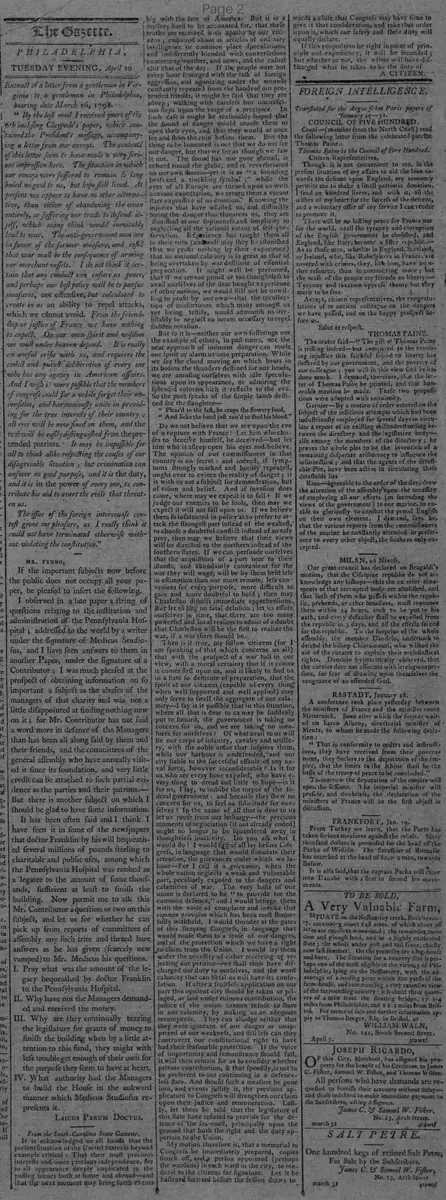
From the South-Carolina State Gazette.
It is acknowledged on all hands that the present situation of the United States is beyond example critical: That their most precious interests and more precious independence, are to all appearance deeply implicated in the passing scenes both at home and abroad—and that the next moment may bring forth events big with the fate of America. But it is a mystery hard to be accounted for, that these truths are received with apathy by our citizens; enquired about as articles of ordinary intelligence or common place speculations, and indifferently blended with conversations concerning weather, and news, and the casual chit chat of the day. If the people were not every hour scourged with the lash of foreign aggression, and agonizing under the wounds constantly repeated from the hands of our pretended friends, it might be said that they are asleep; walking with careless but unconscious steps upon the verge of a precipice. In such case it might be reasonably hoped that the sound of danger would arouse them to open their eyes, and that they would at once see and shun the ruin before them. But the thing to be lamented is not that we do not see our danger, but that we see as though we saw it not. The sound has gone abroad, is echoed round the globe, and is reverberated on our own shores—yet it is as "a sounding brass and a tinkling cymbal;" while the eyes of all Europe are turned upon us with anxious expectation, we return them a vacant stare expressive of no emotion. Knowing the injuries that have assailed us, and distinctly seeing the danger that threatens us, they are astonished at our supineness and simplicity in neglecting all the rational means of self-preservation. Experience has taught them all in their turn (sad well may they be astonished that we profit nothing by their experience) that no national calamity is so great as that of being overtaken by war destitute of essential preparation. It might well be presumed, that if we are too proud or too thoughtless to avail ourselves of the dear bought experience of other nations, we would still not be unwilling to profit by our own—that the recollection of misfortunes which many amongst us yet living testify, would admonish us irresistibly to neglect no means necessary to repel sudden invasion.
But so it is—neither our own sufferings nor the example of others, in past times, nor the near approach of imminent danger can rouse our spirit or alarm us into preparation. While we see the cloud moving on which bears in its bosom the thunders destined for our heads, we are amusing ourselves with idle speculations upon its appearance, or admiring the splendid colors which it reflects to the eye. So the poet speaks of the simple lamb destined for the slaughter—
"Pleas'd to the last, he crops the flowery food,
And licks the hand just rais'd to shed his blood."
Do we not believe that we are upon the eve of a rupture with France?—Let him who chooses to deceive himself, be deceived but let him who is asleep open his eyes and believe. The opinion of our commissioners in that country is no secret: and indeed, if symptoms strongly marked and hourly repeated, ought ever to evince the reality of danger; it is with us not a subject for demonstration, but of vision and belief. And if invasion does come, where may we expect it to fall? If we judge our enemies to be fools, then may we expect it will not fall upon us. If we believe them so infatuated in policy as to prefer to attack the strongest part instead of the weakest, to choose a doubtful conflict instead of an easy prey, then may we believe that their views will be directed to the northern instead of the southern states. If we can persuade ourselves that the acquisition of a port near to their islands, and abundantly convenient for the war they will wage, will be by them held less in estimation than one more remote, less convenient for every purpose, more difficult to gain and more doubtful to hold; then may Charleston dismiss immediate apprehensions.
But let us hug no fatal delusion; let us assure ourselves in time, that there are too many powerful and local reasons to admit of a doubt that Charleston will be the first to realize the war, if a war there should be.
Then is it true, my fellow citizens (for I am speaking of that which concerns us all) that with the prospect of a war full in our view, with a moral certainty that if it comes it comes first upon us, and is likely to find us in a state so destitute of preparation, that the spirit of our citizens (capable of every thing when well supported and well applied) may only serve to swell the aggregate of our calamity—I say is it possible that in this situation, where all that is dear to us may be suddenly put to hazard, the government is taking no concern for us, and we are taking no measures for ourselves? Of what avail to us will be our corps of infantry, cavalry and artillery, with the noble ardor that inspires them, while our harbour is undefended, and our city liable to the successful assault of any naval force, however inconsiderable? Is it for us who are every hour exposed, who have every thing to dread and little to hope—is it for us, I say, to imbibe the torpor of the federal government: and because they shew no concern for us, to feel no solicitude for ourselves? In the name of all that is dear to us let us rouse from our lethargy—the precious moments of negociation (if not already ended) ought no longer to be squandered away in thoughtless inactivity. Do you ask what I would do? I would first of all lay before Congress, in language that would stimulate their attention, the grievances under which we labour—For I call it a grievance, when the whole nation neglects a weak and vulnerable part, peculiarly exposed to the dangers and calamities of war. The very basis of our union is declared to be "to provide for the common defence," and I would besiege them with the voice of complaint and invoke that common provision which has been most shamefully withheld. I would thunder at the gates of this sleeping Congress, in language that would rouse them to a sense of our dangers, and of the protection which we have a right to claim from the Union. I would lay them under the necessity of either receiving or rejecting our petition—we shall then have discharged our duty to ourselves, and the worst calamity that can befall us will have its consolation. If after a fruitless application on our part this opulent city should be taken or pillaged, or laid under ruinous contribution, the justice of the union cannot refuse to share in our calamity, by making us an adequate recompense. They can allege neither that they were ignorant of our danger or unapprised of our weakness, and still less can they controvert our constitutional right to have had their reasonable protection. If the voice of importunity and remonstrance should fail, it will then remain for us to consider whether private contribution, & that speedily, is not to be preferred to our continuing in a defenceless state. And should such a measure be gone into, and events justify it, the previous application to Congress will strengthen our claim upon their justice and remuneration. Lastly, let them be told that the legislature of this state have refused to provide for the defence of the sea-coast, principally upon the ground that both the right and the duty appertain to the Union.
My motion therefore is, that a memorial to Congress be immediately prepared, copies struck off, and a person appointed (perhaps the wardens) in each ward in the city, to tender it to the citizens for signature. Let it be hastened forward before the session draws towards a close that Congress may have time to give it that consideration, and take that order upon it, which our safety and their duty will equally dictate.
If this proposition be right in point of principle and expediency, it will be seconded; but whether or not, the writer will have discharged what he takes to be the duty of
A CITIZEN.
It is acknowledged on all hands that the present situation of the United States is beyond example critical: That their most precious interests and more precious independence, are to all appearance deeply implicated in the passing scenes both at home and abroad—and that the next moment may bring forth events big with the fate of America. But it is a mystery hard to be accounted for, that these truths are received with apathy by our citizens; enquired about as articles of ordinary intelligence or common place speculations, and indifferently blended with conversations concerning weather, and news, and the casual chit chat of the day. If the people were not every hour scourged with the lash of foreign aggression, and agonizing under the wounds constantly repeated from the hands of our pretended friends, it might be said that they are asleep; walking with careless but unconscious steps upon the verge of a precipice. In such case it might be reasonably hoped that the sound of danger would arouse them to open their eyes, and that they would at once see and shun the ruin before them. But the thing to be lamented is not that we do not see our danger, but that we see as though we saw it not. The sound has gone abroad, is echoed round the globe, and is reverberated on our own shores—yet it is as "a sounding brass and a tinkling cymbal;" while the eyes of all Europe are turned upon us with anxious expectation, we return them a vacant stare expressive of no emotion. Knowing the injuries that have assailed us, and distinctly seeing the danger that threatens us, they are astonished at our supineness and simplicity in neglecting all the rational means of self-preservation. Experience has taught them all in their turn (sad well may they be astonished that we profit nothing by their experience) that no national calamity is so great as that of being overtaken by war destitute of essential preparation. It might well be presumed, that if we are too proud or too thoughtless to avail ourselves of the dear bought experience of other nations, we would still not be unwilling to profit by our own—that the recollection of misfortunes which many amongst us yet living testify, would admonish us irresistibly to neglect no means necessary to repel sudden invasion.
But so it is—neither our own sufferings nor the example of others, in past times, nor the near approach of imminent danger can rouse our spirit or alarm us into preparation. While we see the cloud moving on which bears in its bosom the thunders destined for our heads, we are amusing ourselves with idle speculations upon its appearance, or admiring the splendid colors which it reflects to the eye. So the poet speaks of the simple lamb destined for the slaughter—
"Pleas'd to the last, he crops the flowery food,
And licks the hand just rais'd to shed his blood."
Do we not believe that we are upon the eve of a rupture with France?—Let him who chooses to deceive himself, be deceived but let him who is asleep open his eyes and believe. The opinion of our commissioners in that country is no secret: and indeed, if symptoms strongly marked and hourly repeated, ought ever to evince the reality of danger; it is with us not a subject for demonstration, but of vision and belief. And if invasion does come, where may we expect it to fall? If we judge our enemies to be fools, then may we expect it will not fall upon us. If we believe them so infatuated in policy as to prefer to attack the strongest part instead of the weakest, to choose a doubtful conflict instead of an easy prey, then may we believe that their views will be directed to the northern instead of the southern states. If we can persuade ourselves that the acquisition of a port near to their islands, and abundantly convenient for the war they will wage, will be by them held less in estimation than one more remote, less convenient for every purpose, more difficult to gain and more doubtful to hold; then may Charleston dismiss immediate apprehensions.
But let us hug no fatal delusion; let us assure ourselves in time, that there are too many powerful and local reasons to admit of a doubt that Charleston will be the first to realize the war, if a war there should be.
Then is it true, my fellow citizens (for I am speaking of that which concerns us all) that with the prospect of a war full in our view, with a moral certainty that if it comes it comes first upon us, and is likely to find us in a state so destitute of preparation, that the spirit of our citizens (capable of every thing when well supported and well applied) may only serve to swell the aggregate of our calamity—I say is it possible that in this situation, where all that is dear to us may be suddenly put to hazard, the government is taking no concern for us, and we are taking no measures for ourselves? Of what avail to us will be our corps of infantry, cavalry and artillery, with the noble ardor that inspires them, while our harbour is undefended, and our city liable to the successful assault of any naval force, however inconsiderable? Is it for us who are every hour exposed, who have every thing to dread and little to hope—is it for us, I say, to imbibe the torpor of the federal government: and because they shew no concern for us, to feel no solicitude for ourselves? In the name of all that is dear to us let us rouse from our lethargy—the precious moments of negociation (if not already ended) ought no longer to be squandered away in thoughtless inactivity. Do you ask what I would do? I would first of all lay before Congress, in language that would stimulate their attention, the grievances under which we labour—For I call it a grievance, when the whole nation neglects a weak and vulnerable part, peculiarly exposed to the dangers and calamities of war. The very basis of our union is declared to be "to provide for the common defence," and I would besiege them with the voice of complaint and invoke that common provision which has been most shamefully withheld. I would thunder at the gates of this sleeping Congress, in language that would rouse them to a sense of our dangers, and of the protection which we have a right to claim from the Union. I would lay them under the necessity of either receiving or rejecting our petition—we shall then have discharged our duty to ourselves, and the worst calamity that can befall us will have its consolation. If after a fruitless application on our part this opulent city should be taken or pillaged, or laid under ruinous contribution, the justice of the union cannot refuse to share in our calamity, by making us an adequate recompense. They can allege neither that they were ignorant of our danger or unapprised of our weakness, and still less can they controvert our constitutional right to have had their reasonable protection. If the voice of importunity and remonstrance should fail, it will then remain for us to consider whether private contribution, & that speedily, is not to be preferred to our continuing in a defenceless state. And should such a measure be gone into, and events justify it, the previous application to Congress will strengthen our claim upon their justice and remuneration. Lastly, let them be told that the legislature of this state have refused to provide for the defence of the sea-coast, principally upon the ground that both the right and the duty appertain to the Union.
My motion therefore is, that a memorial to Congress be immediately prepared, copies struck off, and a person appointed (perhaps the wardens) in each ward in the city, to tender it to the citizens for signature. Let it be hastened forward before the session draws towards a close that Congress may have time to give it that consideration, and take that order upon it, which our safety and their duty will equally dictate.
If this proposition be right in point of principle and expediency, it will be seconded; but whether or not, the writer will have discharged what he takes to be the duty of
A CITIZEN.
What sub-type of article is it?
War Or Peace
Military Affairs
Foreign Affairs
What keywords are associated?
War With France
Charleston Defense
National Apathy
Congress Petition
Military Preparation
Foreign Aggression
What entities or persons were involved?
France
Congress
Charleston
South Carolina
Federal Government
Commissioners In France
Editorial Details
Primary Topic
Urging Preparation For Potential War With France And Defense Of Charleston
Stance / Tone
Alarmist Call To Action Against National Apathy
Key Figures
France
Congress
Charleston
South Carolina
Federal Government
Commissioners In France
Key Arguments
Citizens Are Apathetic Despite Critical Situation And Imminent Danger From France
Charleston Is The Most Vulnerable Point For Invasion Due To Its Location
Government Neglects Defense Of Vulnerable Areas Like Charleston
Petition Congress For Protection As Per Union's Basis For Common Defense
If Congress Fails, Consider Private Contributions For Defense
State Legislature Refuses Sea Coast Defense As Duty Of Union