Thank you for visiting SNEWPapers!
Sign up free
Genius Of Liberty
Lowell, La Salle County, Illinois
What is this article about?
Anti-slavery article from Dublin Monitor excerpts Mr. Gurney's 'Winter in the West Indies,' showcasing successful emancipation in St. Christopher's, Antigua, and Jamaica with economic gains, increased productivity, and property value rises, urging U.S. statesmen like Henry Clay to abolish slavery.
Clipping
OCR Quality
Full Text
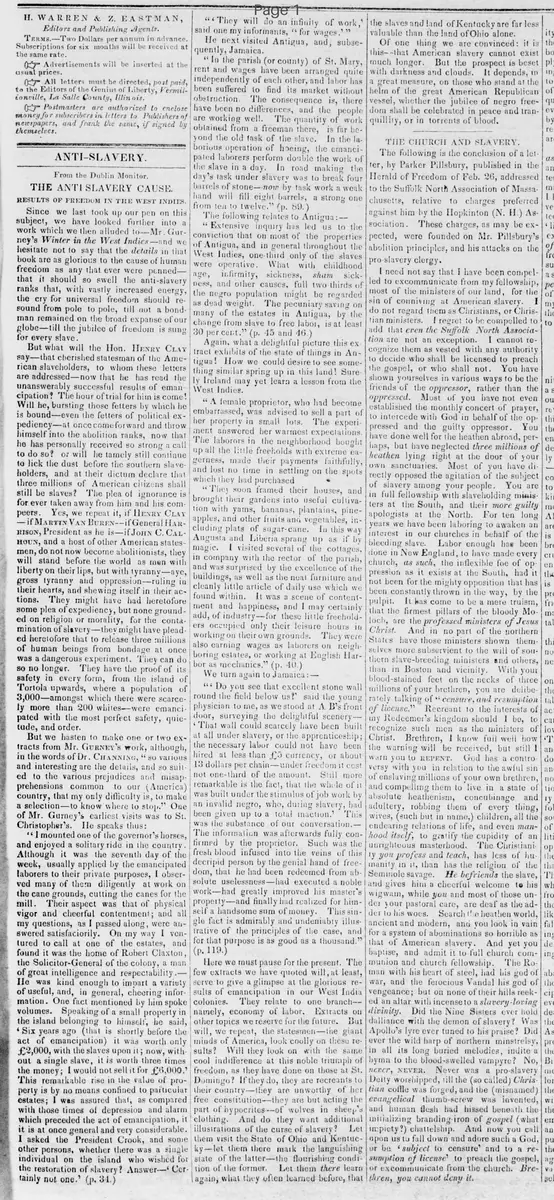
From the Dublin Monitor.
THE ANTISLAVERY CAUSE.
RESULTS OF FREEDOM IN THE WEST INDIES.
Since we last took up our pen on this subject, we have looked further into a work which we then alluded to—Mr. Gurney's Winter in the West Indies—and we hesitate not to say that the details in that book are as glorious to the cause of human freedom as any that ever were penned—that it should so swell the anti-slavery ranks that, with vastly increased energy, the cry for universal freedom should resound from pole to pole, till not a bondman remained on the broad expanse of our globe—till the jubilee of freedom is sung for every slave.
But what will the Hon. Henry Clay—that cherished statesman of the American slaveholders, to whom these letters are addressed—now that he has read the unanswerably successful results of emancipation? The hour of trial for him is come! Will he, bursting those fetters by which he is bound—even the fetters of political expediency—at once come forward and throw himself into the abolition ranks, now that he has personally received so strong a call to do so? or will he tamely still continue to lick the dust before the southern slaveholders, and at their dictum declare that three millions of American citizens shall still be slaves? The plea of ignorance is forever taken away from him and his compeers. Yes, we repeat it, if Henry Clay—if Martin Van Buren—if General Harrison, President as he is—if John C. Calhoun, and a host of other American statesmen, do not now become abolitionists, they will stand before the world as men with liberty on their lips, but with tyranny—aye, gross tyranny and oppression—ruling in their hearts, and shewing itself in their actions. They might have had heretofore some plea of expediency, but none grounded on religion or morality, for the contamination of slavery—they might have pleaded heretofore that to release three millions of human beings from bondage at once was a dangerous experiment. They can do so no longer. They have the proof of its safety in every form, from the island of Tortola upwards, where a population of 3,000—amongst which there were scarcely more than 200 whites—were emancipated with the most perfect safety, quietude, and order.
But we hasten to make one or two extracts from Mr. Gurney's work, although, in the words of Dr. Channing, "so various and interesting are the details, and so suited to the various prejudices and misapprehensions common to our (America) country, that my only difficulty is, to make a selection—to know where to stop." One of Mr. Gurney's earliest visits was to St. Christopher's. He speaks thus:
"I mounted one of the governor's horses, and enjoyed a solitary ride in the country. Although it was the seventh day of the week, usually applied by the emancipated laborers to their private purposes, I observed many of them diligently at work on the cane grounds, cutting the canes for the mill. Their aspect was that of physical vigor and cheerful contentment; and all my questions, as I passed along, were answered satisfactorily. On my way I ventured to call at one of the estates, and found it was the home of Robert Claxton, the Solicitor-General of the colony, a man of great intelligence and respectability.—He was kind enough to impart a variety of useful, and, in general, cheering information. One fact mentioned by him spoke volumes. Speaking of a small property in the island belonging to himself, he said, Six years ago (that is shortly before the act of emancipation) it was worth only £2,000, with the slaves upon it; now, without a single slave, it is worth three times the money; I would not sell it for £6,000. This remarkable rise in the value of property is by no means confined to particular estates; I was assured that, as compared with those times of depression and alarm which preceded the act of emancipation, it is at once general and very considerable. I asked the President Crook, and some other persons, whether there was a single individual on the island who wished for the restoration of slavery? Answer—'Certainly not one.' (p. 34.)"
"They will do an infinity of work, said one of my informants, "for wages."" He next visited Antigua, and, subsequently, Jamaica.
"In the parish (or county) of St. Mary rent and wages have been arranged quite independently of each other, and labor has been suffered to find its market without obstruction. The consequence is, there have been no differences, and the people are working well. The quantity of work obtained from a freeman there, is far beyond the old task of the slave. In the laborious operation of hoeing, the emancipated laborers perform double the work of the slave in a day. In road making the day's task under slavery was to break four barrels of stone—now by task work a weak hand will fill eight barrels, a strong one from ten to twelve." (p. 89.)
The following relates to Antigua :—
"Extensive inquiry has led us to the conviction that on most of the properties of Antigua, and in general throughout the West Indies, one-third only of the slaves were operative. What with childhood, age, infirmity, sickness, sham sickness, and other causes, full two thirds of the negro population might be regarded as dead weight. The pecuniary saving on many of the estates in Antigua, by the change from slave to free labor, is at least 30 per cent." (p. 45 and 46.)
Again, what a delightful picture this extract exhibits of the state of things in Antigua! How we could desire to see something similar spring up in this land! Surely Ireland may yet learn a lesson from the West Indies.
"A female proprietor, who had become embarrassed, was advised to sell a part of her property in small lots. The experiment answered her warmest expectations. The laborers in the neighborhood bought up all the little freeholds with extreme eagerness, made their payments faithfully, and lost no time in settling on the spots which they had purchased. They soon framed their houses, and brought their gardens into useful cultivation with yams, bananas, plantains, pineapples, and other fruits and vegetables, including plats of sugar-cane. In this way Augusta and Liberia sprang up as if by magic. I visited several of the cottages, in company with the rector of the parish, and was surprised by the excellence of the buildings, as well as the neat furniture and cleanly little article of daily use which we found within. It was a scene of contentment and happiness, and I may certainly add, of industry—for these little freeholders occupied only their leisure hours in working on their own grounds. They were also earning wages as laborers on neighboring estates, or working at English Harbor as mechanics." (p. 40.)
We turn again to Jamaica:-
"Do you see that excellent stone wall round the field below us?' said the young physician to me, as we stood at A. B.'s front door, surveying the delightful scenery—'That wall could scarcely have been built at all under slavery, or the apprenticeship; the necessary labor could not have been hired at less than £5 currency, or about 13 dollars per chain—under freedom it cost not one-third of the amount. Still more remarkable is the fact, that the whole of it was built under the stimulus of job work by an invalid negro, who, during slavery, had been given up to a total inaction.' This was the substance of our conversation.—The information was afterwards fully confirmed by the proprietor. Such was the fresh blood infused into the veins of this decrepid person by the genial hand of freedom, that he had been redeemed from absolute uselessness—had executed a noble work—had greatly improved his master's property—and finally had realized for himself a handsome sum of money. This single fact is admirably and undeniably illustrative of the principles of the case, and for that purpose is as good as a thousand." (p. 119.)
Here we must pause for the present. The few extracts we have quoted will, at least, serve to give a glimpse at the glorious results of emancipation in our West India colonies. They relate to one branch—namely, economy of labor. Extracts on other topics we reserve for the future. But will, we repeat, the statesmen—the giant minds of America, look coolly on these results? Will they look on with the same cool indifference at this noble triumph of freedom, as they have done on those at St. Domingo? If they do, they are recreants to their country—they are unworthy of her free constitution—they are but acting the part of hypocrites—of wolves in sheep's clothing. And do they want additional illustrations of the curse of slavery? Let them visit the State of Ohio and Kentucky—let them there mark the languishing state of the latter—the flourishing condition of the former. Let them there learn again, what they often learned before, that the slaves and land of Kentucky are far less valuable than the land of Ohio alone.
Of one thing we are convinced: it is this—that American slavery cannot exist much longer. But the prospect is beset with darkness and clouds. It depends, in a great measure, on those who stand at the helm of the great American Republican vessel, whether the jubilee of negro freedom shall be celebrated in peace and tranquillity, or in torrents of blood.
What sub-type of article is it?
What themes does it cover?
What keywords are associated?
What entities or persons were involved?
Where did it happen?
Story Details
Key Persons
Location
West Indies
Event Date
Post Emancipation (Circa 1834 Onwards)
Story Details
The article excerpts Mr. Gurney's observations on successful emancipation in West Indies islands like St. Christopher's, Antigua, and Jamaica, detailing economic benefits such as increased property values, labor productivity, and savings from free labor, while criticizing American statesmen for not supporting abolition and predicting the end of U.S. slavery.