Thank you for visiting SNEWPapers!
Sign up free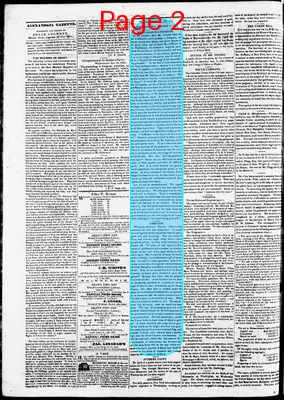
Editorial
January 21, 1833
Phenix Gazette
Alexandria, Virginia
What is this article about?
An 1833 editorial from Alexandria, D.C., critiques John C. Calhoun's views blaming government consolidation for the crisis, attributing it instead to excessive state rights claims. It opposes coercion against South Carolina's nullification, favoring compromise, peace, and even allowing secession to avoid bloodshed.
Clipping

OCR Quality
98%
Excellent
Full Text
ALEXANDRIA, (D. C.)
MONDAY MORNING. JANUARY 21, 1833.
MR. CALHOUN'S OPINIONS.
In the remarks which Mr. Calhoun made on the President's recent message to Congress, he stated, among other things, that to the success of the party, which had elevated Mr. Jefferson to the Presidency, he considered, might be attributed the duration of the Government; and that the present situation of the country, placed as it is on the verge of dissolution, may be ascribed to 'the powerful workings of the consolidating principle.' To the first of these assertions we have nothing to object, because it is a mere matter of opinion, in which principles need not be involved, and other men may think very differently from Mr. Calhoun on the subject. We profess to believe that the 'inherent principles of decay,' of which Mr. Calhoun very philosophically speaks, are not so firmly seated in this government as to be made to quicken, grow up and yield fruit, upon the elevation or depression of any single man, or the temporary ascendancy of any particular party. It is true, we admit, that the success of one bad man or one bad measure; or the contrary events, may produce evil or happy results, as the circumstances may happen to occur, and all bearing ultimately and directly upon the duration of the government and the maintenance of its fair and just proportions;—but it would require a continuance and series of untoward and unfortunate causes in a free, representative republic to produce such a disaster as its final destruction. Upon such a question, however, we have no disposition to argue or theorise.
'Sufficient to the day is the evil thereof.'
What we wish particularly to notice is the second opinion advanced by Mr. Calhoun, which we have quoted above. To us it does seem that the very converse of the proposition is true. There is no manner of doubt but that the country is absolutely on the very verge of civil war or dissolution. But, then, what has produced this result? Surely not any effort that has been made to bind together and unite its different parts. No! It is rather because the government experiences the centrifugal action of the states. In every instance in our history where danger has been incurred, we have found it produced by false and unfounded notions of state rights and state sovereignty.
Let us not be misunderstood, We regard consolidation in very nearly the same light that Mr Calhoun does. We look upon it as the next worse evil to disunion. Under a consolidated government we should fear that some steel clad warrior, would arise to 'crush under his armed heel' the 'liberties of our country.' What we assert is, that heretofore experience has proved, and now facts prove, that the most menacing evils which have threatened and do threaten the government do not owe their origin to the 'powerful workings of the consolidating principle.'
COERCION.
Who is for coercion? Not we. This is a Government of love and compromise. It cannot be held together but by the golden links of peace, good will and friendship. The iron chains of force and violence might weigh down a brave people for a time, but they would ultimately be shaken off. We scout at and reject the doctrines of nullification and secession, as constitutional, lawful, legal rights, appertaining to state sovereignty. But we uphold, or rather we would admit, willingly, the revolutionary right of secession, the right to resist oppression, when it becomes intolerable—the right for the maintenance of which Hampden and Sidney so gloriously suffered. Why do not the advocates of the South Carolina doctrines place themselves upon this ground? Because they know that the parallel would utterly fail. South Carolina has not been so intolerably oppressed as to justify her in the sight of God or man, in breaking up this happy Union. The effort then is masked under the guise of constitutional nullification—an absurdity so monstrous that we cannot conceive how it can find a place in the intellect of man. What then, it is inquired, would we do? We can answer this by saying, what we would not have done. We say, let no blood be shed—let civil strife be hushed forever, by the determination of the government, on no account, to permit a sword to be unsheathed. We had almost said, perish the Union! before a single drop of blood is spilled! If South Carolina will resist, let her go—let her pluck out her bright star from that glorious galaxy that glitters on her country's flag, and transfer it to her own, there to shed—a baleful light over her future fortunes and destinies. It will be a sad and a bitter day that sees the dismemberment of these states, but far more sad and far more bitter will be the day which witnesses the battle grounds of Eutaw and Guilford converted into fields of slaughter and carnage made by the bayonets of brothers.
MONDAY MORNING. JANUARY 21, 1833.
MR. CALHOUN'S OPINIONS.
In the remarks which Mr. Calhoun made on the President's recent message to Congress, he stated, among other things, that to the success of the party, which had elevated Mr. Jefferson to the Presidency, he considered, might be attributed the duration of the Government; and that the present situation of the country, placed as it is on the verge of dissolution, may be ascribed to 'the powerful workings of the consolidating principle.' To the first of these assertions we have nothing to object, because it is a mere matter of opinion, in which principles need not be involved, and other men may think very differently from Mr. Calhoun on the subject. We profess to believe that the 'inherent principles of decay,' of which Mr. Calhoun very philosophically speaks, are not so firmly seated in this government as to be made to quicken, grow up and yield fruit, upon the elevation or depression of any single man, or the temporary ascendancy of any particular party. It is true, we admit, that the success of one bad man or one bad measure; or the contrary events, may produce evil or happy results, as the circumstances may happen to occur, and all bearing ultimately and directly upon the duration of the government and the maintenance of its fair and just proportions;—but it would require a continuance and series of untoward and unfortunate causes in a free, representative republic to produce such a disaster as its final destruction. Upon such a question, however, we have no disposition to argue or theorise.
'Sufficient to the day is the evil thereof.'
What we wish particularly to notice is the second opinion advanced by Mr. Calhoun, which we have quoted above. To us it does seem that the very converse of the proposition is true. There is no manner of doubt but that the country is absolutely on the very verge of civil war or dissolution. But, then, what has produced this result? Surely not any effort that has been made to bind together and unite its different parts. No! It is rather because the government experiences the centrifugal action of the states. In every instance in our history where danger has been incurred, we have found it produced by false and unfounded notions of state rights and state sovereignty.
Let us not be misunderstood, We regard consolidation in very nearly the same light that Mr Calhoun does. We look upon it as the next worse evil to disunion. Under a consolidated government we should fear that some steel clad warrior, would arise to 'crush under his armed heel' the 'liberties of our country.' What we assert is, that heretofore experience has proved, and now facts prove, that the most menacing evils which have threatened and do threaten the government do not owe their origin to the 'powerful workings of the consolidating principle.'
COERCION.
Who is for coercion? Not we. This is a Government of love and compromise. It cannot be held together but by the golden links of peace, good will and friendship. The iron chains of force and violence might weigh down a brave people for a time, but they would ultimately be shaken off. We scout at and reject the doctrines of nullification and secession, as constitutional, lawful, legal rights, appertaining to state sovereignty. But we uphold, or rather we would admit, willingly, the revolutionary right of secession, the right to resist oppression, when it becomes intolerable—the right for the maintenance of which Hampden and Sidney so gloriously suffered. Why do not the advocates of the South Carolina doctrines place themselves upon this ground? Because they know that the parallel would utterly fail. South Carolina has not been so intolerably oppressed as to justify her in the sight of God or man, in breaking up this happy Union. The effort then is masked under the guise of constitutional nullification—an absurdity so monstrous that we cannot conceive how it can find a place in the intellect of man. What then, it is inquired, would we do? We can answer this by saying, what we would not have done. We say, let no blood be shed—let civil strife be hushed forever, by the determination of the government, on no account, to permit a sword to be unsheathed. We had almost said, perish the Union! before a single drop of blood is spilled! If South Carolina will resist, let her go—let her pluck out her bright star from that glorious galaxy that glitters on her country's flag, and transfer it to her own, there to shed—a baleful light over her future fortunes and destinies. It will be a sad and a bitter day that sees the dismemberment of these states, but far more sad and far more bitter will be the day which witnesses the battle grounds of Eutaw and Guilford converted into fields of slaughter and carnage made by the bayonets of brothers.
What sub-type of article is it?
Constitutional
Partisan Politics
War Or Peace
What keywords are associated?
Calhoun Opinions
Consolidation Principle
State Rights
Nullification
Secession
Coercion
South Carolina
Union Preservation
What entities or persons were involved?
Mr. Calhoun
Mr. Jefferson
South Carolina
President
Editorial Details
Primary Topic
Critique Of Calhoun's Views On Consolidation And Opposition To Coercion In Nullification Crisis
Stance / Tone
Opposed To Nullification And Coercion, Favoring Compromise And Peace To Preserve Union Without Bloodshed
Key Figures
Mr. Calhoun
Mr. Jefferson
South Carolina
President
Key Arguments
Success Of Jefferson's Party Contributed To Government Duration
Current Crisis Stems From Excessive State Rights And Sovereignty Notions, Not Consolidation
Consolidation Is A Grave Evil But Less Than Disunion
Reject Nullification And Secession As Constitutional Rights
Admit Revolutionary Right To Secession Against Intolerable Oppression, But South Carolina's Case Does Not Qualify
Oppose Coercion; Prefer Peace, Compromise, And Even Allowing Secession Over Civil War And Bloodshed