Thank you for visiting SNEWPapers!
Sign up free
Story
January 15, 1903
Cañon City Record
Canon City, Fremont County, Colorado
What is this article about?
Promotional piece on the Arkansas Valley in Southern Colorado, touting its superb climate, varied agricultural and mineral resources, and untapped industrial potential to draw settlers and investors from the East and abroad, predicting rapid population growth and prosperity.
Clipping
OCR Quality
98%
Excellent
Full Text
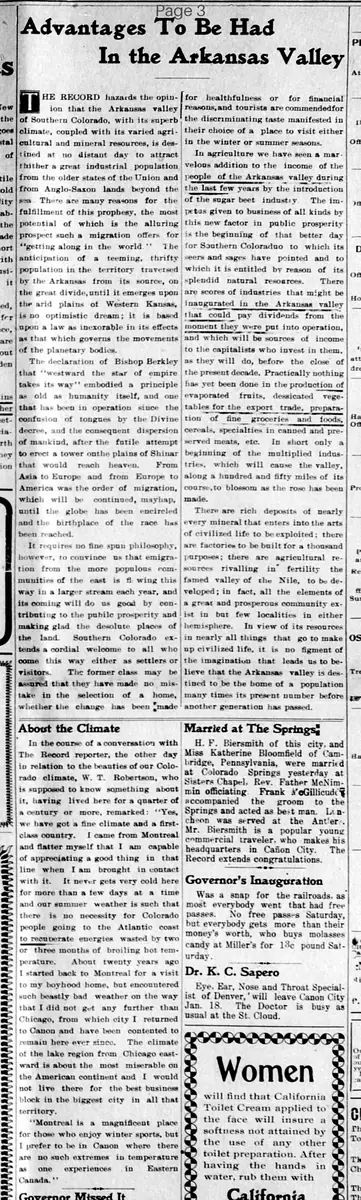
Advantages To Be Had
In the Arkansas Valley
THE RECORD hazards the opinion that the Arkansas valley of Southern Colorado, with its superb climate, coupled with its varied agricultural and mineral resources, is destined at no distant day to attract thither a great industrial population from the older states of the Union and from Anglo-Saxon lands beyond the sea. There are many reasons for the fulfillment of this prophesy, the most potential of which is the alluring prospect such a migration offers for "getting along in the world." The anticipation of a teeming, thrifty population in the territory traversed by the Arkansas from its source, on the great divide, until it emerges upon the arid plains of Western Kansas, is no optimistic dream; it is based upon a law as inexorable in its effects as that which governs the movements of the planetary bodies.
The declaration of Bishop Berkley that "westward the star of empire takes its way" embodied a principle as old as humanity itself, and one that has been in operation since the confusion of tongues by the Divine decree, and the consequent dispersion of mankind, after the futile attempt to erect a tower on the plains of Shinar that would reach heaven.
From Asia to Europe and from Europe to America was the order of migration, which will be continued, mayhap, until the globe has been encircled and the birthplace of the race has been reached.
It requires no fine spun philosophy, however, to convince us that emigration from the more populous communities of the east is flowing this way in a larger stream each year, and its coming will do us good by contributing to the public prosperity and making glad the desolate places of the land. Southern Colorado extends a cordial welcome to all who come this way either as settlers or visitors.
The former class may be assured that they have made no mistake in the selection of a home, whether the change has been made for healthfulness or for financial reasons, and tourists are commended for the discriminating taste manifested in their choice of a place to visit either in the winter or summer seasons.
In agriculture we have seen a marvelous addition to the income of the people of the Arkansas valley during the last few years by the introduction of the sugar beet industry. The impetus given to business of all kinds by this new factor in public prosperity is the beginning of that better day for Southern Colorado to which its seers and sages have pointed and to which it is entitled by reason of its splendid natural resources.
There are scores of industries that might be inaugurated in the Arkansas valley that could pay dividends from the moment they were put into operation, and which will be sources of income to the capitalists who invest in them, as they will do, before the close of the present decade. Practically nothing has yet been done in the production of evaporated fruits, desiccated vegetables for the export trade, preparation of fine groceries and foods, cereals, specialties in canned and preserved meats, etc. In short only a beginning of the multiplied industries, which will cause the valley, along a hundred and fifty miles of its course, to blossom as the rose has been made.
There are rich deposits of nearly every mineral that enters into the arts of civilized life to be exploited; there are factories to be built for a thousand purposes; there are agricultural resources rivalling in fertility the famed valley of the Nile, to be developed; in fact, all the elements of a great and prosperous community exist in but few localities in either hemisphere. In view of its resources in nearly all things that go to make up civilized life, it is no figment of the imagination that leads us to believe that the Arkansas valley is destined to be the home of a population many times its present number before another generation has passed.
About the Climate
In the course of a conversation with The Record reporter, the other day in relation to the beauties of our Colorado climate, W. T. Robertson, who is supposed to know something about it, having lived here for a quarter of a century or more, remarked: "Yes, we have got a fine climate and a first-class country. I came from Montreal and flatter myself that I am capable of appreciating a good thing in that line when I am brought in contact with it. It never gets very cold here for more than a few days at a time and our summer weather is such that there is no necessity for Colorado people going to the Atlantic coast to recuperate energies wasted by two or three months of broiling hot temperature.
About twenty years ago I started back to Montreal for a visit to my boyhood home, but encountered such beastly bad weather on the way that I did not get any further than Chicago, from which city I returned to Canon and have been contented to remain here ever since. The climate of the lake region from Chicago eastward is about the most miserable on the American continent and I would not live there for the best business block in the biggest city in all that territory.
"Montreal is a magnificent place for those who enjoy winter sports, but I prefer to be in Canon where there are no such extremes in temperature as one experiences in Eastern Canada."
In the Arkansas Valley
THE RECORD hazards the opinion that the Arkansas valley of Southern Colorado, with its superb climate, coupled with its varied agricultural and mineral resources, is destined at no distant day to attract thither a great industrial population from the older states of the Union and from Anglo-Saxon lands beyond the sea. There are many reasons for the fulfillment of this prophesy, the most potential of which is the alluring prospect such a migration offers for "getting along in the world." The anticipation of a teeming, thrifty population in the territory traversed by the Arkansas from its source, on the great divide, until it emerges upon the arid plains of Western Kansas, is no optimistic dream; it is based upon a law as inexorable in its effects as that which governs the movements of the planetary bodies.
The declaration of Bishop Berkley that "westward the star of empire takes its way" embodied a principle as old as humanity itself, and one that has been in operation since the confusion of tongues by the Divine decree, and the consequent dispersion of mankind, after the futile attempt to erect a tower on the plains of Shinar that would reach heaven.
From Asia to Europe and from Europe to America was the order of migration, which will be continued, mayhap, until the globe has been encircled and the birthplace of the race has been reached.
It requires no fine spun philosophy, however, to convince us that emigration from the more populous communities of the east is flowing this way in a larger stream each year, and its coming will do us good by contributing to the public prosperity and making glad the desolate places of the land. Southern Colorado extends a cordial welcome to all who come this way either as settlers or visitors.
The former class may be assured that they have made no mistake in the selection of a home, whether the change has been made for healthfulness or for financial reasons, and tourists are commended for the discriminating taste manifested in their choice of a place to visit either in the winter or summer seasons.
In agriculture we have seen a marvelous addition to the income of the people of the Arkansas valley during the last few years by the introduction of the sugar beet industry. The impetus given to business of all kinds by this new factor in public prosperity is the beginning of that better day for Southern Colorado to which its seers and sages have pointed and to which it is entitled by reason of its splendid natural resources.
There are scores of industries that might be inaugurated in the Arkansas valley that could pay dividends from the moment they were put into operation, and which will be sources of income to the capitalists who invest in them, as they will do, before the close of the present decade. Practically nothing has yet been done in the production of evaporated fruits, desiccated vegetables for the export trade, preparation of fine groceries and foods, cereals, specialties in canned and preserved meats, etc. In short only a beginning of the multiplied industries, which will cause the valley, along a hundred and fifty miles of its course, to blossom as the rose has been made.
There are rich deposits of nearly every mineral that enters into the arts of civilized life to be exploited; there are factories to be built for a thousand purposes; there are agricultural resources rivalling in fertility the famed valley of the Nile, to be developed; in fact, all the elements of a great and prosperous community exist in but few localities in either hemisphere. In view of its resources in nearly all things that go to make up civilized life, it is no figment of the imagination that leads us to believe that the Arkansas valley is destined to be the home of a population many times its present number before another generation has passed.
About the Climate
In the course of a conversation with The Record reporter, the other day in relation to the beauties of our Colorado climate, W. T. Robertson, who is supposed to know something about it, having lived here for a quarter of a century or more, remarked: "Yes, we have got a fine climate and a first-class country. I came from Montreal and flatter myself that I am capable of appreciating a good thing in that line when I am brought in contact with it. It never gets very cold here for more than a few days at a time and our summer weather is such that there is no necessity for Colorado people going to the Atlantic coast to recuperate energies wasted by two or three months of broiling hot temperature.
About twenty years ago I started back to Montreal for a visit to my boyhood home, but encountered such beastly bad weather on the way that I did not get any further than Chicago, from which city I returned to Canon and have been contented to remain here ever since. The climate of the lake region from Chicago eastward is about the most miserable on the American continent and I would not live there for the best business block in the biggest city in all that territory.
"Montreal is a magnificent place for those who enjoy winter sports, but I prefer to be in Canon where there are no such extremes in temperature as one experiences in Eastern Canada."
What sub-type of article is it?
Historical Event
Journey
Personal Triumph
What themes does it cover?
Exploration
Fortune Reversal
Triumph
What keywords are associated?
Arkansas Valley
Southern Colorado
Migration
Climate
Agriculture
Mineral Resources
Industrial Development
What entities or persons were involved?
W. T. Robertson
Where did it happen?
Arkansas Valley, Southern Colorado
Story Details
Key Persons
W. T. Robertson
Location
Arkansas Valley, Southern Colorado
Story Details
The article promotes the Arkansas Valley's climate, agricultural and mineral resources, and potential for industries like sugar beets and mining to attract migrants from the East and Europe, predicting population growth; includes W. T. Robertson's endorsement of the local climate over Eastern regions.