Thank you for visiting SNEWPapers!
Sign up free
The Redwood Gazette
Redwood Falls, Redwood County, Minnesota
What is this article about?
In June 1894, Walter Wellman's Arctic expedition, post-shipwreck of the Ragnvald Jarl, endures sledging over rough ice near Northeast Land, sacrifices dogs for boating, and navigates aluminium boats through gales and ice perils near Cape Platen, testing endurance and bravery.
Merged-components note: Merged continuation of the Arctic expedition story 'AFTER THE SHIPWRECK' across pages 1 and 7; relabeled from 'foreign_news' to 'story' as it is a narrative article; included adjacent image on page 1 due to spatial overlap and reading order proximity.
Clippings
1 of 2
OCR Quality
Full Text
Wellman and His Party In the Boats.
DELIGHTS OF ARCTIC SLEDGING.
Story of the Expedition From June 6 to 10-Fate of the Faithful Dogs--Tests of Patience and Endurance--Moments of Great Peril.
[Copyright, 1894, by Walter Wellman. All rights reserved.]
Monday, June 10.-Though it is only a little more than a fortnight since we left the Ragnvald Jarl, in that time we have had a great variety of experiences. We have tasted the delights of arctic sledging, have had our steamer wrecked behind us, have known the pangs of hunger, wallowed in deep snow, fought our way through ice incredibly rough, bathed in a most beautiful natural bathtub within the ice, and finally we have found some open water, killed our dogs in order to take advantage of it and have been shipwrecked in our aluminium boats, escaping with our lives only through the superior strength of those admirable little craft.
Today we are in a pocket. Our camp is about four miles from the shore of Northeast Land, Cape Platen bearing southwest. The ice is so rough in every direction, even that from which we have come, that it is difficult to see how we are to move at all. We are, in fact, wholly surrounded by a frozen jungle which grows more forbidding and impassable as the northwest storms beat up the ice and with the power of a million hydraulic presses ceaselessly ram and jam it upon the shore. Some way out of this dilemma must be found, and our scouts are now out looking for a feasible road.
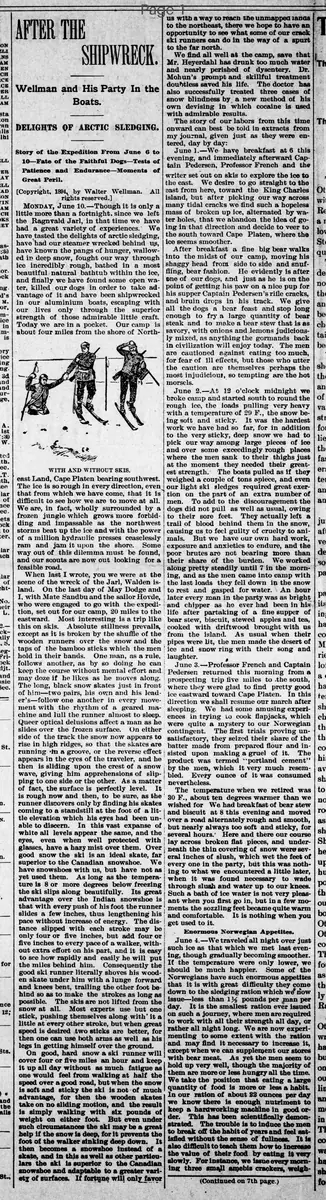
When last I wrote you we were at the scene of the wreck of the Jarl, Walden island. On the last day of May Dodge and I, with Mate Sandbu and the sailor Hovde, who were engaged to go with the expedition, set out for our camp, 20 miles to the eastward. Most interesting is a trip like this on skis. Absolute stillness prevails, except as it is broken by the shuffle of the wooden runners over the snow and the taps of the bamboo sticks which the men hold in their hands. One man, as a rule, follows another, as by so doing he can keep the course without mental effort and may doze if he likes as he moves along. The long, black snow skates just in front of him--two pairs, his own and his leader's--follow one another in every movement with the rhythm of a geared machine and lull the runner almost to sleep. Queer optical delusions affect a man as he slides over the frozen surface. On either side of the track the snow now appears to rise in high ridges, so that the skates are running in a groove, or the reverse effect appears in the eyes of the traveler, and he then is sliding upon the crest of a snow wave, giving him apprehensions of slipping to one side or the other. As a matter of fact, the surface is perfectly level. It is rough now and then, to be sure, as the runner discovers only by finding his skates coming to a standstill at the foot of a little elevation which his eyes had been unable to discern. In this vast expanse of white all levels appear the same, and the eyes, even when well protected with glasses, have a hazy mist over them. Over good snow the skis are an ideal skate, far superior to the Canadian snowshoe. We have snowshoes with us, but have not as yet used them. As long as the temperature is 8 or more degrees below freezing the ski slips along beautifully. Its great advantage over the Indian snowshoe is that with every push of his foot the runner slides a few inches, thus lengthening his pace without increase of energy. The distance slipped with each stroke may be only four or five inches, but add four or five inches to every pace of a walker, without extra effort on his part, and it is easy to see how rapidly and easily he will put the miles behind him. Consequently the good ski runner literally shoves his wooden skate under him with a lunge forward and knees bent, trailing the other foot behind so as to make the strokes as long as possible. The skis are not lifted from the snow at all. Most experts use but one stick, pushing themselves along with it a little at every other stroke, but when great speed is desired two sticks are better, for then one can use both arms as well as his legs in getting himself over the ground. On good, hard snow a ski runner will cover four or five miles an hour and keep it up all day without as much fatigue as one would feel from walking at half the speed over a good road, but when the snow is soft and sticky the ski is not of much advantage, for then the wooden skates take on no sliding motion, and the result is simply walking with six pounds of weight on either foot. But even under such circumstances the ski may be a great help if the snow is deep, for it prevents the foot of the walker sinking deep down. It then becomes a snowshoe instead of a skate, and in this as well as other particulars the ski is superior to the Canadian snowshoe and adaptable to a greater variety of surfaces. If fortune will only favor us with a way to reach the unmapped lands to the northeast, there we hope to have an opportunity to see what some of our crack ski runners can do in the way of a spurt to the far north.
We find all well at the camp, save that Mr. Heyerdahl has drunk too much water and nearly perished of dysentery. Dr. Mohun's prompt and skillful treatment doubtless saved his life. The doctor has also successfully treated three cases of snow blindness by a new method of his own devising in which cocaine is used with admirable results.
The story of our labors from this time onward can best be told in extracts from my journal, given just as they were entered, day by day:
June 1.-We have breakfast at 6 this evening, and immediately afterward Captain Pedersen, Professor French and the writer set out on skis to explore the ice to the east. We desire to go straight to the east from here, toward the King Charles island, but after picking our way across many tidal cracks we find such a hopeless mass of broken up ice, alternated by water holes, that we abandon the idea of going in that direction and decide to veer to the south toward Cape Platen, where the ice seems smoother.
After breakfast a fine big bear walks into the midst of our camp, moving his shaggy head from side to side and snuffing, bear fashion. He evidently is after one of our dogs, and just as he is on the point of getting his paw on a nice pup for his supper Captain Pedersen's rifle cracks, and bruin drops in his track. We give all the dogs a bear feast and stop long enough to fry a large quantity of bear steak and to make a bear stew that is as savory, with onions and lemons judiciously mixed, as anything the gourmands back in civilization will enjoy today. The men are cautioned against eating too much, for fear of ill effects, but those who utter the caution are themselves perhaps the most injudicious, so tempting are the hot morsels.
June 2.-At 12 o'clock midnight we broke camp and started south to round the rough ice, the loads pulling very heavy with a temperature of 29 F., the snow being soft and sticky. It was the hardest work we have had so far, for in addition to the very sticky, deep snow we had to pick our way among large pieces of ice and over some exceedingly rough places where the men sank to their thighs just at the moment they needed their greatest strength. The boats pulled as if they weighed a couple of tons apiece, and even our light ski sledges required great exertion on the part of an extra number of men. To add to the discouragement the dogs did not pull as well as usual, owing to their sore feet. They actually left a trail of blood behind them in the snow, causing us to feel guilty of cruelty to animals. But we have our own hard work, exposure and anxieties to endure, and the poor brutes are not bearing more than their share of the burden. We worked along pretty steadily until 7 in the morning, and as the men came into camp with the last loads they fell down in the snow to rest and gasped for water. An hour later every man in the party was as bright and chipper as he ever had been in his life after partaking of a fine supper of bear stew, biscuit, stewed apples and tea, cooked with driftwood brought with us from the island. As usual when their pipes were lit the men made the desert of ice and snow ring with their song and laughter.
June 3.-Professor French and Captain Pedersen returned this morning from a prospecting trip five miles to the south, where they were glad to find pretty good ice eastward toward Cape Platen. In this direction we shall resume our march after sleeping. We had some amusing experiences in trying to cook flapjacks, which were quite a mystery to our Norwegian contingent. The first trials proving unsatisfactory, they seized their share of the batter made from prepared flour and insisted upon making a gruel of it. The product was termed "portland cement" by the men, which it very much resembled. Every ounce of it was consumed nevertheless.
The temperature when we retired was 30 F., about ten degrees warmer than we wished for. We had breakfast of bear stew and biscuit at 8 this evening and moved over a road alternately rough and smooth, but nearly always too soft and sticky, for several hours. Here and there our course lay across broken flat pieces, and underneath the thin covering of snow were several inches of slush, which wet the feet of every one in the party, but this was nothing to what we encountered a little later, when it was found necessary to wade through slush and water up to our knees. Such a bath of ice water is not very pleasant when you first go in, but in a few moments the sozzling feet became quite warm and comfortable. It is nothing when you get used to it.
Enormous Norwegian Appetites.
June 4.-We traveled all night over just such ice as that which we met last evening, though gradually becoming smoother. If the temperature were only lower, we should be much happier. Some of the Norwegians have such enormous appetites that it is with great difficulty they come down to the sledging ration which we now issue--less than 1½ pounds per man per day. It is the smallest ration ever issued on such a journey, where men are required to work with all their strength all day, or rather all night long.
We are now experimenting to some extent with the ration and may find it necessary to increase it, except when we can supplement our stores with bear meat. As yet the men seem to hold up very well, though the majority of them are more or less hungry all the time. We take the position that eating a large quantity of food is more or less a habit. In our ration of about 22 ounces per day we know there is enough nutriment to keep a hardworking machine in good order. This has been scientifically demonstrated. The trouble is to induce the men to break off the habit of years and feel satisfied without the sense of fullness. It is also difficult to teach them how to increase the value of their food by eating it very slowly. For instance, we issue every morning three small animal crackers, weighing--
(Continued on 7th page.)
can get along at all, so the risk of injury
to our little craft must be endured. As
yet we notice no damage. The rivets have
not even started.
Discouraging Difficulties
It must be confessed that the difficulties
which we have encountered, the loss of
our steamer, the unfavorable nature of the
season and the slow rate of our travel, are
very discouraging. Our original plan of
reaching the heavy ice to the north was
frustrated first by the wide belt of impas-
sable drift ice between the pack and the
shore. Often the pack is hard down upon
the land and comparatively smooth, af-
fording a surface on which we could have
traveled to the northeast, though perhaps
slowly, as we had originally intended.
Then came the loss of the steamer while
we were trying the experiment of sledging
to the eastward, precluding the possibility
of carrying out our alternative -that of a
return to the ship in case the wind chang-
ed and afforded an opportunity to push
northward by steam. In our journey over
the ice we have had a great deal of bad
road, but in the face of all these discour-
agements we have kept to our work, de-
termined to do all that can be prudently
done to achieve success. We now often
joke one another about the high spirits we
were in when fortune was smiling her
sweetest upon us and it seemed as if we
had found a royal road to the highest lati-
tudes. But we remind one another also
of our prediction, made at that time, to
the effect that we should get our share of
hard luck before the year was over, and
that when it came we should fight it out
like men and smile and sing even in the
midst of our misfortunes. Well, that is
just what we are doing now.
As we sit writing up our journal this
June morning at 3 a. m., with the lap for
a desk and the gunwale of a boat for a
chair, the scene is one of rare beauty-a
perfectly blue sky from horizon to hori-
zon, a warm sun in the heavens, not a
breath of air stirring, the sharp or conical
peaks of Spitzbergen and high inland ice
a hundred miles away glittering like a
city of domes, towers and minarets. Cape
Platen looms up dark and shadowy eight
or ten miles to the eastward of us. Thirty
miles northwest we can just see Walden
island, on whose low shore the Ragnvald
Jarl lies a hopeless wreck, with Captain
Bottelfsen and his crew camped on the ice
foot near by. Absolute stillness reigns,
or would reign save for the snoring of a
draft dog under the boat and the screech-
ing of an arctic fowl over the heavy ice.
As I write in the journal Dr. Mohun sits
near by, with his eyes alert for bear. We
are in the bear country, sure enough, for
we see tracks every half mile, but not a
shot has the good doctor yet had
Supper camp was made at 1 o'clock, the
last mile having fatigued all hands very
much, being a succession of icy hummocks
and deep pockets of snow. The meal con-
sisted of the cartridge soup, so called,
made in two pots and giving every man
the second cupful: biscuit, two pounds of
corned beef in slices, apples and tea. Some
of the men having complained of late of
the fare, we took occasion as the first
course was served to address the party and
ask Mr. Franklin to interpret for us, re-
minding them that no other arctic sledging
party had ever had such rich and whole-
some food in the field nor so much in nu-
trition or variety as we are having. Where
other arctic expeditions had simply frozen
pemmican and tea we have our concen-
trated food in hot dishes, and fruit and tea
besides, all hot. It was even necessary to
remind some of the men that what they
have jokingly and perhaps in one or two
instances sneeringly called "soup three
times a day" was really only one portion
of soup per day, the other two dishes being
an improvement upon the old style pem-
nican in that it was richer in nourish-
ment and always served hot. These re-
marks, when interpreted into Norsk, were
greeted with "Madget good!" from the
Norwegian contingent.
Another dog was sacrificed tonight for
the breakfast of his mates, nearly all of
whom have learned to enjoy the cannibal-
istic feast. The men jokingly undressed
the victim and prepared him for the exe-
cution by taking off his collar and har-
ness.
Mr. Dahl is our lord high execu-
tioner.
Just after retiring to our sleeping bags,
and while all hands were smoking, a ther-
mometer was swung for five minutes over
our heads and within the awnings. To
our great surprise, it registered 70 degrees
F. The temperature outside was 33 de-
grees. About midday we were all roused
from slumber by the heat. Though we
had crawled only half way into our sleep-
ing bags and had raised the awning before
going to sleep, the temperature was not to
be endured. We had to get out of the
reinskins entirely and pass the remainder
of the day under the half blanket which
we use for a pillow. This evening about 5
o'clock a strong wind from the south
sprang up, and though the temperature re-
mained stationary we had as much diffi-
culty in keeping warm as we had before
in keeping cool. We breakfasted at 7
o'clock and set out on our journey at 8 in
a howling wind which sent the snow fly-
ing in hurtling, whistling clouds. It beat
into our faces and the eyes of the poor
dogs, making the work exceedingly un-
comfortable. One had to work hard in or-
der to keep warm, and, the road improv-
ing, we made rapid progress.
A little after 11 o'clock this evening,
when we were within about six miles of
Cape Platen and had advanced nearly
four miles, Captain Pedersen mounted a
high piece of ice, cast his eye to the north-
east and took off his hat and shouted:
"Hurrah! Open water!" We all clambered
up beside him, and a shout of joy leaped
from all our throats. To the northeast, as
far as our vision could extend, was a broad
belt of open water. "The strong southerly
wind was giving us the opportunity which
we had been looking for. The ice had even
opened out from the vicinity of Marten's
island, and had we but known it we could
have remained in camp there, saved our-
selves five days of the hardest kind of
work and launched our boats there as
well as here. But in arctic work as in
many other affairs of life one cannot look
far ahead, and our policy has been and
will continue to be to work on, through
water when we can, over the ice when we
must. Naturally enough, the men are all
tired of the hard work of dragging the
boats and sledges and glad enough to take
to the water. The sailormen were particu-
larly delighted, and all hands set to work
with redoubled energy.
June 7.-At 1 o'clock this morning or-
ders were issued to prepare to go to sea
with all possible speed. First it was nec-
essary to move the camp from the pressed
up ice, which, if loosened by the drift,
might overturn and involve us in disaster.
Near by was a large level floe, and we
transferred all our equipment to it. There
the boats were unloaded and overturned
and carefully examined for injuries. We
were delighted to find they had suffered so
little during the ordeal to which they had
been subjected. The Parry was intact.
The Kane had been bent a little by colli-
sions with the ice, but was tight and
whole. The Lockwood had a hole in it
about a quarter of an inch in diameter
which was easily stopped up. The rivets in
all the plating of the boats seemed as well
set as the day the craft came from the
builder's shop. In an incredibly short
time the sailormen had put up masts with
bamboo poles and rigged sail to them. The
loads in the boats were restowed for a voy-
age.
Twelve of the dogs are led away behind
the high ice and shot, poor recompense
for the services which they have rendered
us. It was not a cheerful scene, that of
their execution. They looked up with
friendly eyes at the men who held the
deadly rifles over them, wholly unmindful
of their impending fate. The brutes had
served us faithfully and had suffered more
than their share of the hardships of the
journey. They had slept in the snow and
shivered in the wind, had left a trail of
blood behind them from their sore feet,
had missed many a meal and dined half
the time on short rations. But the neces-
sities of arctic work know no such thing
as pity where dogs are concerned, and the
rifles cracked one after another, and the
ice was soon strewn with the bloody
corpses of our faithful servitors. A dozen
dogs remain, and their fate hangs in the
balance. We have not yet decided wheth-
er we shall take them with us on the boats
or mercifully put an end to their careers
with our winchesters before embarking.
The boats being made ready for launch-
ing, it was found that no room remained
for dogs. They couldn't be carried with-
out filling the boats so full that there
would be no room for any one to stir, and
there being no other way out of the diffi-
culty it was with great sorrow we gave the
order to have the remaining dozen shot.
If we are able to reach land to the north
east, a dozen of these dogs would be of in-
estimable value to us in our sledging oper-
ations there. We have been compelled to
kill today at least 20 good draft animals,
dogs that pull a heavy load and keep it up
all day long, strong and of great endur-
ance, able to withstand any sort of weath-
er, and with their feet, at first somewhat
sore, constantly getting better. Of the 53
dogs which we bought in Belgium perhaps
30 or 35 were useful in arctic work. We
lost some by accident, others strayed away,
and a few were spoiled by inconsiderate
treatment and lack of patience on the part
of the men. During the first week of their
service they were at their worst, but im-
proved daily. Had we exercised a little
more care in buying larger and sounder
dogs and a little more patience in their use
our experiment with Belgian draft dogs
would have been a marked success. It was
a success as it was, notwithstanding the
long confinement of the animals in the
hold of the ship and the peculiar difficul-
ties under which they labored when final-
ly put to work. They are well adapted to
sledging work, and we regret exceedingly
that the change of plan made necessary in
our expedition by the adoption of the east-
ern route and the early launching of the
boats in open water has made it impossi-
ble for us to carry the experiment to a
conclusion. We do not say that if we were
to organize another arctic expedition we
should employ European dogs, but are in-
clined to think we would, taking care to
procure very large and strong dogs and to
have them well accustomed to the lan-
guage of the men who were to work with
them. As it is, we confess that no more
than 50 or 60 per cent of the dogs which
we brought from Belgium were of useful-
ness to us, but that percentage might
easily have been raised to 80 or 90 by the
exercise of greater caution in purchasing
and other conditions. We have therefore
spent nearly $1,500 in our dog experiment
only to find that just at the moment they
were becoming of real value to us it is nec-
essary to leave them behind, killed out
of mercy. If we had the best dogs in the
world-and some of our animals could not
be improved upon-it would be the same.
We and they would have to part company
at the water's edge. Some of the men
nearly shed tears as the winchesters crack-
ed out the death of Wolf, Tom, Bebe and
others who had become favorites by their
great strength and willingness to work.
Perhaps the saddest fate of all was that
of Bob, who long reigned as the king dog
aboard ship. He ruled the pack with his
iron jaws. All the other dogs were afraid
of him, and most of the men also. None
but Mr. Franklin would make friends
with him, and for Franklin Bob appeared
to have genuine affection. As soon as we
came upon the ice the other dogs wreaked
terrible vengeance upon the king. They
rebelled against his rule, and by concert
of action set upon him and chewed and
tore and bit him into the most miserable
specimen of dog life that ever walked the
earth. He hung about the camp barely
able to walk, but compelled always to
keep out of the way of his brothers, who
seemed never to tire of "taking out of his
hide" recompense for the ills and torments
they had suffered at his hands during the
days of his reign. But for the intercession
of Mr. Franklin Bob would have been shot
long ago. Pride never had a greater fall.
The last seen of old Bob was three or four
days ago when some of the men went back
to Marten's island for driftwood. There,
by the refuse of our old camp, lay the for-
mer king of the pack, unable to move. A
bullet ended his career.
Two Hours of Hard Work.
We had two hours of hard work this
morning getting our boats and sledges
across a half mile of pressed up ice to the
edge of the water. But the men were so
glad to see the ocean rippling before them
that they worked as never before, and we
had difficulty in restraining their ardor
and preventing them smashing the equip-
ment, so eager were they for the launch-
ing. The wind died away, and the sun
shone with incredible fierceness, causing
the men to mop their faces as they worked.
It was 9 o'clock this morning before
we reached the edge of the water with all
our outfit, and much good it did our
hearts to see the ocean calm and blue and
no ice in sight to the eastward. An hour
more was spent in preparing for the voy-
age. Our four aluminium sledges were
lashed together in pairs, tandem, two be-
ing towed after the Parry and two after
the Lockwood. Before embarking a num-
ber of us stripped and dived into the sea
from the high ice, greatly to the astonish-
ment of a seal who was swimming about
a few yards away.
At 11 o'clock we set sail, and, the wind
dying away, took to our oars. This even-
ing, after five hours of hard work and a
day that has been 20 hours long, we made
camp near Cape Platen, every one wet,
tired and miserable, the weather having
become inclement. After supper we is-
sued a ration of brandy and then crawled
into our sleeping bags.
We were so much fatigued that we fell
asleep with our lighted cigars and pipes
in our mouths. In half an hour all were
roused by the voice of Captain Pedersen
calling us out. The wind had shifted to
the northwest, and blowing strong had
beaten up the sea and began to break off
the edge of the shore ice where our camp
was. Imagine the pleasure of being rooted
out of our warm sleeping bags into the
cold wind to move the boats and sledges
to a place of greater safety. Fortunately
we had not far to go, and in half an hour
everything had been moved a hundred feet
farther up on the ice and with some heavy
blocks between us and the wind. Even
here we did not know but it would be
necessary to move again before morning
should the wind go more to the north, but
we decided to risk it and crawled again
into our snug bags.
Our progress today was very encourag-
ing. We rowed about 12 miles in 5 hours.
Only one of the three aluminium boats,
the Parry, leaked at all, and that very lit-
tle. Any wooden boat would have been
splintered into kindling wood by the rough
usage to which our light metal craft have
been subjected. Our aluminium sledges,
lashed rigidly to bamboo poles, tandem,
took kindly to the water. It is almost im-
possible to capsize them, and their con-
tents were perfectly dry. With any other
form of sledge than this it would have
been impossible for us to have made the
boat voyage of today, for the simple rea-
son that the boats could not carry all the
load.
June 8.-We spent the morning thor-
ough ly repairing the Parry, tightening
her rivets. A novelty of the breakfast was
the choice of the Norwegians to eat their
slice of bacon raw instead of having it
cooked. The weather was incredibly hot,
with a temperature of 34 degrees F. in
the shade and perhaps 50 degrees in the
sun. We actually suffered from the heat.
Here for the first time in our journey we
were able to scoop up perfectly fresh wa-
ter from the base of the high pieces of ice.
We left a notice of our visit under a cairn
on the rocks of Cape Platen.
As we took to the water at 1 this after-
noon the wind sprang up from the north-
west, with snow, quickly changing the
summer scene to one of decided wintry as-
pect. It proved a good sailing breeze, and
we hoisted our canvas and sped away to
the east, following the shore ice after go-
ing a mile or so, the Lockwood and the
Kane towing the two pairs of sledges after
them. We had to stop at the edge of the
shore ice and wait an hour or more in the
driving snowstorm for the wind to clear a
way for us. A queer scene our party made
standing about upon the ice in the midst
of a white desert, the boats rapping and
lapping against the margin of our frozen
shore. Though the land was but a mile or
two to the south, we could see it only at in-
tervals. Dreary as the aspect was, our men
proved cheerful in its midst. Professor
French and Captain Pedersen went ahead
to mount high pieces of ice and look for
an opening. Mr. Dodge, as usual, struck
up a bit of song, in which the Norwegians
joined.
Dr. Mohun and others found snug rest-
ing places in the lee of masses of ice.
Presently a narrow strip of open water
appeared ahead of us, and we set out. The
wind was almost a gale, and whenever we
got far from the shore ice the big waves
made our little boats dance a lively tune.
The Kane fell far behind, and we soon
signaled the Lockwood to join the Parry
at the edge of the ice and wait for her.
When she came up, we held a council of
war, and as a result of it issued orders
that all the boats should keep as near the
shore ice as possible, and that the Parry
should take the Kane, with its sledge, in
tow. Our idea in this was that near the
fast ice the water was smoother than far-
ther out, and that in case of trouble to ei-
ther of the boats the shore ice would be
near at hand to make fast to. This seemed
a wise precaution, and if the order had
been carefully obeyed we should have had
no trouble. But about 4 o'clock in the
afternoon, before we had realized that
danger threatened, the Parry and the
Kane found themselves in a most perilous
situation. We came to a deep bay in the
shore ice, across the mouth of which the
wind was blowing with tremendous force.
At first it was our intention to cut across
the sea end of the bay and around the
point of ice beyond. But, seeing the Lock-
wood working up the bay, evidently to
make camp for supper, we changed our
course and endeavored to follow into the
bight. It came near being a fatal change
of plan for us. As the Parry and Kane
were brought about broadside to the wind
and their sails taken in the gale swept
them with amazing rapidity toward the
edge of the ice, where the surf was tossing
in the air and large and small pieces of ice
were surging up and down furiously. Be-
fore the men could get out the oars-and
in the strong wind it would not have
made any difference if they had been al-
ready manned-we were upon the lee shore
of the bay. It was a critical moment, but
luckily every man kept his head. With
oars and boat hooks we held the two boats
off the ice the best we could, though,
with all our efforts, we ground against it
with a force which threatened to destroy
the craft under our feet and leave us
struggling amid the water and ice. Hav-
ing come broadside on, our danger was the
greater, and the first thing we endeavored
to do was to swing the stern outward and
force an entrance bow on. So great was
the pressure of the wind that at one mo-
ment it looked as if we should not be able
to do this, and that the expedition would
be wrecked, even if some of us did not
lose our lives. The boats were bobbing
up and down like a pair of corks in a storm
tossed sea, and the aluminium sledges,
containing 1,000 pounds of our precious
food, were without protection astern the
Kane and in imminent danger of being
ground to pieces. Few words were spoken
in this moment of peril, save by those in
authority. Every man worked for dear
life, and we soon had the infinite satisfac-
tion of seeing the bow of the Parry point-
ed in between two large pieces, where the
force of the wind, joined to our efforts,
soon drove her farther. In a few seconds
the men had jumped out upon floating
pieces, though partly submerged, which
were moving up and down in the surf and
threatening to go to pieces at any mo-
ment.
Standing in water up to their knees,
they pulled the Parry farther toward the
solid ice, and in a few seconds more we
were all out of the boat upon the surging,
broken pieces, and the battle was practi-
cally over. It was the work of a moment
to pull the Parry upon the margin of the
solid ice and then to run the Kane and
the two sledges through the opening thus
made. We were out of our trouble almost
as quickly as we had been plunged into
it, but for several minutes it looked as if
we had for the second time in our expedi-
tion suffered serious shipwreck in the jaws
of the ice. In the work of extricating
the boats and sledges from their peril all
hands showed fine courage and presence
of mind. Sailors Ellefsen and Hovde risk-
ed their lives by getting out upon the
dancing, loose pieces, while the four young
men from Christiania--Captain Juell, Al-
mie, Dahl and Heyerdahl-were equally
brave and prompt in rescuing their boat,
the Kane and the sledges. Mr. Dodge,
in the bow of the Parry, did wonders with
a boat hook in opening up an entrance in
the margin of the ice, while Professor
French did his best to keep the boat from
beating to pieces. While assisting in this
task Dr. Mohun sprained his right wrist se-
it may easily be imagined that we all
felt better when we stood upon firm ice
and had the boats and sledges by our side.
Our satisfaction was increased by an ex-
amination of the craft, which showed that
none of them had been injured in the
slightest by their battle with the surf and
the ice. The Lockwood had sailed up to
the head of the bay, but Captain Pedersen
and others of her crew came over to our
landing place, and after consultation it
was decided the Lockwood should join the
other two boats for camp. This was ef-
fected in good sailor style by Captain Pe-
dersen and his men, who rowed against
the wind to a point opposite the spot
where we had had our little battle with
the elements and then drifted in and land-
ed, with the help of our men, with boat
hooks in their hands, without much trou-
ble. At this place, about eight miles
northeast of Cape Platen, we camped for
the night, the westerly gale continuing
and the ice closing up to the north and
east, thus barring our farther progress
in the boats. It was not a very comfort-
able camp, but we were glad enough to
eat our hot supper and crawl into our
sleeping bags after the excitement and
dangers of the day.
WALTER WELLMAN.
Itch on human and horses and all
animals cured in 30 minutes by Wool-
ford's Sanitary Lotion. This never
fails. Sold by H. M. Hitchcock & Co.
druggists, Redwood Falls Minn. 17-52t
What sub-type of article is it?
What themes does it cover?
What keywords are associated?
What entities or persons were involved?
Where did it happen?
Story Details
Key Persons
Location
Northeast Land, Cape Platen, Walden Island, Spitzbergen
Event Date
June 1894
Story Details
After the Ragnvald Jarl shipwreck, Wellman's party sledges over rough Arctic ice, endures hunger and cold, kills dogs for food and to lighten boats, discovers open water, launches aluminium boats, and escapes peril in a gale near Cape Platen.