Thank you for visiting SNEWPapers!
Sign up free
National Gazette
Philadelphia, Philadelphia County, Pennsylvania
What is this article about?
Admiral Paul Jones died in Paris on July 18, 1792. The French National Assembly ordered a public funeral after the American minister requested a private one. A deputation attended the procession to St. Eustache cemetery, where Protestant minister M. Marron delivered a eulogy praising Jones's heroism for American and French liberty.
Clipping
OCR Quality
Full Text
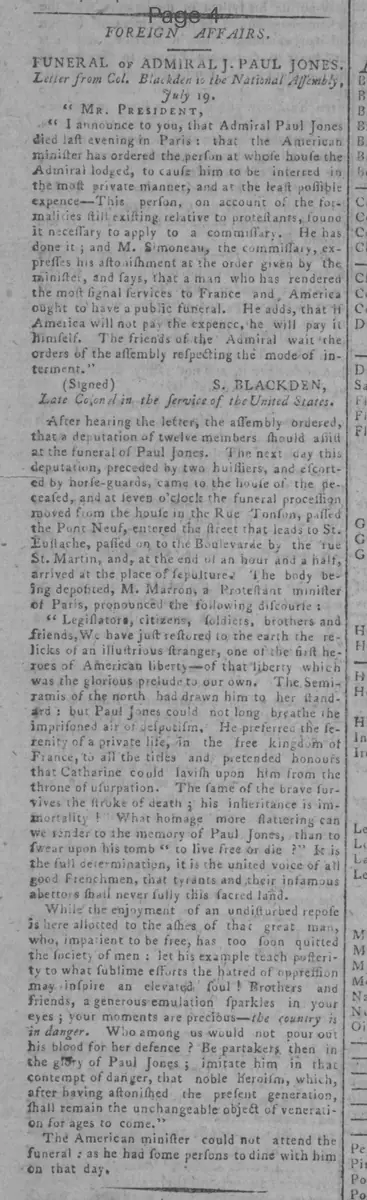
FUNERAL OF ADMIRAL J. PAUL JONES.
Letter from Col. Blackden to the National Assembly.
July 19.
MR. PRESIDENT,
I announce to you, that Admiral Paul Jones died last evening in Paris : that the American minister has ordered the person at whose house the Admiral lodged, to cause him to be interred in the most private manner, and at the least possible expense—This person, on account of the formalities still existing relative to protestants, found it necessary to apply to a commissary. He has done it ; and M. Simoneau, the commissary, expresses his astonishment at the order given by the minister, and says, that a man who has rendered the most signal services to France and America ought to have a public funeral. He adds, that if America will not pay the expense, he will pay it himself. The friends of the Admiral wait the orders of the assembly respecting the mode of interment.
(Signed)
S. BLACKDEN,
Late Colonel in the service of the United States.
After hearing the letter, the assembly ordered, that a deputation of twelve members should assist at the funeral of Paul Jones. The next day this deputation, preceded by two huissiers, and escorted by horse-guards, came to the house of the deceased, and at eleven o'clock the funeral procession moved from the house in the Rue Tournon, passed the Pont Neuf, entered the street that leads to St. Eustache, passed on to the Boulevarde by the rue St. Martin, and, at the end of an hour and a half, arrived at the place of sepulture. The body being deposited, M. Marron, a Protestant minister of Paris, pronounced the following discourse:
"Legislators, citizens, soldiers, brothers and friends, We have just restored to the earth the relics of an illustrious stranger, one of the first heroes of American liberty—of that liberty which was the glorious prelude to our own. The Semiramis of the north had drawn him to her standard : but Paul Jones could not long breathe the imprisoned air of Despotism, He preferred the serenity of a private life, in the free kingdom of France, to all the titles and pretended honours that Catharine could lavish upon him from the throne of usurpation. The fame of the brave survives the stroke of death ; his inheritance is immortality ! What homage more flattering can we render to the memory of Paul Jones, than to wear upon his tomb "to live free or die ?" It is the full determination, it is the united voice of all good Frenchmen, that tyrants and their infamous abettors shall never pollute this sacred land. While the enjoyment of an undisturbed repose is here allotted to the ashes of that great man, who, impatient to be free, has too soon quitted the society of men : let his example teach posterity to what sublime efforts the hatred of oppression may inspire an elevated soul! Brothers and friends, a generous emulation sparkles in your eyes; your moments are precious—the country is in danger. Who among us would not pour out his blood for her defence ? Be partakers then in the glory of Paul Jones ; imitate him in that contempt of danger, that noble heroism, which, after having astonished the present generation, shall remain the unchangeable object of veneration for ages to come."
The American minister could not attend the funeral : as he had some persons to dine with him on that day.
What sub-type of article is it?
What keywords are associated?
What entities or persons were involved?
Where did it happen?
Foreign News Details
Primary Location
Paris
Event Date
July 19
Key Persons
Outcome
public funeral arranged by national assembly despite american minister's request for private interment; deputation attended; eulogy delivered emphasizing heroism and liberty.
Event Details
Admiral Paul Jones died in Paris the evening before July 19. Col. Blackden informed the National Assembly, noting the American minister's order for a private, inexpensive burial. Commissary M. Simoneau objected and offered to pay for a public funeral. The Assembly sent a deputation of twelve members. The next day, the procession from Rue Tournon to the cemetery at St. Eustache included huissiers and horse-guards. M. Marron delivered a discourse on Jones's contributions to liberty. The American minister did not attend due to prior dinner engagement.