Thank you for visiting SNEWPapers!
Sign up free
Literary
September 17, 1825
Concord Register
Concord, Merrimack County, New Hampshire
What is this article about?
Journal entry from a western traveler describing the Mississippi River's islands, currents, and changes like Needham's cutoff; scenic Natchez on a bluff; bustling New Orleans with its layout, commerce, diverse population, and Sunday customs; and Cincinnati's advantageous site and rapid growth to 12,000 inhabitants.
Clipping
OCR Quality
95%
Excellent
Full Text
From the Westchester (Virginia) Republican.
JOURNAL OF A WESTERN TRAVELLER.
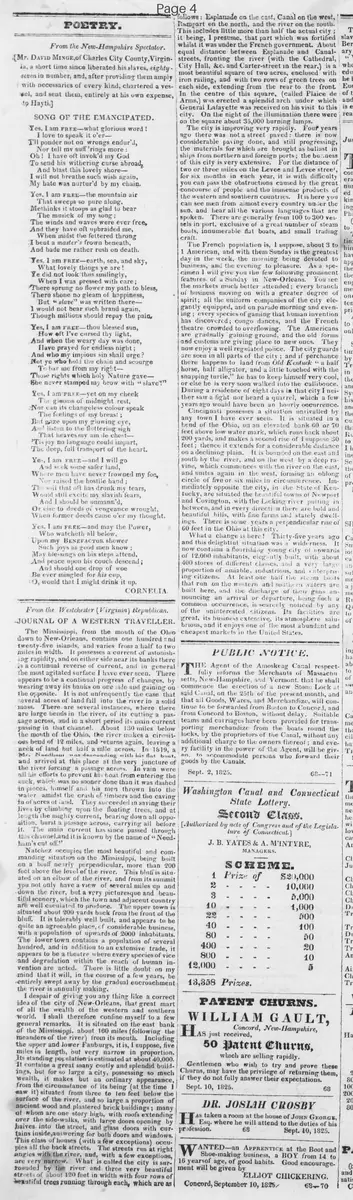
The Mississippi, from the mouth of the Ohio down to New-Orleans, contains one hundred and twenty-five islands, and varies from a half to two miles in width. It possesses a current of astonishing rapidity, and on either side near its banks there is a continual reverse of current, and in general the most agitated surface I have ever seen. There appears to be a continual progress of changes, by wearing away its banks on one side and gaining on the opposite. It is not unfrequently the case that several acres of land fall into the river in a solid mass. There are several instances, where there are large bends in the river, of its cutting a passage across, and in a short period its main current passing in that channel. About 130 miles below the mouth of the Ohio, the river makes a circuitous bend of 12 miles, and returns again, leaving a neck of land but half a mile across. In 1819, a Mr. Needham was descending with his flat boat, and arrived at this place at the very juncture of the river forcing a passage across. In vain were all his efforts to prevent his boat from entering the suck, which was no sooner done than it was dashed in pieces, himself and his men thrown into the water amidst the crash of timbers and the caving in of acres of land. They succeeded in saving their lives by climbing upon the floating trees, and at length the mighty current, bearing down all opposition, burst a passage across, carrying all before it. The main current has since passed through this channel, and it is known by the name of "Needham's cut off."
Natchez occupies the most beautiful and commanding situation on the Mississippi, being built on a bluff nearly perpendicular, more than 200 feet above the level of the river. This bluff is situated on an elbow of the river, and from its summit you not only have a view of several miles up and down the river, but a very picturesque and beautiful scenery, which the town and adjacent country are well calculated to produce. The upper town is situated about 200 yards back from the front of the bluff. It is tolerably well built, and appears to be quite an agreeable place, of considerable business, with a population of upwards of 2000 inhabitants. The lower town contains a population of several hundred, and in addition to an extensive trade, it appears to be a theatre where every species of vice and degradation within the reach of human invention are acted. There is little doubt on my mind that it will, in the course of a few years, be entirely swept away by the gradual encroachment the river is annually making.
I despair of giving you any thing like a correct idea of the city of New-Orleans, that great mart of all the wealth of the western and southern world. I shall therefore confine myself to a few general remarks. It is situated on the east bank of the Mississippi, about 100 miles (following the meanders of the river) from its mouth. Including the upper and lower Faubourgs, it is, I suppose, five miles in length, but very narrow in proportion. Its standing population is estimated at about 40,000. It contains a great many costly and splendid buildings, but for so large a city, possessing so much wealth, it makes but an ordinary appearance, from the circumstance of its being (at the time I saw it) situated from three to ten feet below the surface of the river, and so large a proportion of ancient wood and plastered brick buildings; many of whom are one story high, with roofs extending over the side-walks, with large doors opening by hinges into the street, and glass doors with curtains inside, answering for both doors and windows. This class of houses (with a few exceptions) occupies all the back streets. The streets run at right angles with the river, and, with a few exceptions, are very narrow. What is called the city is surrounded by the river and three very beautiful streets of about 120 feet in width with four rows of beautiful trees running through each, which are as follows: Esplanade on the east, Canal on the west, Rampart on the north, and the river on the south. This includes little more than half the actual city; it being, I presume, that part which was fortified whilst it was under the French government. About equal distance between Esplanade and Canal-streets, fronting the river (with the Cathedral, City Hall, &c. and Chartres-street in the rear,) is a most beautiful square of two acres, enclosed with iron railing, and with two rows of green trees on each side, extending from the rear to the front. In the centre of this square, (called Place d'Armes,) was erected a splendid arch under which General Lafayette was received on his visit to this city. On the night of the illumination there were on the square about 35,000 burning lamps.
The city is improving very rapidly. Four years ago there was not a street paved: there is now considerable paving done, and still progressing, the materials for which are brought as ballast in ships from northern and foreign ports; the business of this city is very extensive. For the distance of two or three miles on the Levee and Levee street, for six months in each year, it is with difficulty you can pass the obstructions caused by the great concourse of people and the immense products of the western and southern countries. It is here you can see men from almost every country under the sun, and hear all the various languages that are spoken. There are generally from 100 to 300 vessels in port, exclusive of a great number of steam boats, innumerable flat boats, and small trading craft.
The French population is, I suppose, about 3 to 1 American, and with them Sunday is the greatest day in the week, the morning being devoted to business, and the evening to pleasure. As a specimen I will give you the few following prominent features of a Sunday in New-Orleans. You see the markets much better attended; every branch of business moving on with a greater degree of spirit; all the uniform companies of the city elegantly equipped, and on parade morning and evening; every species of gaming that human invention has discovered; congo dances, and the French theatre crowded to overflowing. The Americans are gradually gaining ground, and the old forms and customs are giving place to new ones. They now enjoy a well regulated police. The city guards are seen in all parts of the city: and if perchance there happens to land from Old Kentuck "a half horse, half alligator, and a little touched with the snapping turtle," he has to keep himself very cool, or else he is very soon walked into the calaboose. During a residence of eight days in that city I neither saw a fight nor heard a quarrel, which a few years ago would have been an hourly occurrence.
Cincinnati possesses a situation unrivalled by any town I have ever seen. It is situated in a bend of the Ohio, on an elevated bank 60 or 70 feet above low water mark, which runs back about 200 yards, and makes a second rise of I suppose 30 feet; thence it extends for a considerable distance on a declining plain. It is bounded on the east and south by the river, and on the west by a deep ravine, which commences with the river on the east, and unites again in the west, forming an oblong circle of five or six miles in circumference. Immediately opposite the city, in the State of Kentucky, are situated the beautiful towns of Newport and Covington, with the Licking river putting in between, and in every direction there are bold and beautiful hills, with fine farms and stately dwellings. There is some years a perpendicular rise of 60 feet in the Ohio at this city.
What a change is here! Thirty-five years ago and this delightful situation was a wilderness. It now contains a flourishing young city of upwards of 12,000 inhabitants, elegantly built, with about 400 stores of different classes, and a very large proportion of amiable, industrious, and enterprising citizens. At least one half the steam boats that run on the western and southern waters are built here, and the discharge of their guns announcing an arrival or departure, being such a common occurrence, is scarcely noticed by any of the uninterested citizens. Its facilities are great, its business extensive, its atmosphere salubrious, and it enjoys one of the most abundant and cheapest markets in the United States.
JOURNAL OF A WESTERN TRAVELLER.
The Mississippi, from the mouth of the Ohio down to New-Orleans, contains one hundred and twenty-five islands, and varies from a half to two miles in width. It possesses a current of astonishing rapidity, and on either side near its banks there is a continual reverse of current, and in general the most agitated surface I have ever seen. There appears to be a continual progress of changes, by wearing away its banks on one side and gaining on the opposite. It is not unfrequently the case that several acres of land fall into the river in a solid mass. There are several instances, where there are large bends in the river, of its cutting a passage across, and in a short period its main current passing in that channel. About 130 miles below the mouth of the Ohio, the river makes a circuitous bend of 12 miles, and returns again, leaving a neck of land but half a mile across. In 1819, a Mr. Needham was descending with his flat boat, and arrived at this place at the very juncture of the river forcing a passage across. In vain were all his efforts to prevent his boat from entering the suck, which was no sooner done than it was dashed in pieces, himself and his men thrown into the water amidst the crash of timbers and the caving in of acres of land. They succeeded in saving their lives by climbing upon the floating trees, and at length the mighty current, bearing down all opposition, burst a passage across, carrying all before it. The main current has since passed through this channel, and it is known by the name of "Needham's cut off."
Natchez occupies the most beautiful and commanding situation on the Mississippi, being built on a bluff nearly perpendicular, more than 200 feet above the level of the river. This bluff is situated on an elbow of the river, and from its summit you not only have a view of several miles up and down the river, but a very picturesque and beautiful scenery, which the town and adjacent country are well calculated to produce. The upper town is situated about 200 yards back from the front of the bluff. It is tolerably well built, and appears to be quite an agreeable place, of considerable business, with a population of upwards of 2000 inhabitants. The lower town contains a population of several hundred, and in addition to an extensive trade, it appears to be a theatre where every species of vice and degradation within the reach of human invention are acted. There is little doubt on my mind that it will, in the course of a few years, be entirely swept away by the gradual encroachment the river is annually making.
I despair of giving you any thing like a correct idea of the city of New-Orleans, that great mart of all the wealth of the western and southern world. I shall therefore confine myself to a few general remarks. It is situated on the east bank of the Mississippi, about 100 miles (following the meanders of the river) from its mouth. Including the upper and lower Faubourgs, it is, I suppose, five miles in length, but very narrow in proportion. Its standing population is estimated at about 40,000. It contains a great many costly and splendid buildings, but for so large a city, possessing so much wealth, it makes but an ordinary appearance, from the circumstance of its being (at the time I saw it) situated from three to ten feet below the surface of the river, and so large a proportion of ancient wood and plastered brick buildings; many of whom are one story high, with roofs extending over the side-walks, with large doors opening by hinges into the street, and glass doors with curtains inside, answering for both doors and windows. This class of houses (with a few exceptions) occupies all the back streets. The streets run at right angles with the river, and, with a few exceptions, are very narrow. What is called the city is surrounded by the river and three very beautiful streets of about 120 feet in width with four rows of beautiful trees running through each, which are as follows: Esplanade on the east, Canal on the west, Rampart on the north, and the river on the south. This includes little more than half the actual city; it being, I presume, that part which was fortified whilst it was under the French government. About equal distance between Esplanade and Canal-streets, fronting the river (with the Cathedral, City Hall, &c. and Chartres-street in the rear,) is a most beautiful square of two acres, enclosed with iron railing, and with two rows of green trees on each side, extending from the rear to the front. In the centre of this square, (called Place d'Armes,) was erected a splendid arch under which General Lafayette was received on his visit to this city. On the night of the illumination there were on the square about 35,000 burning lamps.
The city is improving very rapidly. Four years ago there was not a street paved: there is now considerable paving done, and still progressing, the materials for which are brought as ballast in ships from northern and foreign ports; the business of this city is very extensive. For the distance of two or three miles on the Levee and Levee street, for six months in each year, it is with difficulty you can pass the obstructions caused by the great concourse of people and the immense products of the western and southern countries. It is here you can see men from almost every country under the sun, and hear all the various languages that are spoken. There are generally from 100 to 300 vessels in port, exclusive of a great number of steam boats, innumerable flat boats, and small trading craft.
The French population is, I suppose, about 3 to 1 American, and with them Sunday is the greatest day in the week, the morning being devoted to business, and the evening to pleasure. As a specimen I will give you the few following prominent features of a Sunday in New-Orleans. You see the markets much better attended; every branch of business moving on with a greater degree of spirit; all the uniform companies of the city elegantly equipped, and on parade morning and evening; every species of gaming that human invention has discovered; congo dances, and the French theatre crowded to overflowing. The Americans are gradually gaining ground, and the old forms and customs are giving place to new ones. They now enjoy a well regulated police. The city guards are seen in all parts of the city: and if perchance there happens to land from Old Kentuck "a half horse, half alligator, and a little touched with the snapping turtle," he has to keep himself very cool, or else he is very soon walked into the calaboose. During a residence of eight days in that city I neither saw a fight nor heard a quarrel, which a few years ago would have been an hourly occurrence.
Cincinnati possesses a situation unrivalled by any town I have ever seen. It is situated in a bend of the Ohio, on an elevated bank 60 or 70 feet above low water mark, which runs back about 200 yards, and makes a second rise of I suppose 30 feet; thence it extends for a considerable distance on a declining plain. It is bounded on the east and south by the river, and on the west by a deep ravine, which commences with the river on the east, and unites again in the west, forming an oblong circle of five or six miles in circumference. Immediately opposite the city, in the State of Kentucky, are situated the beautiful towns of Newport and Covington, with the Licking river putting in between, and in every direction there are bold and beautiful hills, with fine farms and stately dwellings. There is some years a perpendicular rise of 60 feet in the Ohio at this city.
What a change is here! Thirty-five years ago and this delightful situation was a wilderness. It now contains a flourishing young city of upwards of 12,000 inhabitants, elegantly built, with about 400 stores of different classes, and a very large proportion of amiable, industrious, and enterprising citizens. At least one half the steam boats that run on the western and southern waters are built here, and the discharge of their guns announcing an arrival or departure, being such a common occurrence, is scarcely noticed by any of the uninterested citizens. Its facilities are great, its business extensive, its atmosphere salubrious, and it enjoys one of the most abundant and cheapest markets in the United States.
What sub-type of article is it?
Journey Narrative
Essay
What themes does it cover?
Commerce Trade
Nature
Social Manners
What keywords are associated?
Mississippi River
New Orleans
Cincinnati
Travel Journal
River Changes
Urban Description
Western Commerce
What entities or persons were involved?
From The Westchester (Virginia) Republican.
Literary Details
Title
Journal Of A Western Traveller.
Author
From The Westchester (Virginia) Republican.
Key Lines
In 1819, A Mr. Needham Was Descending With His Flat Boat, And Arrived At This Place At The Very Juncture Of The River Forcing A Passage Across. In Vain Were All His Efforts To Prevent His Boat From Entering The Suck, Which Was No Sooner Done Than It Was Dashed In Pieces, Himself And His Men Thrown Into The Water Amidst The Crash Of Timbers And The Caving In Of Acres Of Land.
It Is Here You Can See Men From Almost Every Country Under The Sun, And Hear All The Various Languages That Are Spoken.
What A Change Is Here! Thirty Five Years Ago And This Delightful Situation Was A Wilderness. It Now Contains A Flourishing Young City Of Upwards Of 12,000 Inhabitants...