Thank you for visiting SNEWPapers!
Sign up free
Editorial
June 4, 1885
Yorkville Enquirer
York, York County, South Carolina
What is this article about?
The editorial posits that happiness is a habit formed through repeated positive thoughts and feelings, particularly in child-rearing via encouragement and order, rather than scolding. It emphasizes self-control, truthfulness, and viewing happiness as a moral duty due to its contagious benefits.
Clipping
OCR Quality
98%
Excellent
Full Text
HAPPINESS A HABIT.
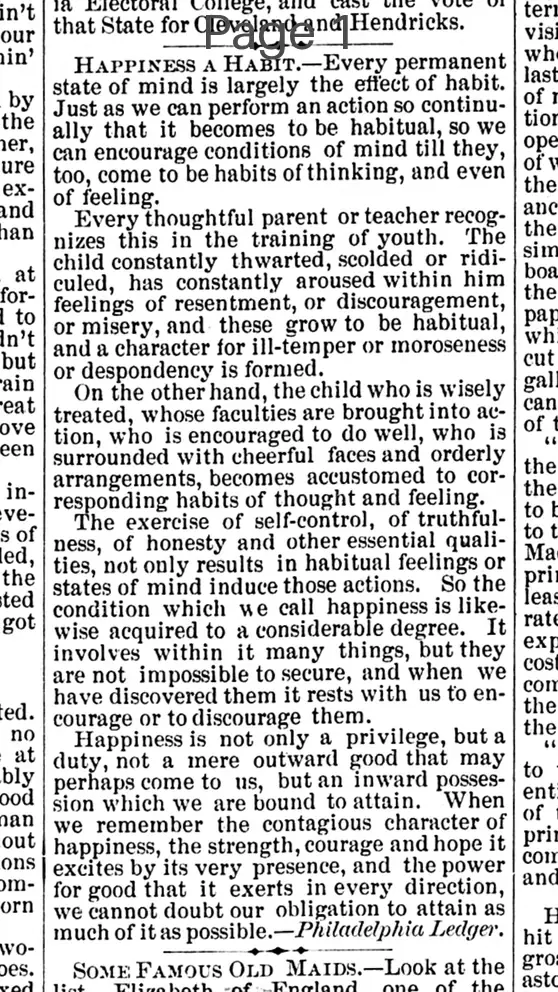
Every permanent state of mind is largely the effect of habit. Just as we can perform an action so continually that it becomes to be habitual, so we can encourage conditions of mind till they, too, come to be habits of thinking, and even of feeling.
Every thoughtful parent or teacher recognizes this in the training of youth. The child constantly thwarted, scolded or ridiculed, has constantly aroused within him feelings of resentment, or discouragement, or misery, and these grow to be habitual, and a character for ill-temper or moroseness or despondency is formed.
On the other hand, the child who is wisely treated, whose faculties are brought into action, who is encouraged to do well, who is surrounded with cheerful faces and orderly arrangements, becomes accustomed to corresponding habits of thought and feeling.
The exercise of self-control, of truthfulness, of honesty and other essential qualities, not only results in habitual feelings or states of mind induce those actions. So the condition which we call happiness is likewise acquired to a considerable degree. It involves within it many things, but they are not impossible to secure, and when we have discovered them it rests with us to encourage or to discourage them.
Happiness is not only a privilege, but a duty, not a mere outward good that may perhaps come to us, but an inward possession which we are bound to attain. When we remember the contagious character of happiness, the strength, courage and hope it excites by its very presence, and the power for good that it exerts in every direction, we cannot doubt our obligation to attain as much of it as possible.—Philadelphia Ledger.
Every permanent state of mind is largely the effect of habit. Just as we can perform an action so continually that it becomes to be habitual, so we can encourage conditions of mind till they, too, come to be habits of thinking, and even of feeling.
Every thoughtful parent or teacher recognizes this in the training of youth. The child constantly thwarted, scolded or ridiculed, has constantly aroused within him feelings of resentment, or discouragement, or misery, and these grow to be habitual, and a character for ill-temper or moroseness or despondency is formed.
On the other hand, the child who is wisely treated, whose faculties are brought into action, who is encouraged to do well, who is surrounded with cheerful faces and orderly arrangements, becomes accustomed to corresponding habits of thought and feeling.
The exercise of self-control, of truthfulness, of honesty and other essential qualities, not only results in habitual feelings or states of mind induce those actions. So the condition which we call happiness is likewise acquired to a considerable degree. It involves within it many things, but they are not impossible to secure, and when we have discovered them it rests with us to encourage or to discourage them.
Happiness is not only a privilege, but a duty, not a mere outward good that may perhaps come to us, but an inward possession which we are bound to attain. When we remember the contagious character of happiness, the strength, courage and hope it excites by its very presence, and the power for good that it exerts in every direction, we cannot doubt our obligation to attain as much of it as possible.—Philadelphia Ledger.
What sub-type of article is it?
Moral Or Religious
Education
What keywords are associated?
Happiness Habit
Moral Duty
Child Training
Self Control
Positive Mindset
Contagious Happiness
What entities or persons were involved?
Philadelphia Ledger
Editorial Details
Primary Topic
Cultivating Happiness As A Habit Through Mindset And Child Rearing
Stance / Tone
Encouraging Happiness As A Moral Duty And Habit
Key Figures
Philadelphia Ledger
Key Arguments
Permanent States Of Mind Form Through Habit, Like Actions
Negative Treatment In Youth Fosters Resentment And Despondency
Positive Encouragement Builds Cheerful Habits
Self Control And Virtues Induce Habitual Positive States
Happiness Is Acquirable And Involves Securing Positive Conditions
Happiness Is A Privilege And Duty Due To Its Contagious Power For Good