Thank you for visiting SNEWPapers!
Sign up free
The Congregationalist
Hartford, Hartford County, Connecticut
What is this article about?
In Philadelphia, James Wood, a prosperous but ambitious father, murders his beloved daughter upon learning of her secret marriage to Peake, which dashed his hopes of marrying her into higher English society; the act stems from excessive, tyrannical affection and morbid ambition, serving as a moral warning.
Clipping
OCR Quality
Full Text
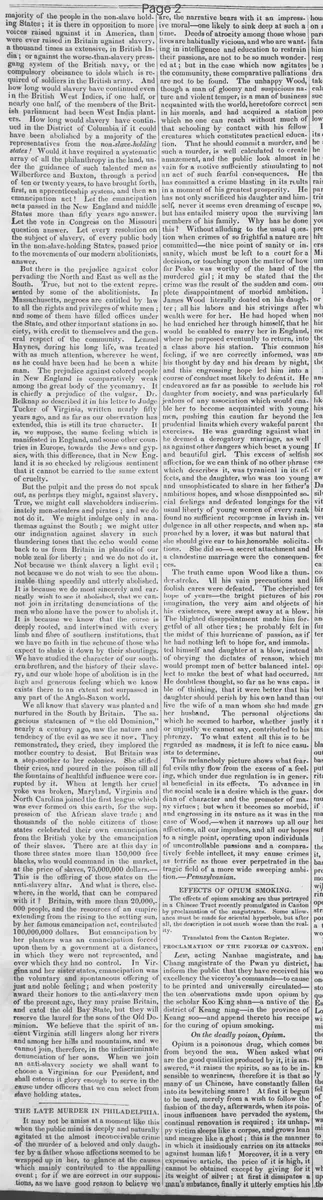
It may not be amiss at a moment like this when the public mind is deeply and naturally agitated at the almost inconceivable crime of the murder of a beloved and only daughter by a father whose affections seemed to be wrapped up in her, to glance at the causes which mainly contributed to the appalling event; for if we are correct in our suppositions, as we have good reason to believe we are, the narrative bears with it an impressive moral one likely to sink deep at such a time.
Deeds of atrocity among those whose lives are habitually vicious, and who are wanting in intelligence and education to restrain their passions, are not to be so much wondered at; but in the case which now agitates the community, these comparative palliations are not to be found. The unhappy Wood, though a man of gloomy and suspicious nature and violent temper, is a man of business acquainted with the world, heretofore correct in his morals, and had acquired a station which no one can reach without much of that schooling by contact with his fellow creatures which constitutes practical education. That he should commit a murder, and such a murder, is well calculated to create amazement, and the public look almost in vain for a motive sufficiently stimulating to an act of such fearful consequences. He has committed a crime blasting in its results in a moment of his greatest prosperity. He has not only sacrificed his daughter and himself, never it seems even dreaming of escape but has entailed misery upon the surviving members of his family. Why has he done this? Without alluding to the usual question when crimes of so frightful a nature are committed-the nice point of sanity or insanity, which must be left to a court for a decision, or touching upon the matter of how far Peake was worthy of the hand of the murdered girl; it may be stated that the crime was the result of the sudden and complete disappointment of morbid ambition.
James Wood literally doated on his daughter: all his labors and his strivings after wealth were for her. He had hoped when he had enriched her through himself, that he would be enabled to marry her in England, where he purposed eventually to return, into a class above his station. This common feeling, if we are correctly informed, was his thought by day and his dream by night and this engrossing hope led him into a course of conduct most likely to defeat it. He endeavored as far as possible to seclude his daughter from society, and was particularly jealous of any association which would enable her to become acquainted with young men, pushing this caution far beyond the prudential limits which every wakeful parent exercises. He was guarding against what he deemed a derogatory marriage, as well as against other dangers which beset a young and beautiful girl. This excess of selfish affection, for we can think of no other phrase which describes it, was tyrannical in its effects, and the daughter, who was too young and unsophisticated to share in her father's ambitious hopes, and whose disappointed social feelings and defeated longings for the usual liberty of young women of every rank found no sufficient recompense in lavish indulgence in all other respects, and when approached by a lover, it was but natural that she should give ear to his honorable solicitations. She did so-a secret attachment and a clandestine marriage were the consequences.
The truth came upon Wood like a thunder-stroke. All his vain precautions and foolish cares were defeated. The cherished hope of years-the bright pictures of his imagination, the very aim and objects of his existence, were swept away at a blow. The blighted disappointment made him forgetful of all other ties; he probably felt in the midst of this hurricane of passion, as if he had nothing left to hope for, and immolated himself and daughter at a blow, instead of obeying the dictates of reason, which would prompt men of better balanced intellect to make the best of what had occurred. He doubtless thought, so far as he was capable of thinking, that it were better that his daughter should perish by his own hand than live the wife of a man whom she had made her husband. The personal objections which he seemed to harbor, whether justly or unjustly we cannot say, contributed to his frenzy. To what extent all this is to be regarded as madness, it is left to nice casuists to determine.
This melancholy picture shows what fearful evils may flow from the excess of a feeling, which under due regulation is in general beneficial in its effects. To advance in the social scale is a desire which is the guardian of character and the promoter of many virtues; but when it becomes so morbid, and engrossing in its nature as it was in the case of Wood,-when it narrows up all our affections, all our impulses, and all our hopes to a single point, operating upon individuals of uncontrollable passions and a comparatively feeble intellect, it may cause crimes as terrific as those ever perpetrated in the tragic field of a more wide sweeping ambition.-Pennsylvanian.
What sub-type of article is it?
What themes does it cover?
What keywords are associated?
What entities or persons were involved?
Where did it happen?
Story Details
Key Persons
Location
Philadelphia
Story Details
James Wood, obsessed with elevating his daughter's social status through a wealthy marriage in England, secludes her from society. She forms a secret attachment and clandestine marriage to Peake. Upon discovery, Wood murders her in a fit of disappointed morbid ambition, sacrificing himself and her rather than accept the union.