Thank you for visiting SNEWPapers!
Sign up free
The Virginia Gazette
Richmond, Williamsburg, Richmond County, Virginia
What is this article about?
An anonymous reader recommends publishing 'masterly Precepts' by Lord Burleigh for his son's instruction, covering advice on marriage, household management, child-rearing, finances, social conduct, and more, praising their useful and noble sentiments.
Merged-components note: The letter to the printer introduces and includes the precepts by Lord Burleigh for his son, which continue across pages; relabeled the second part from literary to letter_to_editor as it is part of the submitted content.
Clippings
1 of 2
OCR Quality
Full Text
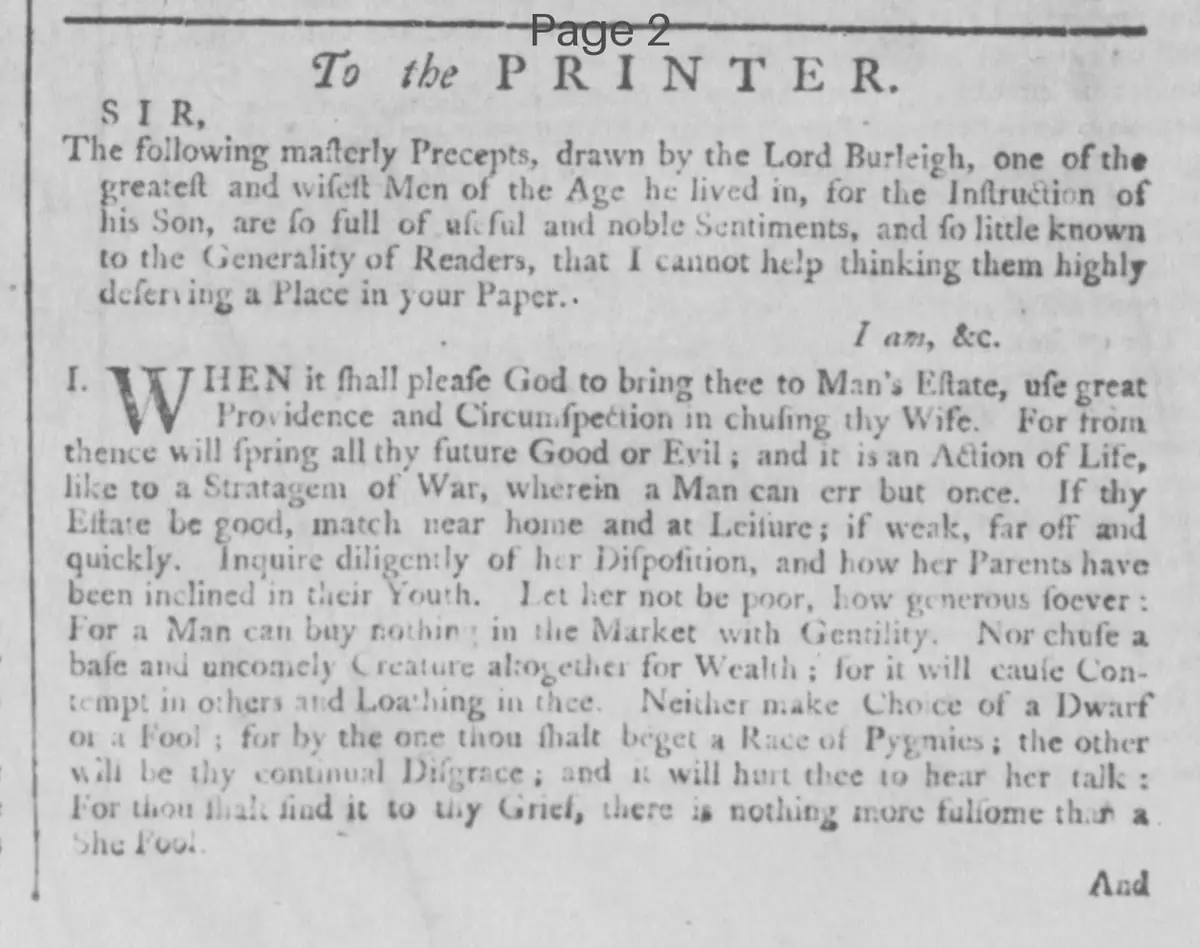
SIR,
The following masterly Precepts, drawn by the Lord Burleigh, one of the
greatest and wisest Men of the Age he lived in, for the Instruction of
his Son, are so full of useful and noble Sentiments, and so little known
to the Generality of Readers, that I cannot help thinking them highly
deserving a Place in your Paper.
I am, &c.
When it shall please God to bring thee to Man's Estate, use great
Providence and Circumspection in choosing thy Wife. For from
thence will spring all thy future Good or Evil: and it is an Action of Life,
like to a Stratagem of War, wherein a Man can err but once. If thy
Estate be good, match near home and at Leisure; if weak, far off and
quickly. Inquire diligently of her Disposition, and how her Parents have
been inclined in their Youth. Let her not be poor, how generous soever:
For a Man can buy nothing in the Market with Gentility. Nor choose a
base and uncomely Creature altogether for Wealth: for it will cause Con-
tempt in others and Loathing in thee. Neither make Choice of a Dwarf
or a Fool: for by the one thou shalt beget a Race of Pygmies; the other
will be thy continual Disgrace; and it will hurt thee to hear her talk:
For thou shalt find it to thy great Grief, there is nothing more fulsome than a
She Fool.
And touching the Guiding of thy House, let thy Hospitality be moderate, and according to the Means of thy Estate, rather plentiful than sparing, not costly. For I never knew any Man grow poor by keeping an orderly Table. But some consume themselves through other Vices, and their Hospitality bears the Blame. But banish wine with Drunkards out of thy House, which is a Vice impairing Health, consuming much, and makes no Shew. I never heard Praise ascribed to the Drunkard, but for the well bearing his Drink; which is a better Commendation for a Brewer's Horse or a Drayman, than a Gentleman. Beware thou spend not above three Fourths of thy Revenue, nor above a third Part of that in thy House, for the other two Parts will do no more than defray thy Extraordinaries, which always surmount the Ordinaries by much; otherwise thou shalt live like a rich Beggar, in continual Want. And the needy Man can never live happily or contentedly; for every Disaster makes him ready to mortgage or sell: And that Gentleman who sells an Acre of Land sells an Ounce of Credit; for Gentility is nothing else than ancient Riches. So that if the Foundation should at any Time sink, the Building must needs follow.
II. Bring thy Children up in Learning and Obedience, yet without outward Austerity. Praise them openly, reprehend them secretly. Give them good Countenance and convenient Maintenance, according to thy Ability, otherwise thy Life will seem their Bondage, and what Portion thou shalt leave them at thy Death, they will thank Death for, and not thee. I am persuaded the foolish Cockering of some Parents, and the over stern Carriage of others, causeth more Men and Women to take ill Courses than their own vicious Inclinations. Marry thy Daughters in time, lest they marry themselves; and suffer not thy Sons to pass the Alps: for they shall learn nothing there but Pride, Blasphemy and Atheism. And if by Travel they shall get a few broken Languages, they shall profit them nothing more than to have one Meal serv'd in divers Dishes. Neither, by my Consent shalt thou train them up in Wars; for he that sets up his Rest to live by that Profession, can hardly be an honest Man, or a good Christian; because it is a Science no longer in Request than Use; for Soldiers in Peace are like Chimnies in Summer.
III. Live not in the Country without Corn and Cattle about thee: for he that putteth his Hand to the Purse for every Expence of Household, is like him that keepeth Water in a Sieve; and what Provision thou shalt want, learn to buy it at the best hand, for there is one Penny saved in four, betwixt buying in thy Need, and when the Market, and Seasons serve fittest for it. Be not served with Kinsmen or Friends; for they expect much and do little: Nor with such as are amorous, for their Heads are intoxicated; and keep rather too few than one too many. Feed them well and pay with the most, and then thou mayest boldly require Service at their Hands.
IV. Let thy Kindred and Allies be welcome at thy House and Table. Grace them with thy Countenance, and further them in all honest Actions; for by this Means thou shalt double the Band of Nature as thou shalt find them so many Advocates to plead an Apology for thee behind thy Back: But shake off those Glow-worms, Parasites and Sycophants, who will feed and fawn upon thee in the Summer of Prosperity. but in an adverse Storm, they will shelter thee no more than an Arbour in Winter.
V. Beware of thy Suretyship for thy best Friends. He that payeth another Man's Debts, seeketh his own Decay. But if thou can'st not otherwise chuse, rather lend thy Money thy self upon good Bonds, although thou borrow it. So shalt thou secure thyself and pleasure thy Friend: Neither borrow Money of a Neighbour or a Friend but of a Stranger, where paying for it thou shalt hear no more of it, otherwise thou shalt eclipse thy Credit, lose thy Freedom, and yet pay as dear as to another. But in borrowing of Money be precious of thy Word, for he that hath Care of Days or Payment is Lord of another Man's Purse.
VI. Undertake no Suit against a poor Man without receiving much Wrong; for besides that thou makest him thy Compere, it is a base Conquest to triumph where there is small Resistance. Neither attempt Law against any Man before thou be fully resolved that thou hast Right on thy Side, and then spare not for either Money or Pains; for a Cause or two so followed and obtained, will free thee from Suits a great Part of thy Life.
VII. Choose to keep some great Man thy Friend; but trouble him not for Trifles. Compliment him often with many, yet small Gifts, and of little Charge: And if thou hast Cause to bestow any great Gratuity, let it be something that may be daily in Sight; otherwise, in this ambitious Age, thou shalt remain like a Ship without a Pole, and be made a Foot-ball for every insulting Companion to spurn at.
VIII. Towards thy Superiors be humble, yet generous; with thine Equals familiar, yet respectful. Towards thy Inferiors shew much Humanity, and some Familiarity. The first prepares thy Way to Advancement; the second makes thee known for a Man well bred; the third gains a good Report, which once got, is easily kept: For right Humanity takes such deep Root in the Minds of the Multitude, that they are more easily gained by unprofitable Courtesies, than by churlish Benefits. Yet I advise thee not to affect or neglect Popularity too much. Seek not to be Essex, shun to be Raleigh.
IX. Trust not any Man with thy Life, Credit, or Estate; or it is mere Folly for a Man to enthral himself to his Friend, as though, Occasion being offered, he should not dare to become the Enemy.
X. Be not currilous in Conversation, nor satyrical in thy Jests; the one will make thee unwelcome to all Company; the other draw on Quarrels, and yet the Hatred of thy best Friends: For suspicious Jests, when any of them savour of Truth, leave Bitterness in the Minds of those who are touched. And though I have already pointed at this inclusively, yet I think it necessary to leave it thee as a special Caution; because I have seen so many prone to quip and gird, that they would rather lose their Friend than their Jest: and if by Chance their boiling Brains yield a quaint Scoff, they will travail to be delivered of it as a Woman with Child; such nimble Fancies are but the Froth of Wit.
What sub-type of article is it?
What themes does it cover?
What keywords are associated?
What entities or persons were involved?
Letter to Editor Details
Recipient
The Printer
Main Argument
the precepts by lord burleigh for his son contain useful and noble sentiments that are little known and deserve publication in the newspaper.
Notable Details