Thank you for visiting SNEWPapers!
Sign up free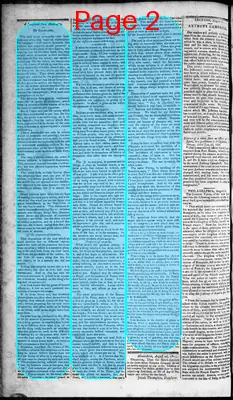
Literary
August 16, 1805
Alexandria Daily Advertiser
Alexandria, Virginia
What is this article about?
Philosophical fragment attributed to Montesquieu discussing contrasts and symmetry in art, sculpture, painting, and writing, contrasting uniformity with variety; explores pleasures of surprise in literature, theater, and nature; covers delicacy, je ne sais quoi, and aesthetic progression leading to admiration.
Clipping
OCR Quality
95%
Excellent
Full Text
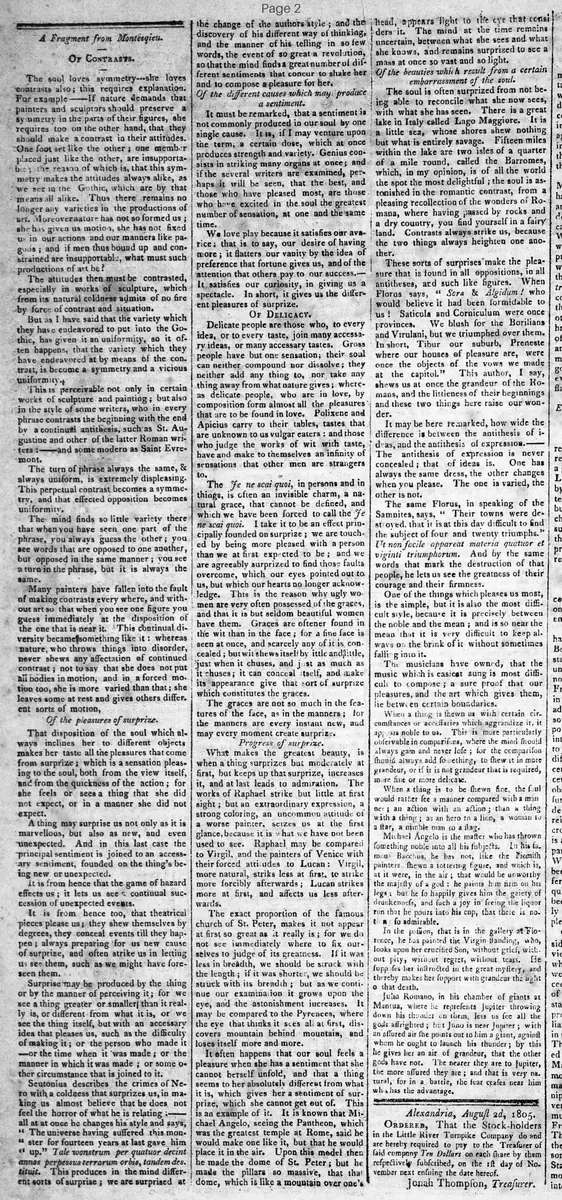
A Fragment from Montesquieu.
Or Contrasts.
The soul loves symmetry—she loves contrasts also; this requires explanation. For example—If nature demands that painters and sculptors should preserve a symmetry in the parts of their figures, she requires too on the other hand, that they should make a contrast in their attitudes. One foot set like the other; one member placed just like the other, are insupportable; the reason of which is, that this symmetry makes the attitudes always alike, as we see in the Gothics, which are by that means all alike. Thus there remains no longer any varieties in the productions of art. Moreover nature has not so formed us; she has given us motion, she has not fixed us in our actions and our manners like pagods; and if men thus bound up and constrained are insupportable, what must such productions of art be?
The attitudes then must be contrasted, especially in works of sculpture, which from its natural coldness admits of no fire by force of contrast and situation.
But as I have said that the variety which they have endeavored to put into the Gothic, has given it an uniformity, so it often happens, that the variety which they have endeavored at by means of the contrast, is become a symmetry and a vicious uniformity.
This is perceivable not only in certain works of sculpture and painting; but also in the style of some writers, who in every phrase contrasts the beginning with the end by a continual antithesis, such as St. Augustine and other of the latter Roman writers—and some modern as Saint Evremond.
The turn of phrase always the same, & always uniform, is extremely displeasing. This perpetual contrast becomes a symmetry, and that effected opposition becomes uniformity.
The mind finds so little variety there that when you have seen one part of the phrase, you always guess the other; you see words that are opposed to one another, but opposed in the same manner; you see a turn in the phrase, but it is always the same.
Many painters have fallen into the fault of making contrasts every where, and without art so that when you see one figure you guess immediately at the disposition of the one that is near it. This continual diversity becomes something like it: whereas nature, who throws things into disorder, never shews any affectation of continued contrast; not to say that she does not put all bodies in motion, and in a forced motion too, she is more varied than that; she leaves some at rest and gives others different sorts of motion,
Of the pleasures of surprize.
That disposition of the soul which always inclines her to different objects makes her taste all the pleasures that come from surprize; which is a sensation pleasing to the soul, both from the view itself and from the quickness of the action; for she feels or sees a thing that she did not expect, or in a manner she did not expect.
A thing may surprize us not only as it is marvellous, but also as new, and even unexpected. And in this last case the principal sentiment is joined to an accessory sentiment, founded on the thing's being new or unexpected.
It is from hence that the game of hazard effects us: it lets us see a continual succession of unexpected events.
It is from hence too, that theatrical pieces please us; they shew themselves by degrees, they conceal events till they happen; always preparing for us new causes of surprize, and often strike us in letting us see them, such as we might have foreseen them.
Surprise may be produced by the thing or by the manner of perceiving it; for we see a thing greater or smaller than it really is, or different from what it is, or we see the thing itself, but with an accessory idea that pleases us, such as the difficulty of making it: or the person who made it—or the time when it was made; or the manner in which it was made: or some other circumstance that is joined to it.
Suetonius describes the crimes of Nero with a coldness that surprizes us, in making us almost believe that he does not feel the horror of what he is relating—at all at once he changes his style and says, "The universe having suffered this monster for fourteen years at last gave him up." Tandem hoc monstrum per quatuor decim annos perpessus terrarum orbis, tandem desinituit. This produces in the mind different sorts of surprize; we are surprised at the change of the author's style: and the discovery of his different way of thinking: and the manner of his telling in so few words, the event of so great a revolution, so that the mind finds a great number of different sentiments that concur to shake her and to compose a pleasure for her.
Of the different causes which may produce a sentiment.
It must be remarked, that a sentiment is not commonly produced in our soul by one single cause. It is, if I may venture upon the term; a certain dose, which at once produces strength and variety. Genius consists in striking many organs at once; and if the several writers are examined, perhaps it will be seen, that the best, and those who have pleased most, are those who have excited in the soul the greatest number of sensations; at one and the same time.
We love play because it satisfies our avarice: that is to say, our desire of having more; it flatters our vanity by the idea of preference that fortune gives us, and of the attention that others pay to our success.—It satisfies our curiosity, in giving us a spectacle. In short, it gives us the different pleasures of surprize.
Of Delicacy.
Delicate people are those who, to every idea, or to every taste, join many accessory ideas, or many accessory tastes. Gross people have but one sensation; their soul can neither compound nor dissolve; they neither add any thing to, nor take any thing away from what nature gives; whereas delicate people, who are in love, by composition form almost all the pleasures that are to be found in love. Polixene and Apicius carry to their tables, tastes that are unknown to us vulgar eaters: and those who judge the works of wit with taste, have and make to themselves an infinity of sensations that other men are strangers to.
The je ne scai quoi, in persons and in things, is often an invisible charm, a natural grace, that cannot be defined, and which we have been forced to call the je ne scai quoi. I take it to be an effect principally founded on surprize; we are touched by being more pleased with a person than we at first expected to be; and we are agreeably surprized to find those faults overcome, which our eyes pointed out to us, but which our hearts no longer acknowledge. This is the reason why ugly women are very often possessed of the graces, and that it is but seldom beautiful women have them. Graces are oftener found in the wit than in the face; for a fine face is seen at once, and scarcely any of it is concealed; but wit shews itself by little and little, just when it chuses, and just as much as it chuses; it can conceal itself, and make its appearance give that sort of surprize which constitutes the graces.
The graces are not so much in the features of the face, as in the manners; for the manners are every instant new, and may every moment create surprize.
Progress of surprize.
What makes the greatest beauty, is when a thing surprizes but moderately at first, but keeps up that surprize, increases it, and at last leads to admiration. The works of Raphael strike but little at first sight; but an extraordinary expression, a strong coloring, an uncommon attitude of a worse painter, seizes us at the first glance, because it is what we have not been used to see. Raphael may be compared to Virgil, and the painters of Venice with their forced attitudes to Lucan: Virgil, more natural, strikes less at first, to strike more forcibly afterwards; Lucan strikes more at first, and affects us less afterwards.
The exact proportion of the famous church of St. Peter, makes it not appear at first so great as it really is; for we do not see immediately where to fix ourselves to judge of its greatness. If it was less in breadth, we should be struck with the length; if it was shorter, we should be struck with its breadth; but as we continue our examination it grows upon the eye, and the astonishment increases. It may be compared to the Pyrenees, where the eye that thinks it sees all at first, discovers mountain behind mountain, and loses itself more and more.
It often happens that our soul feels a pleasure when she has a sentiment that she cannot herself unfold, and that a thing seems to her absolutely different from what it is, which gives her a sentiment of surprize, which she cannot get out of. This is an example of it. It is known that Michael Angelo, seeing the Pantheon, which was the greatest temple at Rome, said he would make one like it, but that he would place it in the air. Upon this model then he made the dome of St. Peter; but he made the pillars so massive, that that dome, which is like a mountain over one's head, appears light to the eye that considers it. The mind at the time remains uncertain, between what she sees and what she knows, and remains surprized to see a mass at once so vast and so light.
Of the beauties which result from a certain embarrassment of the soul.
The soul is often surprized from not being able to reconcile what she now sees, with what she has seen. There is a great lake in Italy called Lago Maggiore. It is a little sea, whose shores shew nothing but what is entirely savage. Fifteen miles within the lake are two isles of a quarter of a mile round, called the Borromean, which, in my opinion, is of all the world the spot the most delightful; the soul is astonished in the romantic contrast, from a pleasing recollection of the wonders of Rome, where having passed by rocks and a dry country, you find yourself in a fairy land. Contrasts always strike us, because the two things always heighten one another.
These sorts of surprizes make the pleasure that is found in all oppositions, in all antitheses, and such like figures. When Florus says, "Sora & Algidum! who would believe it had been formidable to us! Saticula and Corniculum were once provinces. We blush for the Borilians and Virulani, but we triumphed over them. In short, Tibur our suburb, Preneste where our houses of pleasure are, were once the objects of the vows we made at the capitol." This author, I say, shews us at once the grandeur of the Romans, and the littleness of their beginnings and these two things here raise our wonder.
It may be here remarked, how wide the difference is between the antithesis of ideas, and the antithesis of expression.—The antithesis of expression is never concealed; that of ideas is. One has always the same dress, the other changes when you please. The one is varied, the other is not.
The same Florus, in speaking of the Samnites, says, "Their towns were destroyed, that it is at this day difficult to find the subject of four and twenty triumphs." Non facile appareat materia quatuor et viginti triumphorum. And by the same words that mark the destruction of that people, he lets us see the greatness of their courage and their firmness.
One of the things which pleases us most, is the simple, but it is also the most difficult style, because it is precisely between the noble and the mean; and is so near the mean that it is very difficult to keep always on the brink of it without sometimes falling into it.
The musicians have owned, that the music which is easiest sung is most difficult to compose; a sure proof that our pleasures, and the art which gives them, lie between certain boundaries.
When a thing is shewn us with certain circumstances or accessories which aggrandize it, it appears noble to us. This is more particularly observable in comparisons, where the mind would always gain and never lose; for the comparison should always add something, to shew it in more grandeur, or if it is not grandeur that is required, more fine or more delicate.
When a thing is to be shewn fine, the soul would rather see a manner compared with a manner; an action with an action; than a thing with a thing; as an hero to a lion, a woman to a star, a nimble man to a stag.
Michael Angelo is the master who has thrown something noble into all his subjects. In his famous Bacchus, he has not, like the Flemish painters, shewn a tottering figure, and which is, as it were, in the air: that would be unworthy the majesty of a god: he paints him firm on his legs: but he so happily gives him the gaiety of drunkenness, and such a joy in seeing the liquor run that he pours into his cup, that there is nothing more admirable.
In the Paison, that is in the gallery at Florence, he has painted the Virgin standing, who, looks upon her crucified Son, without grief, without pity, without regret, without tears. He supposes her instructed in the great mystery, and thereby makes her support with grandeur the sight of that death.
Julio Romano, in his chamber of giants at Mantua, where he represents Jupiter throwing down his thunder on them, lets us see all the gods affrighted; but Juno is near Jupiter; with an assured air she points out to him a giant, against whom he ought to launch his thunder: by this he gives her an air of grandeur, that the other gods have not. The nearer they are to Jupiter, the more assured they are; and that is very natural, for in a battle, the fear ceases near him who has the advantage.
Or Contrasts.
The soul loves symmetry—she loves contrasts also; this requires explanation. For example—If nature demands that painters and sculptors should preserve a symmetry in the parts of their figures, she requires too on the other hand, that they should make a contrast in their attitudes. One foot set like the other; one member placed just like the other, are insupportable; the reason of which is, that this symmetry makes the attitudes always alike, as we see in the Gothics, which are by that means all alike. Thus there remains no longer any varieties in the productions of art. Moreover nature has not so formed us; she has given us motion, she has not fixed us in our actions and our manners like pagods; and if men thus bound up and constrained are insupportable, what must such productions of art be?
The attitudes then must be contrasted, especially in works of sculpture, which from its natural coldness admits of no fire by force of contrast and situation.
But as I have said that the variety which they have endeavored to put into the Gothic, has given it an uniformity, so it often happens, that the variety which they have endeavored at by means of the contrast, is become a symmetry and a vicious uniformity.
This is perceivable not only in certain works of sculpture and painting; but also in the style of some writers, who in every phrase contrasts the beginning with the end by a continual antithesis, such as St. Augustine and other of the latter Roman writers—and some modern as Saint Evremond.
The turn of phrase always the same, & always uniform, is extremely displeasing. This perpetual contrast becomes a symmetry, and that effected opposition becomes uniformity.
The mind finds so little variety there that when you have seen one part of the phrase, you always guess the other; you see words that are opposed to one another, but opposed in the same manner; you see a turn in the phrase, but it is always the same.
Many painters have fallen into the fault of making contrasts every where, and without art so that when you see one figure you guess immediately at the disposition of the one that is near it. This continual diversity becomes something like it: whereas nature, who throws things into disorder, never shews any affectation of continued contrast; not to say that she does not put all bodies in motion, and in a forced motion too, she is more varied than that; she leaves some at rest and gives others different sorts of motion,
Of the pleasures of surprize.
That disposition of the soul which always inclines her to different objects makes her taste all the pleasures that come from surprize; which is a sensation pleasing to the soul, both from the view itself and from the quickness of the action; for she feels or sees a thing that she did not expect, or in a manner she did not expect.
A thing may surprize us not only as it is marvellous, but also as new, and even unexpected. And in this last case the principal sentiment is joined to an accessory sentiment, founded on the thing's being new or unexpected.
It is from hence that the game of hazard effects us: it lets us see a continual succession of unexpected events.
It is from hence too, that theatrical pieces please us; they shew themselves by degrees, they conceal events till they happen; always preparing for us new causes of surprize, and often strike us in letting us see them, such as we might have foreseen them.
Surprise may be produced by the thing or by the manner of perceiving it; for we see a thing greater or smaller than it really is, or different from what it is, or we see the thing itself, but with an accessory idea that pleases us, such as the difficulty of making it: or the person who made it—or the time when it was made; or the manner in which it was made: or some other circumstance that is joined to it.
Suetonius describes the crimes of Nero with a coldness that surprizes us, in making us almost believe that he does not feel the horror of what he is relating—at all at once he changes his style and says, "The universe having suffered this monster for fourteen years at last gave him up." Tandem hoc monstrum per quatuor decim annos perpessus terrarum orbis, tandem desinituit. This produces in the mind different sorts of surprize; we are surprised at the change of the author's style: and the discovery of his different way of thinking: and the manner of his telling in so few words, the event of so great a revolution, so that the mind finds a great number of different sentiments that concur to shake her and to compose a pleasure for her.
Of the different causes which may produce a sentiment.
It must be remarked, that a sentiment is not commonly produced in our soul by one single cause. It is, if I may venture upon the term; a certain dose, which at once produces strength and variety. Genius consists in striking many organs at once; and if the several writers are examined, perhaps it will be seen, that the best, and those who have pleased most, are those who have excited in the soul the greatest number of sensations; at one and the same time.
We love play because it satisfies our avarice: that is to say, our desire of having more; it flatters our vanity by the idea of preference that fortune gives us, and of the attention that others pay to our success.—It satisfies our curiosity, in giving us a spectacle. In short, it gives us the different pleasures of surprize.
Of Delicacy.
Delicate people are those who, to every idea, or to every taste, join many accessory ideas, or many accessory tastes. Gross people have but one sensation; their soul can neither compound nor dissolve; they neither add any thing to, nor take any thing away from what nature gives; whereas delicate people, who are in love, by composition form almost all the pleasures that are to be found in love. Polixene and Apicius carry to their tables, tastes that are unknown to us vulgar eaters: and those who judge the works of wit with taste, have and make to themselves an infinity of sensations that other men are strangers to.
The je ne scai quoi, in persons and in things, is often an invisible charm, a natural grace, that cannot be defined, and which we have been forced to call the je ne scai quoi. I take it to be an effect principally founded on surprize; we are touched by being more pleased with a person than we at first expected to be; and we are agreeably surprized to find those faults overcome, which our eyes pointed out to us, but which our hearts no longer acknowledge. This is the reason why ugly women are very often possessed of the graces, and that it is but seldom beautiful women have them. Graces are oftener found in the wit than in the face; for a fine face is seen at once, and scarcely any of it is concealed; but wit shews itself by little and little, just when it chuses, and just as much as it chuses; it can conceal itself, and make its appearance give that sort of surprize which constitutes the graces.
The graces are not so much in the features of the face, as in the manners; for the manners are every instant new, and may every moment create surprize.
Progress of surprize.
What makes the greatest beauty, is when a thing surprizes but moderately at first, but keeps up that surprize, increases it, and at last leads to admiration. The works of Raphael strike but little at first sight; but an extraordinary expression, a strong coloring, an uncommon attitude of a worse painter, seizes us at the first glance, because it is what we have not been used to see. Raphael may be compared to Virgil, and the painters of Venice with their forced attitudes to Lucan: Virgil, more natural, strikes less at first, to strike more forcibly afterwards; Lucan strikes more at first, and affects us less afterwards.
The exact proportion of the famous church of St. Peter, makes it not appear at first so great as it really is; for we do not see immediately where to fix ourselves to judge of its greatness. If it was less in breadth, we should be struck with the length; if it was shorter, we should be struck with its breadth; but as we continue our examination it grows upon the eye, and the astonishment increases. It may be compared to the Pyrenees, where the eye that thinks it sees all at first, discovers mountain behind mountain, and loses itself more and more.
It often happens that our soul feels a pleasure when she has a sentiment that she cannot herself unfold, and that a thing seems to her absolutely different from what it is, which gives her a sentiment of surprize, which she cannot get out of. This is an example of it. It is known that Michael Angelo, seeing the Pantheon, which was the greatest temple at Rome, said he would make one like it, but that he would place it in the air. Upon this model then he made the dome of St. Peter; but he made the pillars so massive, that that dome, which is like a mountain over one's head, appears light to the eye that considers it. The mind at the time remains uncertain, between what she sees and what she knows, and remains surprized to see a mass at once so vast and so light.
Of the beauties which result from a certain embarrassment of the soul.
The soul is often surprized from not being able to reconcile what she now sees, with what she has seen. There is a great lake in Italy called Lago Maggiore. It is a little sea, whose shores shew nothing but what is entirely savage. Fifteen miles within the lake are two isles of a quarter of a mile round, called the Borromean, which, in my opinion, is of all the world the spot the most delightful; the soul is astonished in the romantic contrast, from a pleasing recollection of the wonders of Rome, where having passed by rocks and a dry country, you find yourself in a fairy land. Contrasts always strike us, because the two things always heighten one another.
These sorts of surprizes make the pleasure that is found in all oppositions, in all antitheses, and such like figures. When Florus says, "Sora & Algidum! who would believe it had been formidable to us! Saticula and Corniculum were once provinces. We blush for the Borilians and Virulani, but we triumphed over them. In short, Tibur our suburb, Preneste where our houses of pleasure are, were once the objects of the vows we made at the capitol." This author, I say, shews us at once the grandeur of the Romans, and the littleness of their beginnings and these two things here raise our wonder.
It may be here remarked, how wide the difference is between the antithesis of ideas, and the antithesis of expression.—The antithesis of expression is never concealed; that of ideas is. One has always the same dress, the other changes when you please. The one is varied, the other is not.
The same Florus, in speaking of the Samnites, says, "Their towns were destroyed, that it is at this day difficult to find the subject of four and twenty triumphs." Non facile appareat materia quatuor et viginti triumphorum. And by the same words that mark the destruction of that people, he lets us see the greatness of their courage and their firmness.
One of the things which pleases us most, is the simple, but it is also the most difficult style, because it is precisely between the noble and the mean; and is so near the mean that it is very difficult to keep always on the brink of it without sometimes falling into it.
The musicians have owned, that the music which is easiest sung is most difficult to compose; a sure proof that our pleasures, and the art which gives them, lie between certain boundaries.
When a thing is shewn us with certain circumstances or accessories which aggrandize it, it appears noble to us. This is more particularly observable in comparisons, where the mind would always gain and never lose; for the comparison should always add something, to shew it in more grandeur, or if it is not grandeur that is required, more fine or more delicate.
When a thing is to be shewn fine, the soul would rather see a manner compared with a manner; an action with an action; than a thing with a thing; as an hero to a lion, a woman to a star, a nimble man to a stag.
Michael Angelo is the master who has thrown something noble into all his subjects. In his famous Bacchus, he has not, like the Flemish painters, shewn a tottering figure, and which is, as it were, in the air: that would be unworthy the majesty of a god: he paints him firm on his legs: but he so happily gives him the gaiety of drunkenness, and such a joy in seeing the liquor run that he pours into his cup, that there is nothing more admirable.
In the Paison, that is in the gallery at Florence, he has painted the Virgin standing, who, looks upon her crucified Son, without grief, without pity, without regret, without tears. He supposes her instructed in the great mystery, and thereby makes her support with grandeur the sight of that death.
Julio Romano, in his chamber of giants at Mantua, where he represents Jupiter throwing down his thunder on them, lets us see all the gods affrighted; but Juno is near Jupiter; with an assured air she points out to him a giant, against whom he ought to launch his thunder: by this he gives her an air of grandeur, that the other gods have not. The nearer they are to Jupiter, the more assured they are; and that is very natural, for in a battle, the fear ceases near him who has the advantage.
What sub-type of article is it?
Essay
What themes does it cover?
Nature
Moral Virtue
What keywords are associated?
Symmetry
Contrast
Surprise
Delicacy
Aesthetics
Art
Nature
Writing Style
What entities or persons were involved?
Montesquieu
Literary Details
Title
A Fragment From Montesquieu. Or Contrasts.
Author
Montesquieu
Subject
On Contrasts, Symmetry, Surprise, And Delicacy In Art And Nature
Form / Style
Philosophical Prose Essay
Key Lines
The Soul Loves Symmetry—She Loves Contrasts Also; This Requires Explanation.
That Disposition Of The Soul Which Always Inclines Her To Different Objects Makes Her Taste All The Pleasures That Come From Surprize;
Delicate People Are Those Who, To Every Idea, Or To Every Taste, Join Many Accessory Ideas, Or Many Accessory Tastes.
What Makes The Greatest Beauty, Is When A Thing Surprizes But Moderately At First, But Keeps Up That Surprize, Increases It, And At Last Leads To Admiration.
Contrasts Always Strike Us, Because The Two Things Always Heighten One Another.