Thank you for visiting SNEWPapers!
Sign up free
Editorial
March 9, 1889
The Weekly Pelican
New Orleans, Orleans County, Louisiana
What is this article about?
Editorial supporting protective tariffs, praising President Harrison's arguments and criticizing Cleveland's free trade views, noting Louisiana planters' need for protection despite voting Democratic; critiques Mills bill for shifting duties without consumer benefit.
Clipping
OCR Quality
98%
Excellent
Full Text
SOUND FOR PROTECTION.
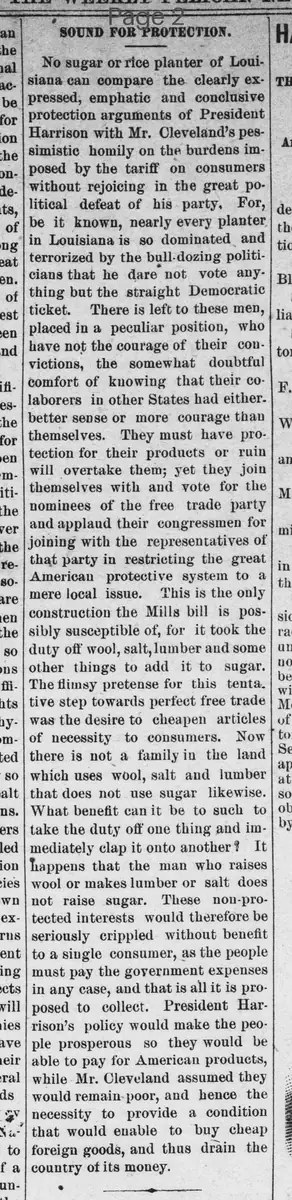
No sugar or rice planter of Louisiana can compare the clearly expressed, emphatic and conclusive protection arguments of President Harrison with Mr. Cleveland's pessimistic homily on the burdens imposed by the tariff on consumers without rejoicing in the great political defeat of his party. For, be it known, nearly every planter in Louisiana is so dominated and terrorized by the bulldozing politicians that he dare not vote anything but the straight Democratic ticket. There is left to these men, placed in a peculiar position, who have not the courage of their convictions, the somewhat doubtful comfort of knowing that their co-laborers in other States had either better sense or more courage than themselves. They must have protection for their products or ruin will overtake them; yet they join themselves with and vote for the nominees of the free trade party and applaud their congressmen for joining with the representatives of that party in restricting the great American protective system to a mere local issue. This is the only construction the Mills bill is possibly susceptible of, for it took the duty off wool, salt, lumber and some other things to add it to sugar. The flimsy pretense for this tentative step towards perfect free trade was the desire to cheapen articles of necessity to consumers. Now there is not a family in the land which uses wool, salt and lumber that does not use sugar likewise. What benefit can it be to such to take the duty off one thing and immediately clap it onto another? It happens that the man who raises wool or makes lumber or salt does not raise sugar. These non-protected interests would therefore be seriously crippled without benefit to a single consumer, as the people must pay the government expenses in any case, and that is all it is proposed to collect. President Harrison's policy would make the people prosperous so they would be able to pay for American products, while Mr. Cleveland assumed they would remain poor, and hence the necessity to provide a condition that would enable them to buy cheap foreign goods, and thus drain the country of its money.
No sugar or rice planter of Louisiana can compare the clearly expressed, emphatic and conclusive protection arguments of President Harrison with Mr. Cleveland's pessimistic homily on the burdens imposed by the tariff on consumers without rejoicing in the great political defeat of his party. For, be it known, nearly every planter in Louisiana is so dominated and terrorized by the bulldozing politicians that he dare not vote anything but the straight Democratic ticket. There is left to these men, placed in a peculiar position, who have not the courage of their convictions, the somewhat doubtful comfort of knowing that their co-laborers in other States had either better sense or more courage than themselves. They must have protection for their products or ruin will overtake them; yet they join themselves with and vote for the nominees of the free trade party and applaud their congressmen for joining with the representatives of that party in restricting the great American protective system to a mere local issue. This is the only construction the Mills bill is possibly susceptible of, for it took the duty off wool, salt, lumber and some other things to add it to sugar. The flimsy pretense for this tentative step towards perfect free trade was the desire to cheapen articles of necessity to consumers. Now there is not a family in the land which uses wool, salt and lumber that does not use sugar likewise. What benefit can it be to such to take the duty off one thing and immediately clap it onto another? It happens that the man who raises wool or makes lumber or salt does not raise sugar. These non-protected interests would therefore be seriously crippled without benefit to a single consumer, as the people must pay the government expenses in any case, and that is all it is proposed to collect. President Harrison's policy would make the people prosperous so they would be able to pay for American products, while Mr. Cleveland assumed they would remain poor, and hence the necessity to provide a condition that would enable them to buy cheap foreign goods, and thus drain the country of its money.
What sub-type of article is it?
Economic Policy
Partisan Politics
What keywords are associated?
Protective Tariffs
Free Trade
Louisiana Planters
Mills Bill
Harrison Policy
Cleveland Views
What entities or persons were involved?
President Harrison
Mr. Cleveland
Louisiana Planters
Democratic Party
Mills Bill
Editorial Details
Primary Topic
Support For Protective Tariffs Against Democratic Free Trade Policies
Stance / Tone
Pro Protectionism, Critical Of Free Trade And Democratic Influence On Louisiana Planters
Key Figures
President Harrison
Mr. Cleveland
Louisiana Planters
Democratic Party
Mills Bill
Key Arguments
Louisiana Sugar And Rice Planters Need Protection But Are Coerced To Vote Democratic
Mills Bill Shifts Duties From Wool, Salt, Lumber To Sugar Without Benefiting Consumers
Protective Tariffs Promote Prosperity And Ability To Buy American Products
Free Trade Policies Assume And Perpetuate Poverty, Draining Money Abroad