Thank you for visiting SNEWPapers!
Sign up free
Literary
July 9, 1799
The New Hampshire Gazette
Portsmouth, Rockingham County, New Hampshire
What is this article about?
An essay offering practical advice on potato cultivation, including soil preferences, minimal hilling to avoid suffocating tubers, timing of earthing, and harvesting at ripeness indicated by leaf fade and stalk shrink. Signed 'AGRICO LA.'
Clipping
OCR Quality
98%
Excellent
Full Text
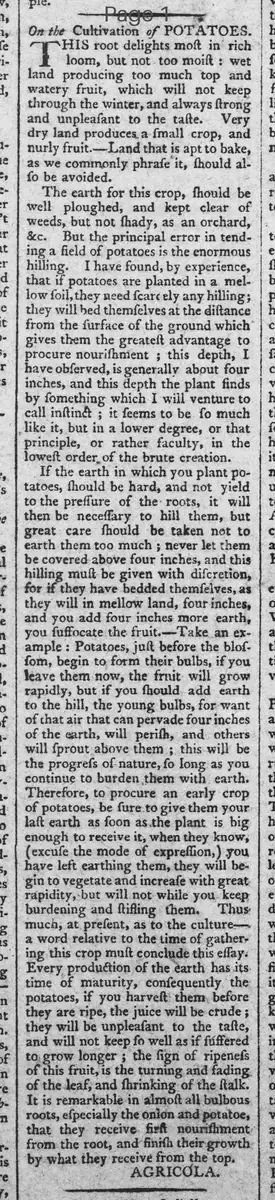
On the Cultivation of POTATOES.
This root delights most in rich loam, but not too moist: wet land producing too much top and watery fruit, which will not keep through the winter, and always strong and unpleasant to the taste. Very dry land produces a small crop, and knurly fruit.--Land that is apt to bake, as we commonly phrase it, should also be avoided.
The earth for this crop, should be well ploughed, and kept clear of weeds, but not shady, as an orchard, &c. But the principal error in tending a field of potatoes is the enormous hilling. I have found, by experience, that if potatoes are planted in a mellow soil, they need scarcely any hilling; they will bed themselves at the distance from the surface of the ground which gives them the greatest advantage to procure nourishment; this depth, I have observed, is generally about four inches, and this depth the plant finds by something which I will venture to call instinct; it seems to be so much like it, but in a lower degree, or that principle, or rather faculty, in the lowest order of the brute creation.
If the earth in which you plant potatoes, should be hard, and not yield to the pressure of the roots. it will then be necessary to hill them, but great care should be taken not to earth them too much; never let them be covered above four inches, and this hilling must be given with discretion, for if they have bedded themselves, as they will in mellow land, four inches. and you add four inches more earth. you suffocate the fruit.--Take an example: Potatoes, just before the blossom, begin to form their bulbs, if you leave them now, the fruit will grow rapidly, but if you should add earth to the hill, the young bulbs, for want of that air that can pervade four inches of the earth, will perish, and others will sprout above them: this will be the progress of nature, so long as you continue to burden them with earth.
Therefore, to procure an early crop of potatoes, be sure to give them your last earth as soon as the plant is big enough to receive it, when they know, (excuse the mode of expression,) you have left earthing them, they will begin to vegetate and increase with great rapidity, but will not while you keep burdening and stifling them. Thus much, at present, as to the culture-- a word relative to the time of gathering this crop must conclude this essay.
Every production of the earth has its time of maturity, consequently. the potatoes, if you harvest them before they are ripe, the juice will be crude; they will be unpleasant to the taste, and will not keep so well as if suffered to grow longer; the sign of ripeness of this fruit, is the turning and fading of the leaf, and shrinking of the stalk. It is remarkable in almost all bulbous roots, especially the onion and potatoe, that they receive first nourishment-- from the root, and finish their growth by what they receive from the top.
AGRICO LA.
This root delights most in rich loam, but not too moist: wet land producing too much top and watery fruit, which will not keep through the winter, and always strong and unpleasant to the taste. Very dry land produces a small crop, and knurly fruit.--Land that is apt to bake, as we commonly phrase it, should also be avoided.
The earth for this crop, should be well ploughed, and kept clear of weeds, but not shady, as an orchard, &c. But the principal error in tending a field of potatoes is the enormous hilling. I have found, by experience, that if potatoes are planted in a mellow soil, they need scarcely any hilling; they will bed themselves at the distance from the surface of the ground which gives them the greatest advantage to procure nourishment; this depth, I have observed, is generally about four inches, and this depth the plant finds by something which I will venture to call instinct; it seems to be so much like it, but in a lower degree, or that principle, or rather faculty, in the lowest order of the brute creation.
If the earth in which you plant potatoes, should be hard, and not yield to the pressure of the roots. it will then be necessary to hill them, but great care should be taken not to earth them too much; never let them be covered above four inches, and this hilling must be given with discretion, for if they have bedded themselves, as they will in mellow land, four inches. and you add four inches more earth. you suffocate the fruit.--Take an example: Potatoes, just before the blossom, begin to form their bulbs, if you leave them now, the fruit will grow rapidly, but if you should add earth to the hill, the young bulbs, for want of that air that can pervade four inches of the earth, will perish, and others will sprout above them: this will be the progress of nature, so long as you continue to burden them with earth.
Therefore, to procure an early crop of potatoes, be sure to give them your last earth as soon as the plant is big enough to receive it, when they know, (excuse the mode of expression,) you have left earthing them, they will begin to vegetate and increase with great rapidity, but will not while you keep burdening and stifling them. Thus much, at present, as to the culture-- a word relative to the time of gathering this crop must conclude this essay.
Every production of the earth has its time of maturity, consequently. the potatoes, if you harvest them before they are ripe, the juice will be crude; they will be unpleasant to the taste, and will not keep so well as if suffered to grow longer; the sign of ripeness of this fruit, is the turning and fading of the leaf, and shrinking of the stalk. It is remarkable in almost all bulbous roots, especially the onion and potatoe, that they receive first nourishment-- from the root, and finish their growth by what they receive from the top.
AGRICO LA.
What sub-type of article is it?
Essay
What themes does it cover?
Agriculture Rural
What keywords are associated?
Potato Cultivation
Soil Preparation
Hilling Potatoes
Harvesting Timing
Agricultural Advice
What entities or persons were involved?
Agrico La.
Literary Details
Title
On The Cultivation Of Potatoes.
Author
Agrico La.
Key Lines
This Root Delights Most In Rich Loam, But Not Too Moist: Wet Land Producing Too Much Top And Watery Fruit, Which Will Not Keep Through The Winter, And Always Strong And Unpleasant To The Taste.
I Have Found, By Experience, That If Potatoes Are Planted In A Mellow Soil, They Need Scarcely Any Hilling;
The Sign Of Ripeness Of This Fruit, Is The Turning And Fading Of The Leaf, And Shrinking Of The Stalk.