Thank you for visiting SNEWPapers!
Sign up free
Story
May 30, 1944
The Onslow County News And Views
Jacksonville, Onslow County, North Carolina
What is this article about?
Dr. D. L. Wray discovers a rare Crowned Tantilla snake while digging in his Raleigh garden. The harmless back-fanged snake, last seen in the area in 1905, is preserved at the State Museum.
Clipping
OCR Quality
100%
Excellent
Full Text
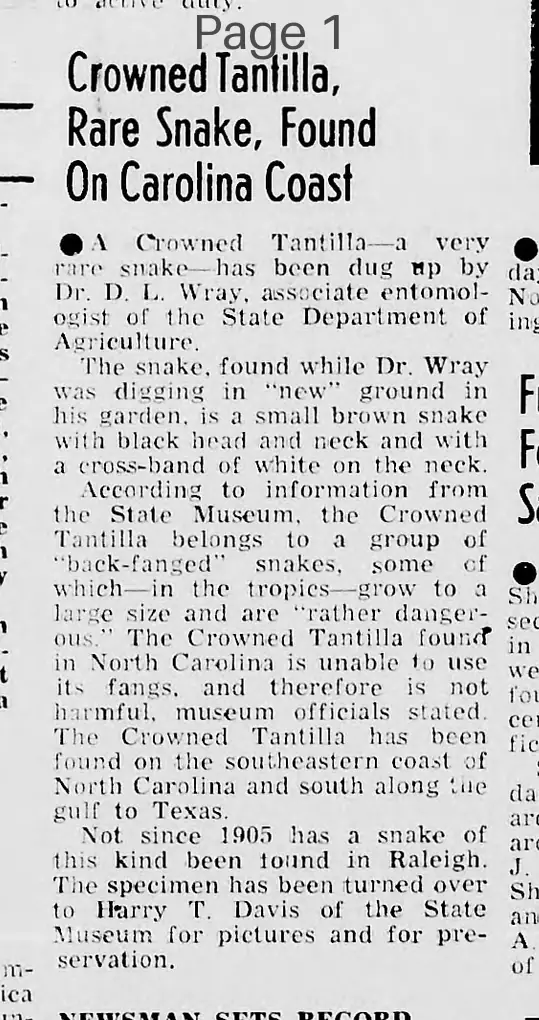
Crowned Tantilla, Rare Snake, Found On Carolina Coast
A Crowned Tantilla—a very rare snake—has been dug up by Dr. D. L. Wray, associate entomologist of the State Department of Agriculture.
The snake, found while Dr. Wray was digging in "new" ground in his garden, is a small brown snake with black head and neck and with a cross-band of white on the neck.
According to information from the State Museum, the Crowned Tantilla belongs to a group of "back-fanged" snakes, some of which—in the tropics—grow to a large size and are "rather dangerous." The Crowned Tantilla found in North Carolina is unable to use its fangs, and therefore is not harmful, museum officials stated.
The Crowned Tantilla has been found on the southeastern coast of North Carolina and south along the gulf to Texas.
Not since 1905 has a snake of this kind been found in Raleigh.
The specimen has been turned over to Harry T. Davis of the State Museum for pictures and for preservation.
A Crowned Tantilla—a very rare snake—has been dug up by Dr. D. L. Wray, associate entomologist of the State Department of Agriculture.
The snake, found while Dr. Wray was digging in "new" ground in his garden, is a small brown snake with black head and neck and with a cross-band of white on the neck.
According to information from the State Museum, the Crowned Tantilla belongs to a group of "back-fanged" snakes, some of which—in the tropics—grow to a large size and are "rather dangerous." The Crowned Tantilla found in North Carolina is unable to use its fangs, and therefore is not harmful, museum officials stated.
The Crowned Tantilla has been found on the southeastern coast of North Carolina and south along the gulf to Texas.
Not since 1905 has a snake of this kind been found in Raleigh.
The specimen has been turned over to Harry T. Davis of the State Museum for pictures and for preservation.
What sub-type of article is it?
Curiosity
Animal Story
What themes does it cover?
Nature
What keywords are associated?
Crowned Tantilla
Rare Snake
North Carolina
Snake Discovery
State Museum
What entities or persons were involved?
Dr. D. L. Wray
Harry T. Davis
Where did it happen?
Southeastern Coast Of North Carolina, Raleigh
Story Details
Key Persons
Dr. D. L. Wray
Harry T. Davis
Location
Southeastern Coast Of North Carolina, Raleigh
Event Date
Not Since 1905
Story Details
Dr. Wray digs up a rare Crowned Tantilla snake in his Raleigh garden; it is a harmless back-fanged species last found locally in 1905 and is preserved at the State Museum.