Thank you for visiting SNEWPapers!
Sign up free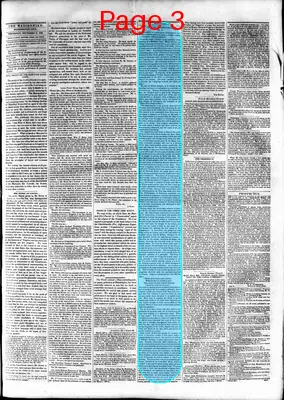
Literary
September 11, 1839
The Madisonian
Washington, District Of Columbia
What is this article about?
In this letter, the author clarifies the term 'Creole' as a descendant of Europeans born in America, critiques delays in Virginia's James River and Kanawha improvement project for trade, describes scenic Jackson's River features like the Forge and arched rocks resembling a castle, and enjoys society at Dibrell's Springs.
Clipping

OCR Quality
95%
Excellent
Full Text
CORRESPONDENCE.
LETTERS OF A CONVALESCENT.
No. X.
WHAT A CREOLE IS—JAMES RIVER IMPROVEMENT—THE FORGE—ARCHED STRATA OF ROCK—A NATURAL CASTLE—VIRGINIANS—DIBRELL'S SPRINGS.
I used the word 'Creole' in my last letter when speaking of a Southern lady. Many persons, including even some lexicographers, are under a misapprehension as to the meaning of the word. I have no doubt some were quite shocked to hear a 'Creole' called a 'lady.' A professed Johnsonian dictionary constituting a part of the 'Treasury of Knowledge,' published in New York, defines 'Creole,' 'the offspring of black and white parents in the West Indies,' and this is the common understanding of the word in the North. But with great deference to the American lexicographer and to the 'Democracy of numbers,' I must take the liberty of alleging this to be a very great mistake. 'Creole' happens to be a French word meaning 'descendant of an European born in America.' A large part of the population of Louisiana being of French descent, this word is generally used in the South as descriptive of that class of our citizens. The word 'mulatto' is used to describe the 'offspring of black and white parents.'
We left the White Sulphur at 5 o'clock in the morning, and drove to Callaghan's to a breakfast of fried chickens. Thence, directing our course to the East, we climbed over a spur of the Alleghany, which afforded us some more fine views, and ran down the hills to Jackson's river, a tributary to the James, soon after crossing which, we entered the little village of Covington, the terminus of the 'James River Improvement.'
This improvement is one of great importance to Virginia, and contemplates the connection, by rail-road and canal, of the James River and Kanawha. The canal is to be constructed from Richmond to Covington, a distance, we believe, of 190 miles.—The improvement is to connect with the Ohio river by rail-road from Covington to Charleston, on the Kanawha, whence the Kanawha will be made navigable to its mouth. The original subscription to this work, which I believe was three millions, has been sometime exhausted, and the canal is not yet completed to Lynchburg.
The Legislature authorized a loan for the prosecution of this work, but no money has been raised. The State is poor, its income being a little over half a million a year, and strange to say, there is in addition, an anti-improvement party in the State, composed of persons probably who live in a section where such improvements cannot practicably be made, and who are for that reason opposed to the undertaking of any, even where they can be made to great advantage! It is also embarrassed by a dreadful apprehension very prevalent among the people, of the danger of getting the State into debt. Another obstruction is, an eternally talking, never acting set of hair-splitters, who will waste as much time and money in disputing about an abstraction as would half unfold the energies of the State. Thus, work is impeded, which, every body ought to see, would give Virginia almost any amount of the trade with the Western States she might desire, and to which her geographical situation would seem naturally to entitle her. The policy of an improvement which should connect the Atlantic and the Ohio by a line through the centre of Virginia, which should open to Richmond a channel of trade accessible to the West a month earlier than the Erie Canal and the Lakes, and which should give to it a precedence, point of time, distance, and convenience over any communication the West may make with New York, Philadelphia, or Baltimore, especially, too, when viewed in connection with the vast undeveloped resources of the State, is so obviously sound, expedient and practicable, that it is a matter of passing wonder to me that every energy of the State should not be brought immediately and efficiently to bear upon its accomplishment.
Passing along the picturesque scenery of Jackson's River, we reach a remarkable place called the Forge. By some strange convulsion, a lofty mountain of rocks seems to have been rent asunder just sufficiently to admit the passage of this stream. On one side, the rocks form almost a vertical wall of immense height, and on the other there is just room for the road upon the margin of the stream, and some one has found a roost in one nook for a little furnace for smelting the iron found in the neighborhood. A little below this gorge is a long bridge across the stream, and a few rods further an excellent tavern kept by Kaiser, who gave us the most bountiful dinner we had seen for a month.—The view up the stream, including the bridge, the furnace, the gorge, the towering rocks of various fanciful shapes, the river, the green trees upon its humble margin, the mountains seen in the distance through the gorge, is one of extreme beauty, worthy of the pencil and the burin. One remarkable fact, occurring frequently on this river, would arrest the particular attention of a geologist. The strata of rock at and below the Forge are arched—some of them describe a slight curve terminating at the top of a peak—others describe nearly a half circle, forming a perfect arch, of which the apparent level of the stream is the diameter. At one place, a gentleman in the stage pointed out the ruins of a castle. The resemblance was so striking that we were completely deceived until our approach dispelled the illusion. Imagine a perpendicular wall 200 feet high—
'Below there does a cave extend,
Wherein there is so dark a grot
That should the Sun himself descend,
I think he could not see a jot.'
Over this are sprung perfect arches of rocky strata—and on the top of the arch stands a palisade, whose irregular turrets are crowned with moss and ivy—here and there a block of stone has fallen out, and you may easily fancy the place it occupied a port hole. How easy to imagine the whole to be old ruined castle walls, if we could have supposed any body foolish enough to build such a castle in this country! But how were these arched strata formed? That's the question!
Not far from these scenes you also observe embankments of pyritous slate, out of which protrude large dark nodules of a spheroidal shape. What do they mean? Tell us that. On the sides of the precipices you also observe streaks of copperas matter, and we were informed that some of the formations are so strongly impregnated with alum, sulphur, iron, &c., that, the people in their vicinity, by putting fragments in the water, suppose they get the virtue and favor of the Spa water, and derive its benefits without its expense.
After a ride of 40 miles among the wonders of which I cheerfully confess I have given rather a dephlogisticated description, we arrived at twilight at Dibrell's Springs, in quite a geoscopical state of mind. Feeling sufficiently hydro-sulphureous, we had previously determined to keep homeward bound, but felt constrained by the attractions of this watering place to suspend our determination for a few days. We had become an excessive hydropote, and finding the water of this spring very similar to that of the White Sulphur, and surrounded by a society of pure, native Virginians, we had no reason to regret our tarrying. The proprietor, who is an agreeable gentleman, introduced us to the Ball Room, where a 'crowd' of genuine Virginia young ladies and gentlemen were dancing the unsophisticated 'Virginia reel' with a spirit and peculiarity of figure which quite enhanced our opinions of that pretty dance And there was so much good nature, bienfaisance and frankness that, we were heartily delighted that our lot had been cast even for a few days in such a pleasant company, of cheerful countenances, honest hearts, amiable tempers, and agreeable manners.
LETTERS OF A CONVALESCENT.
No. X.
WHAT A CREOLE IS—JAMES RIVER IMPROVEMENT—THE FORGE—ARCHED STRATA OF ROCK—A NATURAL CASTLE—VIRGINIANS—DIBRELL'S SPRINGS.
I used the word 'Creole' in my last letter when speaking of a Southern lady. Many persons, including even some lexicographers, are under a misapprehension as to the meaning of the word. I have no doubt some were quite shocked to hear a 'Creole' called a 'lady.' A professed Johnsonian dictionary constituting a part of the 'Treasury of Knowledge,' published in New York, defines 'Creole,' 'the offspring of black and white parents in the West Indies,' and this is the common understanding of the word in the North. But with great deference to the American lexicographer and to the 'Democracy of numbers,' I must take the liberty of alleging this to be a very great mistake. 'Creole' happens to be a French word meaning 'descendant of an European born in America.' A large part of the population of Louisiana being of French descent, this word is generally used in the South as descriptive of that class of our citizens. The word 'mulatto' is used to describe the 'offspring of black and white parents.'
We left the White Sulphur at 5 o'clock in the morning, and drove to Callaghan's to a breakfast of fried chickens. Thence, directing our course to the East, we climbed over a spur of the Alleghany, which afforded us some more fine views, and ran down the hills to Jackson's river, a tributary to the James, soon after crossing which, we entered the little village of Covington, the terminus of the 'James River Improvement.'
This improvement is one of great importance to Virginia, and contemplates the connection, by rail-road and canal, of the James River and Kanawha. The canal is to be constructed from Richmond to Covington, a distance, we believe, of 190 miles.—The improvement is to connect with the Ohio river by rail-road from Covington to Charleston, on the Kanawha, whence the Kanawha will be made navigable to its mouth. The original subscription to this work, which I believe was three millions, has been sometime exhausted, and the canal is not yet completed to Lynchburg.
The Legislature authorized a loan for the prosecution of this work, but no money has been raised. The State is poor, its income being a little over half a million a year, and strange to say, there is in addition, an anti-improvement party in the State, composed of persons probably who live in a section where such improvements cannot practicably be made, and who are for that reason opposed to the undertaking of any, even where they can be made to great advantage! It is also embarrassed by a dreadful apprehension very prevalent among the people, of the danger of getting the State into debt. Another obstruction is, an eternally talking, never acting set of hair-splitters, who will waste as much time and money in disputing about an abstraction as would half unfold the energies of the State. Thus, work is impeded, which, every body ought to see, would give Virginia almost any amount of the trade with the Western States she might desire, and to which her geographical situation would seem naturally to entitle her. The policy of an improvement which should connect the Atlantic and the Ohio by a line through the centre of Virginia, which should open to Richmond a channel of trade accessible to the West a month earlier than the Erie Canal and the Lakes, and which should give to it a precedence, point of time, distance, and convenience over any communication the West may make with New York, Philadelphia, or Baltimore, especially, too, when viewed in connection with the vast undeveloped resources of the State, is so obviously sound, expedient and practicable, that it is a matter of passing wonder to me that every energy of the State should not be brought immediately and efficiently to bear upon its accomplishment.
Passing along the picturesque scenery of Jackson's River, we reach a remarkable place called the Forge. By some strange convulsion, a lofty mountain of rocks seems to have been rent asunder just sufficiently to admit the passage of this stream. On one side, the rocks form almost a vertical wall of immense height, and on the other there is just room for the road upon the margin of the stream, and some one has found a roost in one nook for a little furnace for smelting the iron found in the neighborhood. A little below this gorge is a long bridge across the stream, and a few rods further an excellent tavern kept by Kaiser, who gave us the most bountiful dinner we had seen for a month.—The view up the stream, including the bridge, the furnace, the gorge, the towering rocks of various fanciful shapes, the river, the green trees upon its humble margin, the mountains seen in the distance through the gorge, is one of extreme beauty, worthy of the pencil and the burin. One remarkable fact, occurring frequently on this river, would arrest the particular attention of a geologist. The strata of rock at and below the Forge are arched—some of them describe a slight curve terminating at the top of a peak—others describe nearly a half circle, forming a perfect arch, of which the apparent level of the stream is the diameter. At one place, a gentleman in the stage pointed out the ruins of a castle. The resemblance was so striking that we were completely deceived until our approach dispelled the illusion. Imagine a perpendicular wall 200 feet high—
'Below there does a cave extend,
Wherein there is so dark a grot
That should the Sun himself descend,
I think he could not see a jot.'
Over this are sprung perfect arches of rocky strata—and on the top of the arch stands a palisade, whose irregular turrets are crowned with moss and ivy—here and there a block of stone has fallen out, and you may easily fancy the place it occupied a port hole. How easy to imagine the whole to be old ruined castle walls, if we could have supposed any body foolish enough to build such a castle in this country! But how were these arched strata formed? That's the question!
Not far from these scenes you also observe embankments of pyritous slate, out of which protrude large dark nodules of a spheroidal shape. What do they mean? Tell us that. On the sides of the precipices you also observe streaks of copperas matter, and we were informed that some of the formations are so strongly impregnated with alum, sulphur, iron, &c., that, the people in their vicinity, by putting fragments in the water, suppose they get the virtue and favor of the Spa water, and derive its benefits without its expense.
After a ride of 40 miles among the wonders of which I cheerfully confess I have given rather a dephlogisticated description, we arrived at twilight at Dibrell's Springs, in quite a geoscopical state of mind. Feeling sufficiently hydro-sulphureous, we had previously determined to keep homeward bound, but felt constrained by the attractions of this watering place to suspend our determination for a few days. We had become an excessive hydropote, and finding the water of this spring very similar to that of the White Sulphur, and surrounded by a society of pure, native Virginians, we had no reason to regret our tarrying. The proprietor, who is an agreeable gentleman, introduced us to the Ball Room, where a 'crowd' of genuine Virginia young ladies and gentlemen were dancing the unsophisticated 'Virginia reel' with a spirit and peculiarity of figure which quite enhanced our opinions of that pretty dance And there was so much good nature, bienfaisance and frankness that, we were heartily delighted that our lot had been cast even for a few days in such a pleasant company, of cheerful countenances, honest hearts, amiable tempers, and agreeable manners.
What sub-type of article is it?
Essay
Journey Narrative
What themes does it cover?
Political
Nature
Commerce Trade
What keywords are associated?
Creole Definition
James River Improvement
Forge Gorge
Arched Strata
Natural Castle
Dibrells Springs
Virginia Society
Literary Details
Title
Letters Of A Convalescent. No. X. What A Creole Is—James River Improvement—The Forge—Arched Strata Of Rock—A Natural Castle—Virginians—Dibrell's Springs.
Subject
Travel Observations In Virginia By A Convalescent
Key Lines
'Creole' Happens To Be A French Word Meaning 'Descendant Of An European Born In America.'
The Policy Of An Improvement Which Should Connect The Atlantic And The Ohio By A Line Through The Centre Of Virginia... Is So Obviously Sound, Expedient And Practicable...
Imagine A Perpendicular Wall 200 Feet High—
'Below There Does A Cave Extend,
Wherein There Is So Dark A Grot
That Should The Sun Himself Descend,
I Think He Could Not See A Jot.'
And There Was So Much Good Nature, Bienfaisance And Frankness That, We Were Heartily Delighted...